

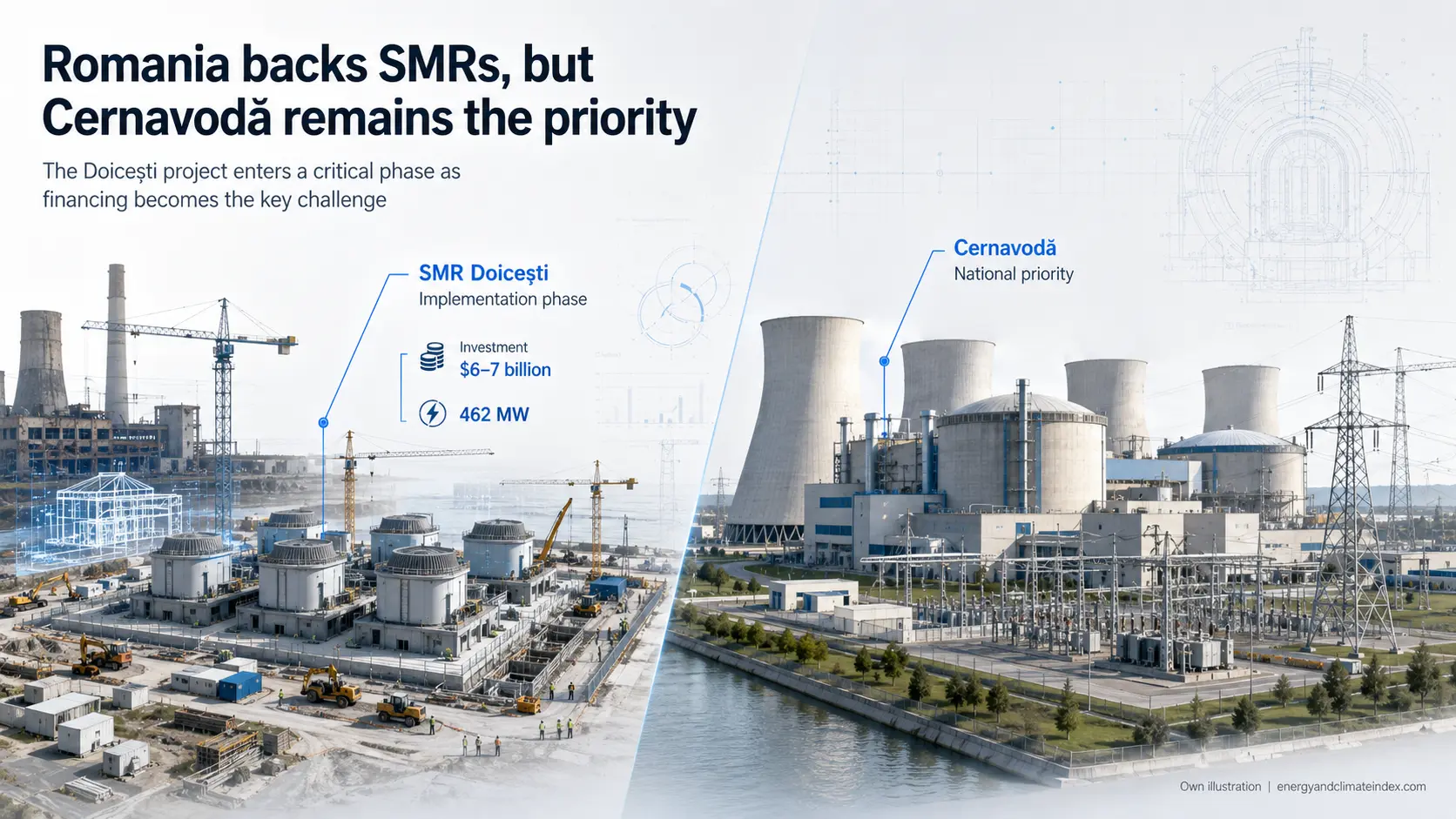
Romania has moved its small modular reactor (SMR) project at Doicești into the implementation phase, but construction will not begin immediately. Although the shareholders of the state-owned nuclear company Nuclearelectrica have approved the final investment decision (FID), the project estimated to cost between $6 billion and $7 billion, still lacks a fully secured financing package.
At the same time, Prime Minister Ilie Bolojan has stated that investments in the existing Cernavodă Nuclear Power Plant are currently more viable.
As a result, Romania’s most advanced SMR initiative has entered its decisive stage: it has received corporate approval but must now prove that it can be financed and remain economically viable.


Final investment decision does not mean immediate construction
The shareholders of Nuclearelectrica, Romania’s state-controlled nuclear power producer and operator of the country’s two operating reactors at Cernavodă, approved the final investment decision for the Doicești project on 12 February.
The decision allows the project to move into its third development phase, covering the preparatory activities required before signing the main Engineering, Procurement and Construction (EPC) contract.
However, the approval remains subject to several conditions. Financing, government and international support, regulatory approvals and contractual arrangements designed to limit Romania’s financial exposure must all be secured before full construction can begin. In other words, the FID does not represent an unconditional green light for immediate construction.
Prime Minister: Cernavodă is the more viable option
Only days after the investment decision was approved, Prime Minister Ilie Bolojan tempered expectations surrounding the project. He said he does not expect construction at Doicești to begin immediately because of the project’s scale, estimated cost and the fact that SMR technology is still at an early commercial stage.
According to the Prime Minister, the project could require between $6 billion and $7 billion, making financing one of its greatest challenges. He stressed that Romania must first establish a credible financing model, assess future electricity demand and confirm the project’s overall economic viability.
At the same time, Bolojan described the projects at Cernavodă Nuclear Power Plant as more viable than the Doicești SMR project. Romania is moving forward with the refurbishment and lifetime extension of Unit 1, while also pursuing the completion of Units 3 and 4, which are based on the proven Canadian CANDU reactor technology.
This does not mean Romania is abandoning the SMR project. Rather, the government must allocate financial and institutional resources across several multi-billion-dollar nuclear investments. Under these circumstances, Cernavodă enjoys a clear advantage thanks to its existing infrastructure, proven technology and more mature project pipeline.
Six U.S.-designed reactors on the site of a former coal plant
The Doicești project is being developed by RoPower Nuclear, a joint venture between Nuclearelectrica and Nova Power & Gas, one of Romania’s leading private energy companies active in electricity generation, supply and natural gas markets.
The project calls for the construction of six NuScale Power small modular reactors. Each module will have a capacity of 77 MW, giving the plant a total installed capacity of 462 MW.
The facility will be built on the site of the former Doicești coal-fired power plant, allowing the reuse of industrial land, parts of the existing grid infrastructure and the skilled local workforce.
The current project structure also foresees the construction and testing of an initial module before proceeding with the remaining five, reducing Romania’s technological and financial risks, as no commercial power plant using this specific NuScale configuration is yet in operation.
A $7 Billion investment for 462 MW
The estimated investment of $6–7 billion is among the project’s most sensitive aspects. Such a capital requirement highlights the financial complexity of deploying first-of-a-kind SMR technology in Europe.
For Romania, the key issue is therefore not only whether the technology can operate successfully, but also whether electricity can be produced at a competitive cost and how financial risks will be shared between the government, investors and lenders.
The project has entered a “critical phase”
In June, Romania’s Ministry of Energy confirmed that the Doicești project had entered a “critical phase.” State Secretary Cristian Bușoi stated that Romania remains fully committed to the project, while acknowledging that financing and several remaining conditions still need to be secured before implementation can proceed.
Nuclearelectrica has also reaffirmed that it is committed to implementing the shareholders’ decision, while emphasizing that all economic and financial conditions attached to the investment remain in force.
As a result, Doicești is neither a cancelled project nor a fully financed one. Instead, it has entered the stage where political support and engineering plans must be translated into binding financial commitments.
A test for the future of SMRs in Europe
The Romanian project carries significance well beyond the country’s borders. If successfully completed, it would become Europe’s first NuScale-based SMR power plant and one of the first examples of converting a former coal-fired power station into a next-generation nuclear facility.
However, the final investment decision has not removed the project’s greatest challenge. Instead, it marks the beginning of its most difficult phase: securing billions of dollars for a technology that has yet to prove its commercial competitiveness at scale.
Romania has formally advanced the Doicești project, but the Prime Minister’s message is clear: Cernavodă remains the country’s top nuclear priority, while the SMR project will have to demonstrate that it can stand on a sound and sustainable financial foundation.
ECI