

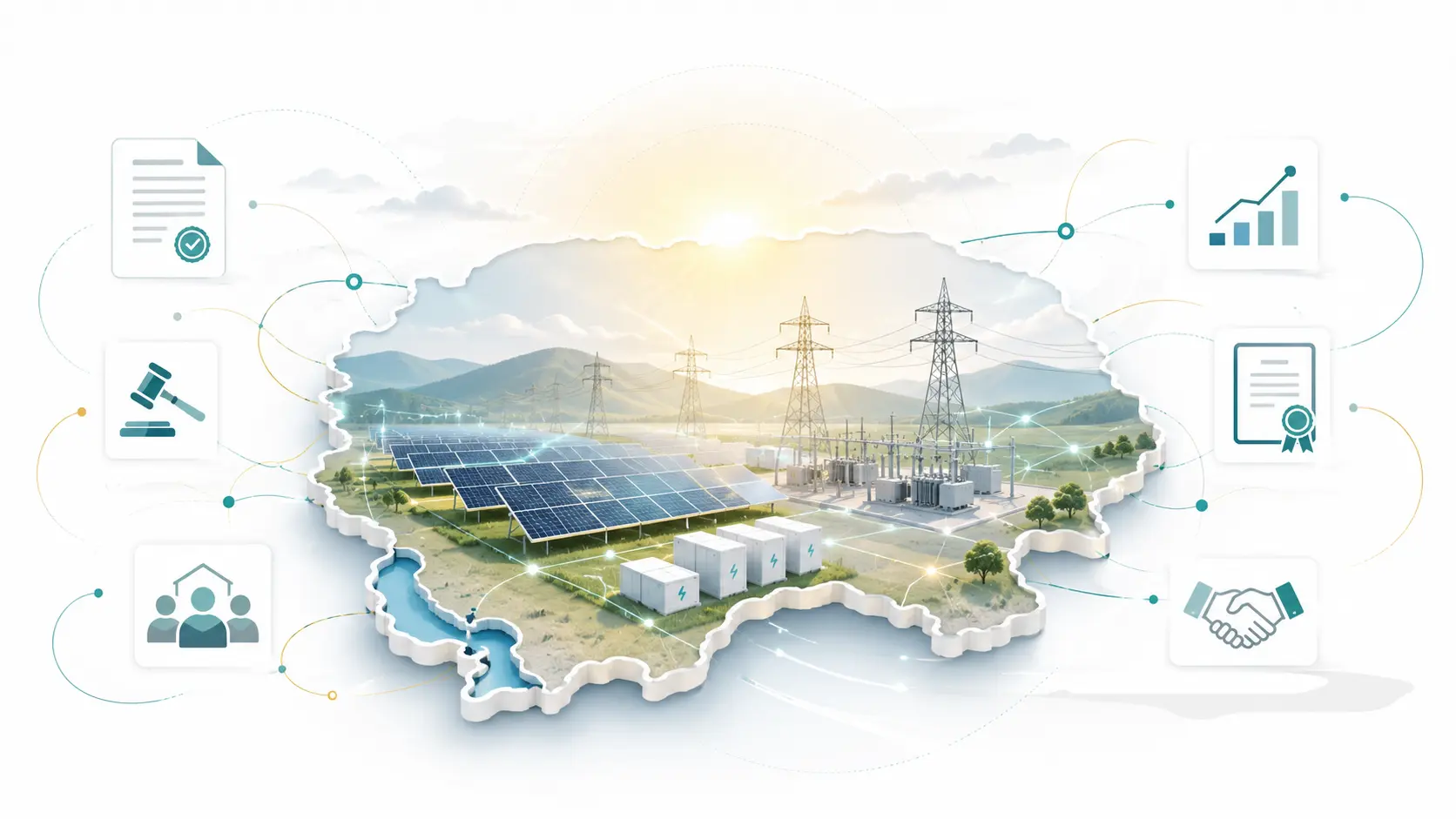
North Macedonia has adopted the new Law on the use of energy from renewable sources, making this the first time the sector has been regulated through a dedicated law.
The drafting of the law began in 2024, as part of the broader alignment with European rules and the reform agenda in the energy sector.
The new legislation sets a framework for the development of renewable energy, investments, auctions, prosumers, energy communities and guarantees of origin.


It is an important step, but it does not mean that the reform is complete. On the contrary, the real test will be its practical implementation.
Market-based support for new investments
One of the most important novelties is the introduction of a two-sided Contract for Difference – CfD, a model already used in Serbia and Montenegro and part of the EU’s market reform.
This model should provide greater certainty for investors in renewable energy, especially in conditions of volatile market prices.
When electricity prices are low, the mechanism provides predictable revenue for producers. When prices are high, part of the difference is returned to the system, limiting excessive profits and reducing the burden on consumers.
In North Macedonia, however, this also raises an important question. The country already has the largest installed photovoltaic capacity in the Western Balkans, exceeding 1 GW, so state support should not be seen only as an instrument for building even more solar megawatts.
The key is to direct support toward projects that bring greater system value: competitive prices, better grid integration, more predictable production, storage potential and a lower burden on the power system.
Therefore, the real question is not only how many new renewable capacities will be built, but what type of projects will receive support, at what price, and with what impact on the grid, the market and consumers.
Citizens and companies gain a bigger role
The law also regulates net metering and net billing mechanisms, which is important for households, companies and public institutions installing photovoltaic systems for self-consumption.
This could open the next stage in the development of small-scale solar systems. However, the effect will depend on the detailed rules: how produced and withdrawn electricity will be calculated, which users will be covered, and how grid-use costs will be treated.
Citizen energy communities are another important novelty. They should enable citizens, municipalities, small companies and public institutions to jointly produce, use, store and sell electricity from renewable sources.
If the model is implemented simply and without administrative bottlenecks, energy communities could become an important instrument for local energy transition, lower costs and greater citizen participation in the energy system.
Guarantees of origin and European market integration
The law also strengthens the framework for guarantees of origin for electricity produced from renewable sources. This mechanism is becoming increasingly important for companies that need to prove they use green energy, especially in their relations with European partners and markets.
For producers, guarantees of origin can create additional market value for green electricity. For the country, they are an important step toward better integration with the European energy market.
The law is the beginning, not the end of the reform
Although the law establishes an important foundation, its effect will not be automatic. Over the next two years, more than ten bylaws need to be adopted, defining the details of auctions, support mechanisms, net metering, net billing, energy communities and guarantees of origin.
That is why the new law should be seen as the beginning of a new phase, not as a completed reform. North Macedonia already has strong growth in photovoltaic capacity, but the next challenge is to integrate that growth into a more organized system with clear rules, a modernized grid and a predictable environment for investment in renewable energy.
ECI