

The project in Northern Greece continues the regional transformation of former coal regions, a transition in which Oslomej became one of the first examples in Southeast Europe through a public-private partnership model.
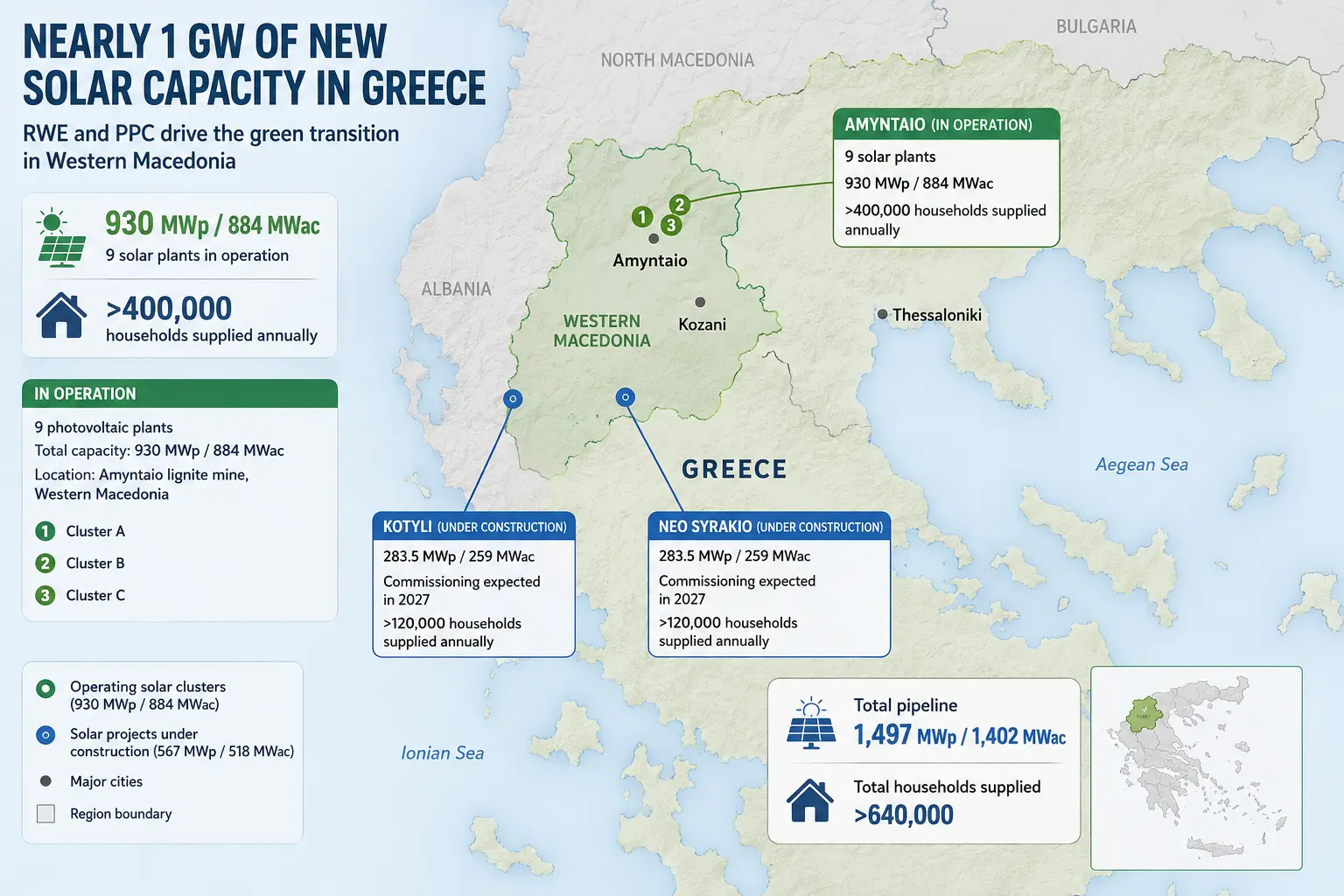
Germany’s largest energy company RWE, one of Europe’s leading investors in renewable energy, and Public Power Corporation (PPC), Greece’s largest electricity utility, have commissioned nine large-scale photovoltaic power plants in Northern Greece.
The projects have a combined capacity of 930 MWp (884 MWac) and have been developed on the site of the former Amyntaio lignite mine in the Northern Greece region.


The photovoltaic plants are grouped into three large-scale clusters and, according to the companies, will generate enough electricity to meet the annual demand of more than 400,000 households. The projects were developed through the joint venture Meton Energy S.A., in which RWE holds a 51% stake and PPC 49%.
From a coal mine to a renewable energy hub
The significance of the project extends far beyond the new generation capacity. It demonstrates how former coal infrastructure can be successfully repurposed for renewable energy production.
For decades, Northern Greece was one of the country’s main lignite-producing regions. Today, it is steadily transforming into a major renewable energy hub.
This model is particularly important for Southeast Europe, where many countries face the same challenge: how to repurpose depleted coal mines, thermal power plant sites and local economies that have long depended on coal. Rather than leaving these areas as abandoned industrial sites, Greece is converting them into large-scale solar projects while taking advantage of existing grid infrastructure, skilled energy-sector workforce and industrial heritage.
Another 567 MW under construction
RWE and PPC are already constructing two additional large-scale solar projects in Northern Greece, Kotyli and Neo Syrakio, with a combined capacity of 567 MWp (518 MWac). Commissioning is expected in 2027, and the projects are forecast to generate enough electricity to supply more than 240,000 households.
Northern Greece is therefore becoming much more than a symbol of the energy transition. It is emerging as a practical example of how former coal mining areas can be transformed into clean energy production centres, attracting major investors while creating new economic opportunities for local communities.
REK Oslomej paved the way for the transformation of former coal mines
The project at Greece’s Amyntaio mine closely resembles the transformation that began at REK Oslomej more than eight years ago, helping to pave the way for the repurposing of former coal mines in North Macedonia and, more broadly, across Southeast Europe.
The transition at Oslomej began with the construction of the country’s first 10 MW photovoltaic power plant on a reclaimed lignite mine as an investment by the state-owned utility AD ESM, signalling as early as 2018 the beginning of the energy transition of former coal mining sites across the region.
In 2021, public-private partnership agreements were signed with Fortis Energy of Türkiye and Solarpro Holding of Bulgaria for the development of two photovoltaic power plants of at least 50 MW each. Both projects entered commercial operation at the end of 2023.
According to the European Bank for Reconstruction and Development (EBRD), the tender represents one of the first utility-scale renewable energy projects in the Western Balkans implemented entirely on a market-based basis, while also being the first 100 MW public-private partnership solar project developed on a former lignite mine in this part of Europe.
ECI