

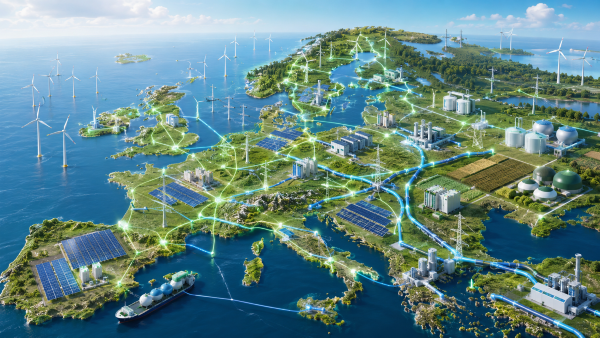
The ENTSO-E and ENTSOG are planning a deep structural transformation of the European energy system in their draft development scenarios.
Last week, they published draft scenarios and an analytical basis for the future planning of Europe’s electricity, gas and hydrogen infrastructure, as part of the next Ten-Year Network Development Plan for European transmission systems — TYNDP 2026.
The main message is clear. Europe is gradually moving away from a model based on fossil fuels and entering a system in which electricity, hydrogen, biomethane and flexibility become the main pillars of security of supply.


The key paradox in the TYNDP 2026 scenarios is this: total energy demand declines, while electricity consumption grows strongly. The reason lies in energy efficiency, electrification and the new role of electricity. It is no longer only an energy carrier for households, industry and transport. In the scenarios, electricity also becomes a feedstock for the production of hydrogen and synthetic fuels.
TYNDP 2026 scenarios: Electrolysis becomes a major consumer of electricity
By 2050, according to the TYNDP 2026 scenarios, electrolysis could become one of the largest new sources of electricity demand. Around one fifth of total electricity in the system would be used for the production of hydrogen and synthetic fuels.
This completely changes the logic of planning. The European power system will no longer be dimensioned only around conventional electricity consumption. It will also have to be planned around the needs of industry, the hydrogen economy, synthetic fuels, storage and flexible consumers.
That is the core shift. Electricity becomes the central infrastructure foundation of the energy transition.
Hydrogen is not a replacement for everything, but a solution for the hardest sectors
In the TYNDP 2026 scenarios, hydrogen does not appear as a mass energy carrier for all sectors. Its role is more concentrated and more industrial. The largest application is expected in heavy industry, non-energy use, refineries and parts of transport where direct electrification is more difficult.
This is an important message. Hydrogen will not replace electricity. It will complement it where direct electrification is not technically or economically the most suitable option.
That is why hydrogen in these scenarios should be understood as part of a broader industrial transformation. It is a tool for hard-to-decarbonise sectors, not a universal solution for every form of energy consumption.
The gas network does not disappear, but gas changes its nature
The TYNDP 2026 scenarios do not show a simple end to gas infrastructure. They show its transformation.
The use of fossil natural gas declines sharply. At the same time, biomethane and synthetic gases gain an increasingly important role. By 2050, domestic biomethane production reaches around 800 TWh per year and becomes the largest component of methane supply.
At the same time, natural gas imports fall from almost 2,500 TWh in 2030 to around 600 TWh in 2050. This shows that Europe’s energy independence is not built only on solar and wind. It is also built on domestic production of renewable gases.
This is one of the most important messages of the report. Gas infrastructure does not necessarily have to disappear. But its content, role and economic logic change radically.
Hydrogen storage will operate more dynamically than gas storage
One of the most interesting technical details in the TYNDP 2026 scenarios is the way hydrogen storage is used.
Traditional natural gas storage mainly serves seasonal balancing. It is filled during periods of lower consumption and withdrawn in winter. Hydrogen storage, according to the scenarios, has a much more active role.
In 2030, hydrogen storage would exceed four full charging and discharging cycles per year. Later, it would stabilise at around three cycles per year.
This shows that hydrogen will not be only a reserve for winter periods. It could become an operational instrument for balancing the entire energy system.
Peak load moves towards midday
The biggest change is not only how much electricity Europe will consume. The change is also when and why it will consume it.
Conventional peak demand remains linked to households, transport and heating. However, when electrolysers, batteries, pumped-storage hydropower plants and other flexible technologies are included in the system, peak load shifts towards midday.
This is logical. During that period, the system has the highest level of solar power generation. Therefore, part of flexible consumption is aligned with the hours of high renewable electricity production.
In the future, grid stability will not depend only on how many power plants Europe has. It will also depend on how intelligently demand is managed.
Solar and wind become the foundation of a new energy independence
By 2050, according to the TYNDP 2026 scenarios, renewable energy sources become a dominant part of the European energy system. Wind and solar become the main foundation of electricity generation.
But this does not mean that the system will rely only on variable sources. On the contrary, they will have to be supported by storage, flexible demand, hydrogen, low-carbon dispatchable capacity and better integration between the electricity, gas and hydrogen systems.
That is why the TYNDP 2026 scenarios are not only a document about decarbonisation. They are a document about a new infrastructure logic.
Europe is no longer planning its energy system around coal, oil and imported gas. In these scenarios, the system is built around electricity, hydrogen, domestic renewable gases, storage and managed demand.
The main message is clear: the energy transition is no longer only about replacing one fuel with another. It is a complete change in the way the system produces, stores, consumes and balances energy.
Viktor Andonov, M.Sc