

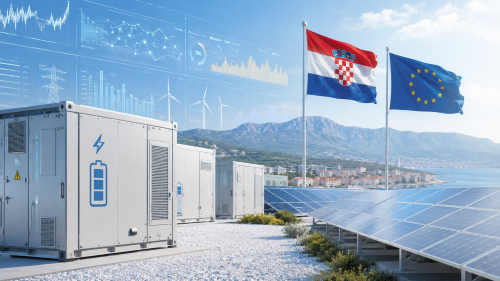
The European Bank for Reconstruction and Development (EBRD) and the Croatian Energy Market Operator (HROTE) have signed a Memorandum of Understanding.
This document establishes a framework for strategic cooperation in the development of energy projects and modern market solutions in Croatia.
Above all, the cooperation should support the energy transition. In addition, it should increase the flexibility of the power system and create a more stable investment framework for green investments.


Special emphasis will be placed on battery energy storage systems, which are becoming key infrastructure for a higher share of renewable energy sources.
Battery systems at the centre of the new cooperation
The Memorandum expands the cooperation previously launched under the Renewable Energy Market Accelerator – REMA programme. It focuses on the development of a support scheme for stationary electricity storage capacities.
In other words, the goal is to prepare models that will facilitate the integration of battery systems into the power system.
At the same time, these models should make investment more predictable for companies and investors.
In addition, battery systems can help make better use of electricity produced by photovoltaic power plants and wind power plants.
When production is high and consumption is low, batteries can absorb surplus energy. Later, that energy can be returned to the system during periods when demand is higher.
Market flexibility and lower risk of negative prices
One of the important goals of the cooperation is to reduce the occurrence of negative electricity prices, which are becoming increasingly common in systems with a high share of variable production from solar and wind.
When production is high and consumption is low, battery systems can absorb surplus energy and return it to the system during periods when it is most needed.
In this way, energy storage is not only a technological solution, but also a market instrument. It can help stabilize prices, improve system balancing and open new opportunities for investors in renewable energy sources.
Croatia is building a framework for the next phase of the energy transition
The cooperation between the EBRD and HROTE shows that Croatia is preparing for the next phase of the energy transition, in which simply building new photovoltaic power plants and wind power plants is no longer enough.
Flexibility, storage, market mechanisms and clear investment rules are needed.
For the countries of the region, this is an important signal. Battery systems are becoming an integral part of energy policy, not an additional element to be considered later.
Without storage and flexibility, the growth of renewable energy sources may face grid constraints, price risks and higher balancing costs.
Editorial Office