

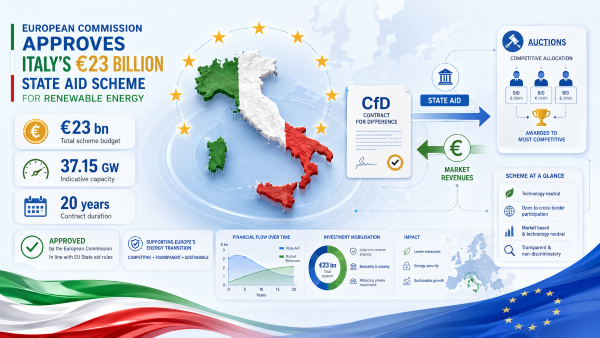
The European Commission has approved Italy’s major €23 billion state aid scheme for renewable energy.
The scheme will support the construction of new renewable power plants across the country. It should add 37.15 GW of new capacity and accelerate the energy transition in one of the largest economies in the European Union.
Support for solar, wind, hydro and biogas
Italy will use the scheme to support power plants that generate electricity from onshore wind, solar energy, hydropower and sewage gas.


According to the European Commission, these projects should add 37.15 GW of renewable capacity. That equals around 48% of Italy’s current installed renewable energy capacity.
This is one of the largest renewable energy support schemes approved in the EU. It should help Italy reach its 2030 target of 39.4% renewables in gross final electricity consumption.
20-year contracts for difference
Italy will grant the support through two-way contracts for difference, known as CfD contracts. These contracts will last for 20 years.
Under this model, the state will compensate producers when the market price of electricity falls below the agreed strike price.
However, when the market price rises above the agreed price, producers will pay the difference back to the state.
This model gives investors more certainty. At the same time, it limits excessive profits when electricity prices are high.
The European Commission assessed the measure as proportionate. It also concluded that the scheme can speed up new renewable investments without causing unnecessary distortion of competition.
Auctions for larger projects
Italy will allocate most of the support through competitive procedures. Investors will compete based on the price they need to develop their projects.
Power plants below 1 MW will have a simpler procedure. They will not need to take part in a standard auction. Instead, the Italian energy regulator ARERA will set the price.
The €23 billion budget depends on estimates of future electricity market prices.
However, the actual net support may be lower. This could happen if market prices turn out higher than expected.
Part of the EU’s new industrial policy
The European Commission approved the scheme under the Clean Industrial Deal State Aid Framework. The Commission adopted this framework in 2025.
Its goal is to help Member States mobilise investment faster. The framework supports clean energy, industrial decarbonisation and lower dependence on imported fossil fuels.
This decision shows that the European Union is using state aid more actively to accelerate the energy transition.
For countries in the region, including North Macedonia, the message is clear. The future development of photovoltaic power plants, wind farms and energy storage systems will depend on well-designed auctions, long-term contracts and clear rules for integrating renewable energy into the electricity system.
Editorial Office