

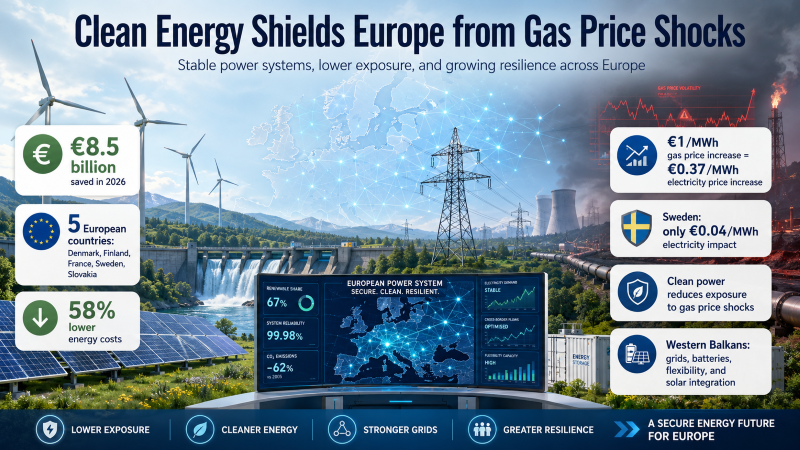
Countries with the cleanest electricity mix are expected to face significantly lower costs than those still dependent on fossil fuels
Five European countries with a high share of clean energy in electricity generation are expected to save around €8.5 billion on energy bills in 2026, according to an analysis reported by Euronews.
The countries are Denmark, Finland, France, Sweden, and Slovakia, where electricity systems rely heavily on renewable energy, nuclear power, and other low-carbon technologies. According to the analysis, these countries will be significantly less exposed to natural gas price shocks compared with countries that still have a higher dependence on fossil fuels.
The assessment shows that consumers in these countries are expected to face 58% lower costs compared with countries with the most polluting electricity mixes, including Poland, Italy, Greece, Estonia, and the Netherlands.


Gas still influences electricity prices
The main reason for the large difference between countries is the way natural gas still affects electricity prices in Europe. Although the share of renewable energy is increasing, gas-fired power plants continue to play an important role in setting market electricity prices in many countries.
In 2025, every €1/MWh increase in the price of gas led, on average, to a €0.37/MWh increase in electricity prices. This shows that European electricity markets remain sensitive to movements in gas prices, although this dependence is gradually declining in countries where clean energy has a larger share.
The higher the share of domestically produced clean electricity, the lower the exposure to imported fuels, geopolitical risks, and sudden price shocks. This is why countries with cleaner electricity mixes now have stronger protection for households and industry.
Sweden shows the value of a clean electricity system
Sweden is one of the strongest examples in the analysis. Thanks to its almost entirely clean electricity mix, the country is only marginally exposed to the direct impact of gas prices.
According to the analysis, when the price of gas increases by €1/MWh, the electricity price in Sweden rises by only €0.04/MWh. The reason is that most of Sweden’s electricity comes from clean sources, making the country far more resilient to market shocks.
This example shows that clean energy is not only a climate policy, but also an economic instrument. It reduces dependence on imported fossil fuels and increases the stability of the electricity system. Although it is not part of the main comparison in the analysis, Norway is another strong European example showing that high domestic production from clean sources, especially hydropower, can significantly reduce exposure to natural gas price shocks.
Renewables are reducing Europe’s exposure
The analysis shows that the European Union is better protected from price shocks today than it was in 2022, when the energy crisis triggered by Russia’s invasion of Ukraine caused a sharp increase in gas and electricity prices.
One of the main reasons is the growth of renewable energy generation. Solar and wind power are increasingly reducing the need for electricity generation from expensive gas, especially during hours with high solar and wind output.
However, the analysis also shows that simply increasing renewable energy is not enough if the system continues to rely heavily on gas-fired power plants during critical periods. In countries where gas remains an important source for covering demand, electricity prices remain much more sensitive to movements on international markets.
Building new capacity alone is not enough
The Netherlands is a good example of this challenge. Although the country has recorded significant growth in solar and wind energy, gas still plays an important role in electricity generation. This means that during periods when renewable generation is insufficient, the system again relies on gas-fired power plants.
Poland faces a similar challenge, as part of its coal replacement is being carried out through gas. This reduces coal dependence, but increases exposure to natural gas prices.
This shows that the energy transition must be carefully planned. If coal is replaced mainly with gas, the risk of price shocks does not disappear; it is simply transferred from one fossil fuel to another. Real protection comes from a combination of renewable energy, nuclear power where available, battery storage systems, flexible demand, modern grids, and better demand-side management.
What does this mean for the Western Balkans?
The message from this analysis is particularly important for the Western Balkans. The region still has a high dependence on coal, imports electricity during certain periods, and has limited flexibility in its power systems. This makes it vulnerable to price shocks, dry hydrological periods, instability on regional markets, and the rising costs of alignment with European climate policies.
In recent years, countries in the region have accelerated the development of solar power plants, but the next phase must be much more systemic. Simply adding new renewable capacity will not be enough if it is not accompanied by investment in grids, battery storage systems, balancing, flexible demand, and market mechanisms that allow cheap daytime electricity to be used more efficiently.
For the Western Balkans, clean energy should be seen not only as an obligation linked to the energy transition, but also as an instrument of economic stability. The more the region reduces its dependence on fossil fuels and imported electricity, the lower the exposure of households and companies to external price shocks will be.
The main lesson is clear: countries that invest early in clean, domestic, and flexible energy will face lower risks, more stable markets, and stronger energy security.
Editorial Office