

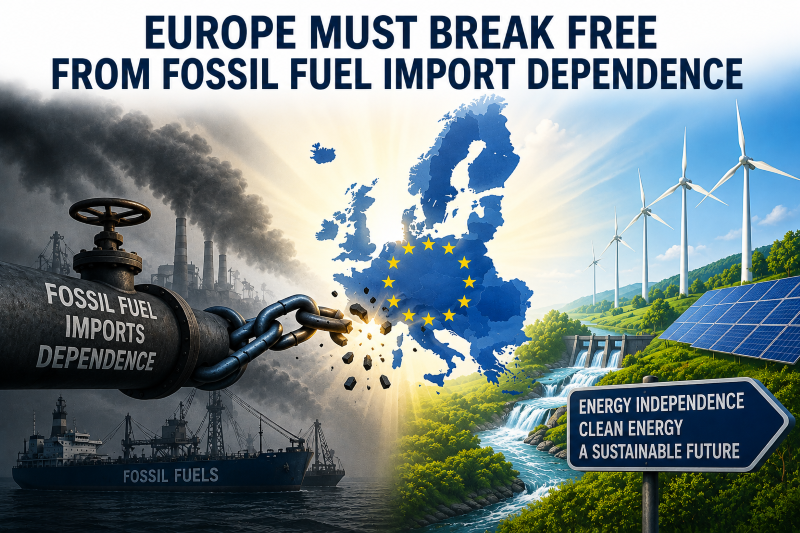
Rising energy prices and unstable supply chains are once again putting Europe’s energy system under severe pressure. Following the disruptions of 2021 and 2022, triggered by reduced Russian gas deliveries and the war in Ukraine, new geopolitical tensions in the Middle East and the conflict involving Iran are further deepening uncertainty on global energy markets.
Risks surrounding the Strait of Hormuz, one of the world’s most important oil transport routes, are once again driving energy prices higher and reopening the debate over Europe’s heavy dependence on imported fossil fuels.
Against this backdrop, the European Academies Science Advisory Council (EASAC) has published a new commentary on “Energy Systems Integration,” in which scientists propose a much deeper integration between electricity, heating, transport, and industry as a key solution for reducing dependence on imported fossil fuels.


In an interview for the Austrian Academy of Sciences, energy expert Neven Duić said that Europe must fundamentally redesign its energy system.
“This Is Not a Short-Term Crisis, but a Permanent One”
“The main problem is Europe’s enormous dependence on energy imports. The European Union imports around 97% of its oil and about 85% of its gas. This is not a short-term crisis, but a permanent one,” Duić said.
According to him, the crisis began back in 2021 with reduced Russian gas deliveries, intensified after Russia’s invasion of Ukraine, and is now being further aggravated by the growing instability in the Middle East.
“The only sustainable solution is to replace fossil fuels with something completely different,” Duić stressed.
Electrification and Integrated Energy Systems
EASAC identifies energy systems integration and large-scale electrification as the central pillars of Europe’s future energy strategy.
According to Duić, Europe possesses significant renewable energy potential, but wind and solar power are variable sources, meaning that the entire energy system must be transformed.
“Electricity, heating, cooling, transport, and industry need to become much more interconnected. At the same time, everything that can be electrified should be electrified,” he said.
Grids and Administrative Barriers Are the Biggest Challenge
Duić warned that the biggest obstacles to the energy transition are the slow expansion of electricity grids and highly complex permitting procedures.
According to him, around 140 GW of planned renewable energy projects across Europe are currently stalled in planning and connection procedures.
“Expanding electricity grids takes far too long, and permitting procedures are extremely complicated,” Duić emphasized.
Dynamic Electricity Tariffs and a Larger Role for Consumers
As part of the solution, EASAC also advocates for broader implementation of dynamic electricity tariffs pricing systems linked to the availability of renewable electricity in the grid.
According to Duić, consumers could actively contribute to system stability by charging electric vehicles or using heating systems during periods of high wind and solar generation.
“Wholesale and retail electricity markets need to become much more interconnected. This already exists in some European countries, but it needs to be implemented on a much broader scale,” he added.
According to the analysis, electrification, renewable energy, and energy storage are becoming not only central pillars of climate policy, but also key instruments for Europe’s energy security and geopolitical stability.
Source: oeaw.ac.at
Editorial Office