

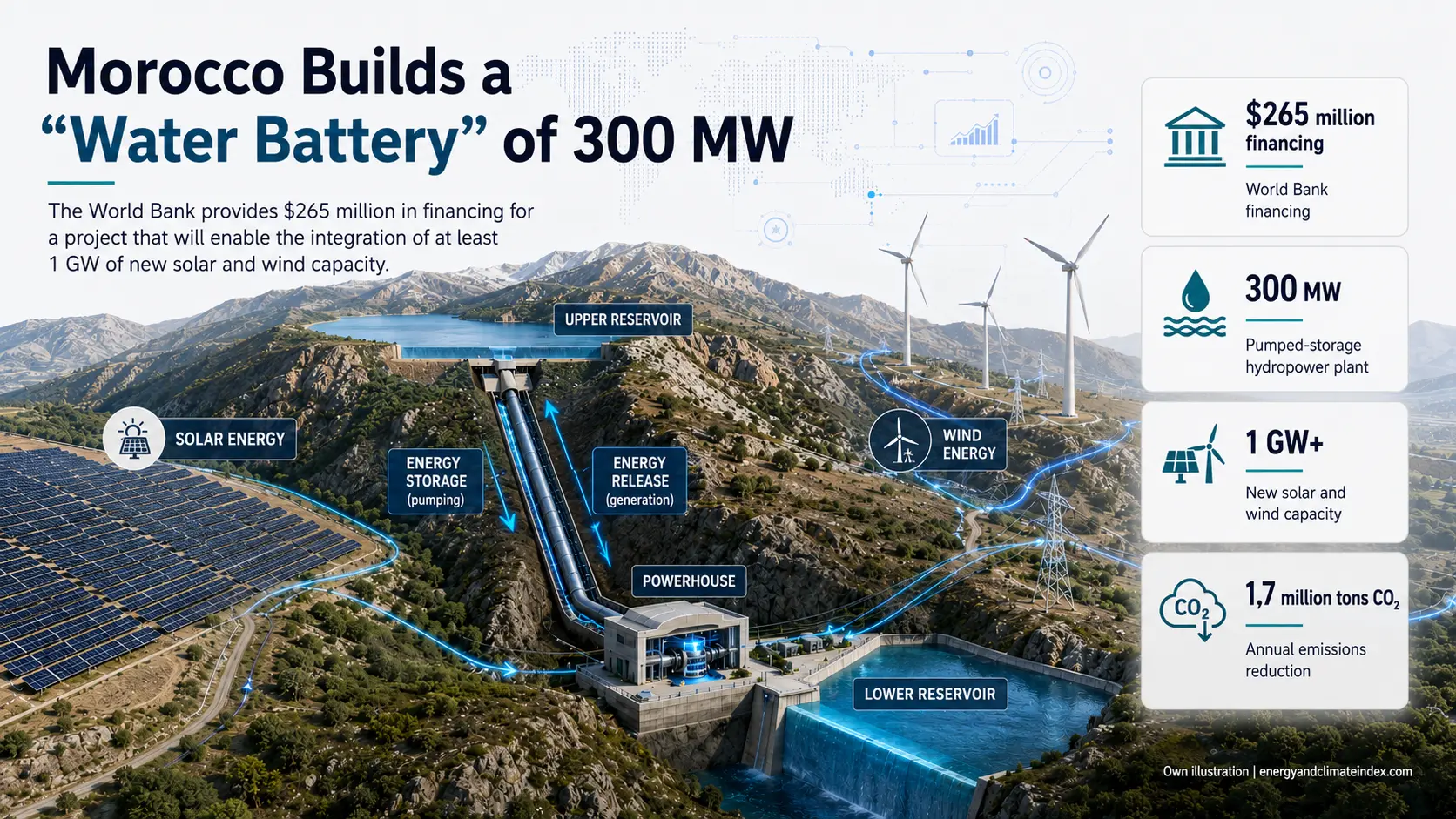
The World Bank has approved a $265 million financing package for the construction of the Ifahsa pumped hydropower plant in northern Morocco, a project designed to increase the flexibility of the country’s electricity system and enable the integration of at least 1 GW of new solar and wind capacity.
The 300 MW facility will be built near the city of Chefchaouen and, according to the World Bank, represents one of the most significant pumped hydropower investments on the African continent.
A giant battery for Morocco’s power system
Unlike conventional hydropower plants, the Ifahsa project will store surplus electricity generated by solar and wind farms.


During periods of high renewable generation, electricity will be used to pump water to an upper reservoir. When demand rises or renewable output declines, the stored water will be released through turbines to generate electricity.
This allows the facility to operate as a giant battery for the national power system, improving grid stability and supporting the integration of variable renewable energy sources.
Capacity for at least 1 GW of additional renewable energy
According to the World Bank, the 300 MW pumped storage plant will enable Morocco to integrate at least 1 GW of additional solar and wind capacity into its electricity grid.
The project is also expected to help mobilise around $1 billion in private investment in the renewable energy sector.
It forms part of Morocco’s broader strategy to strengthen energy security, improve power system resilience and deliver cleaner electricity to households and businesses.
Expected to replace around 3 TWh of fossil-fuel generation
By enabling greater renewable energy integration, the project is expected to replace approximately 3 TWh of fossil-fuel-based electricity generation every year.
The World Bank estimates this will help avoid around 1.7 million tonnes of carbon dioxide emissions annually.
Cleaner electricity generation is also expected to strengthen the competitiveness of Moroccan industries, as global markets increasingly demand products with a lower carbon footprint.
Around 820 direct jobs during construction
The construction phase is expected to create around 820 direct jobs per year.
Additional employment is also anticipated through the development of new solar and wind projects made possible by the additional storage and grid-balancing capacity.
The project will be implemented by Morocco’s National Office of Electricity and Drinking Water (ONEE), with additional co-financing provided by the African Development Bank.
The World Bank financing package includes funding from the International Bank for Reconstruction and Development (IBRD), concessional financing from the Clean Technology Fund, a grant from the Livable Planet Fund, and technical assistance through the Energy Sector Management Assistance Program (ESMAP).
ECI