

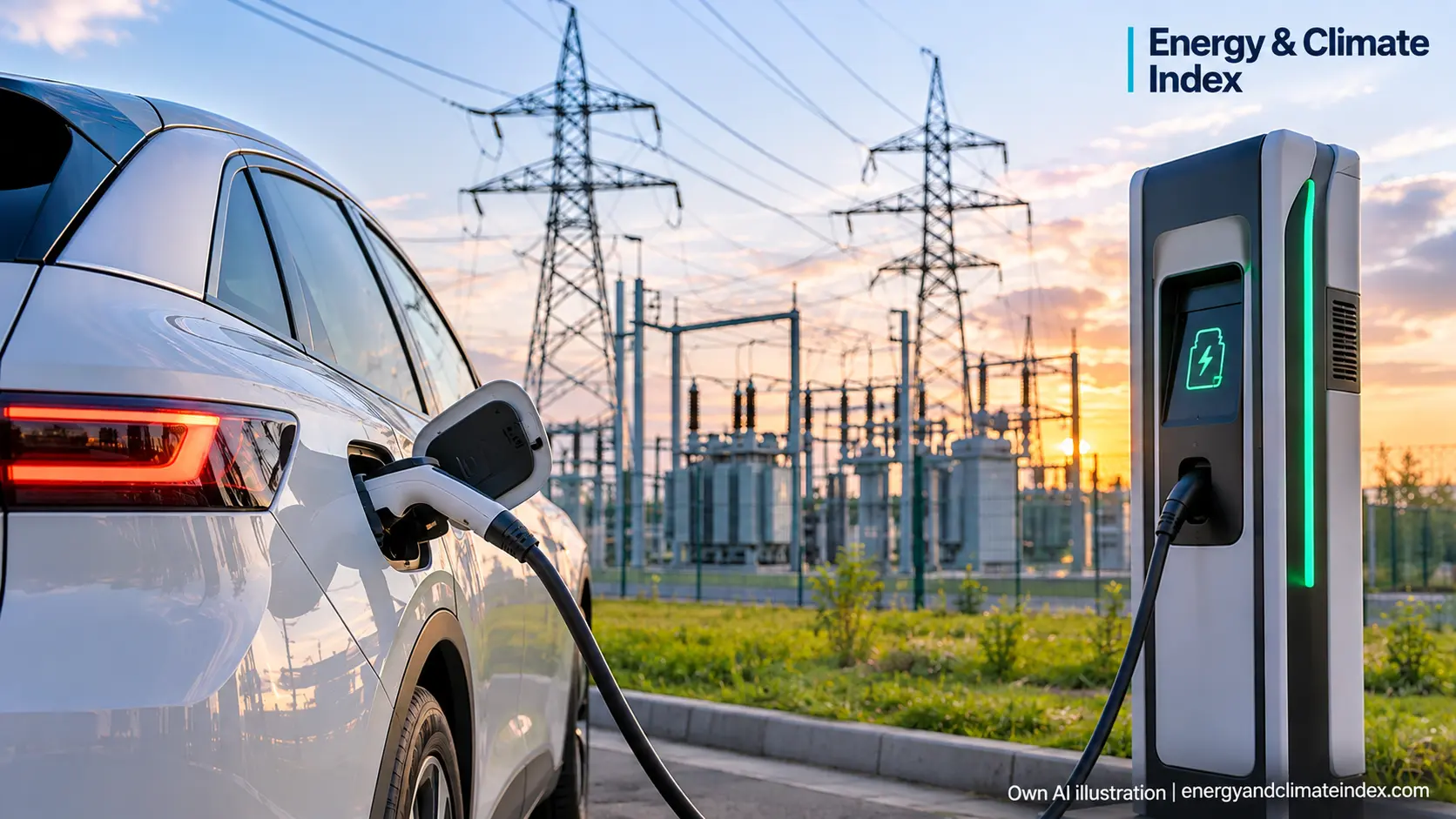
Europe could avoid €10.6 billion in electricity distribution grid investments by 2030 through more efficient management of electric vehicle charging, according to a study conducted by Siemens for the European organisations ACEA, ChargeUp Europe and EIT Urban Mobility.
The analysis estimates that approximately €24.7 billion in distribution grid investments would be required to accommodate the expected growth in electric vehicles. However, implementing smart charging and digital load management could reduce the investment requirement to €14.1 billion, representing a potential reduction of approximately 43%.
The study, Electricity Grids in Europe, published in September 2026, examines 64 urban centres across the 27 European Union member states, as well as Iceland, Liechtenstein and Norway.


Its findings suggest that the expansion of electric mobility depends not only on the number of charging stations installed but also on how electricity demand is managed.
Electric vehicle numbers expected to increase nearly fourfold
Siemens estimates that the number of battery electric vehicles in the analysed urban centres will increase by an average factor of 3.8 by 2030 compared with 2024.
This growth will place considerable additional pressure on electricity distribution networks, particularly in cities with high levels of private vehicle ownership and extensive charging infrastructure.
The majority of required investments, approximately 77.7%, will be concentrated in low-voltage networks, where residential chargers and many workplace charging facilities are connected.
According to the projections, electric vehicles could account for 27.3% of passenger cars in Sweden and 15.7% in Germany by 2030. The corresponding shares are expected to reach 4.6% in Italy, 4.5% in Spain and 2.5% in Poland.
At the same time, the electrification of light commercial vehicles will create additional demand for grid capacity, particularly at logistics centres and businesses operating large vehicle fleets.
In Poland, for example, the number of electric light commercial vehicles could increase almost tenfold by the end of the decade.
Germany stands out as one of the markets facing the greatest need for additional grid investment. Berlin alone is estimated to require approximately €1.1 billion in electricity network investments by 2030.
Smart charging could significantly reduce investment costs
The study’s central finding is that electric vehicles do not necessarily need to place simultaneous demand on electricity networks.
By introducing intelligent management systems, charging can be automatically adjusted according to available grid capacity and real-time electricity consumption.
For example, rather than having large numbers of vehicles charging simultaneously during evening peak hours, part of the demand could be shifted to periods of lower electricity consumption, such as overnight.
This approach enables more efficient use of existing infrastructure and reduces the need for additional power lines, substations, transformers and other network components.
According to Siemens, combining digitalisation, smart charging and targeted grid infrastructure investments could reduce projected costs from €24.7 billion to €14.1 billion.
This represents potential savings of €10.6 billion without restricting the anticipated growth in electric vehicle adoption.
However, the study emphasises that smart charging does not eliminate the need for physical grid reinforcement. All 64 urban centres included in the analysis will still require some additional network investments.
Digitalisation becomes essential to Europe’s electric mobility transition
The findings indicate that the future expansion of electric mobility will require closer coordination between distribution system operators, charging infrastructure companies and institutions responsible for transport infrastructure planning.
Smart charging involves digital technologies that monitor electricity demand and automatically adjust charging power in near real time.
These systems can reduce simultaneous peak demand, improve the utilisation of existing grid capacity and postpone some planned infrastructure investments.
Residential charging will play a particularly important role. According to the study’s assumptions, between 55% and 62% of electric vehicle owners in the representative cities could have access to home charging by 2030.
This further highlights the importance of low-voltage networks, which will need to accommodate increasing electricity demand while maintaining security and reliability of supply.
The study demonstrates that the energy transition does not depend exclusively on building new infrastructure. A significant share of future electricity demand could be accommodated through more efficient utilisation of existing assets.
For European distribution system operators, this means that investments in digitalisation, automation and demand-side management are becoming just as important as traditional network expansion.
ECI