

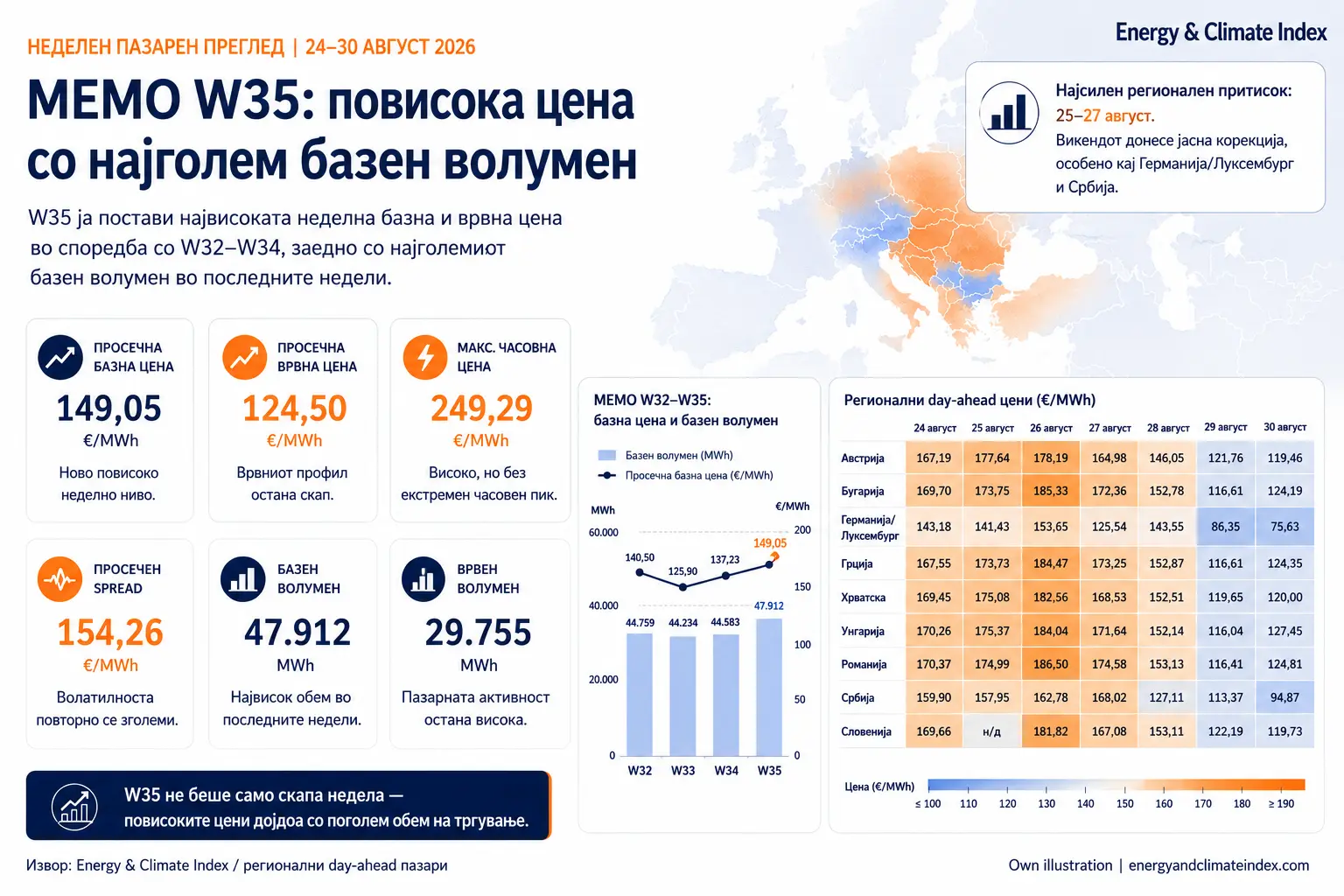
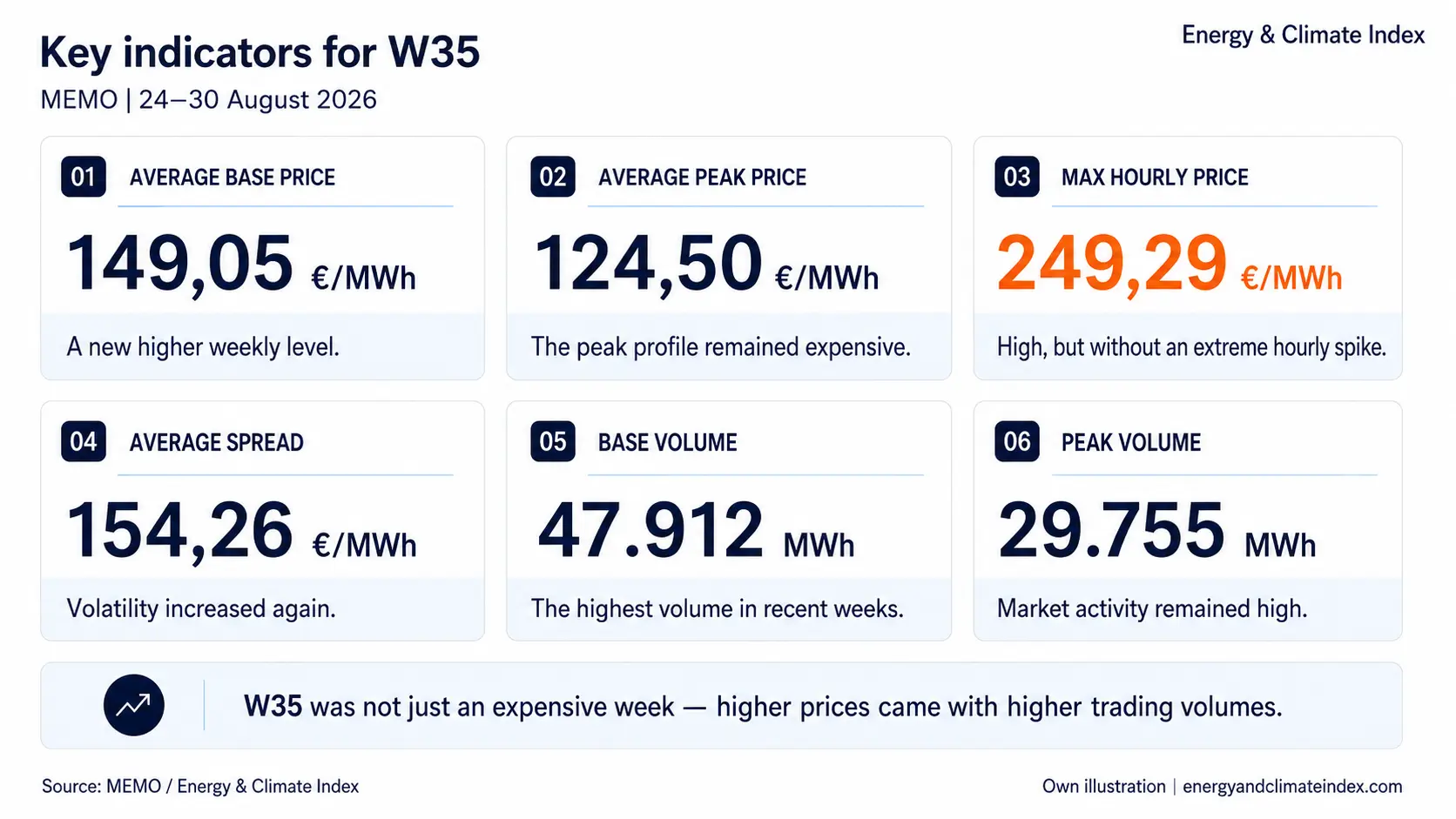
W35 brought another increase on MEMO. The average base price rose to 149.05 €/MWh, while the peak price reached 124.50 €/MWh. This was not only a continuation of the expensive working days seen in W34, but a new higher weekly level, accompanied by the highest base volume in recent weeks of 47,912 MWh.
In W34, the main signal was the strong peak profile. In W35, the price moved one step higher: the base price increased by 11.82 €/MWh, while the peak price rose by 6.72 €/MWh compared with W34. At the same time, the maximum hourly price reached 249.29 €/MWh, while the average spread increased to 154.26 €/MWh.
This shows that the market did not calm down. On the contrary, W35 extended the high summer regime, but with an even larger trading volume.


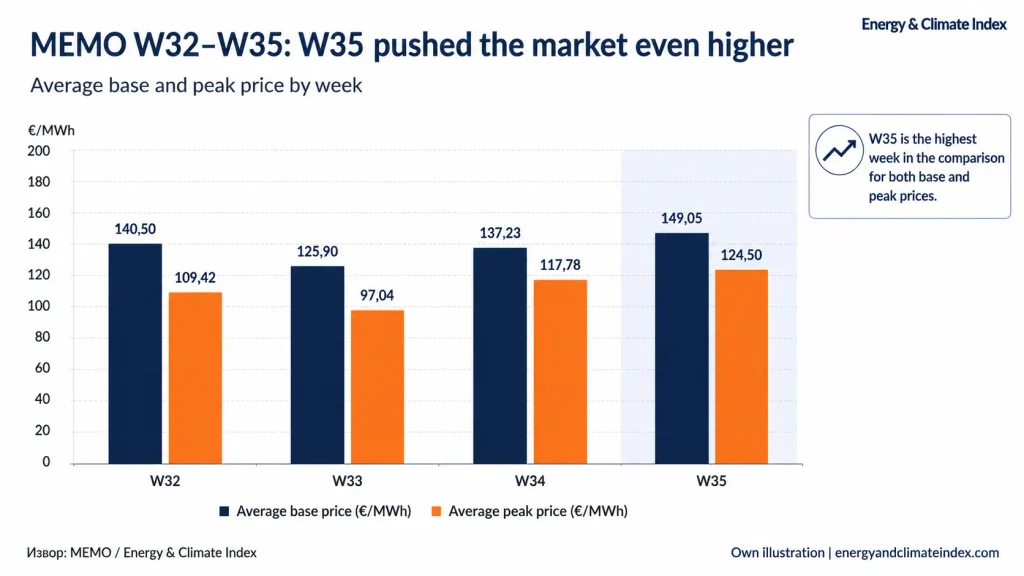
MEMO moved into an even higher weekly zone
Compared with W34, the increase in the base price was larger than the increase in the peak price. This is an important difference: W35 was not only a week with more expensive peak hours, but a week in which the entire price profile shifted upward.
The base price reached 149.05 €/MWh, above both W34 and W32. The peak price of 124.50 €/MWh was also the highest in the comparison with previous weeks. This means W35 should not be read as an isolated peak-price effect, but as a week in which both the base and peak profiles remained expensive.
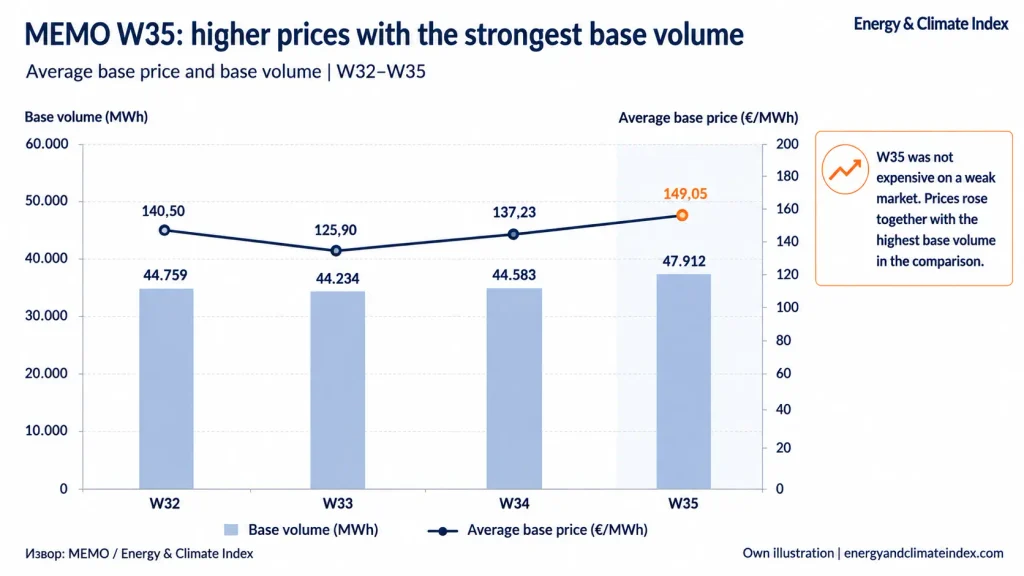
Volume strengthens the weight of the signal
The most important additional signal is volume. Base volume increased from 44,583 MWh in W34 to 47,912 MWh in W35, while peak volume reached 29,755 MWh.
This means that W35 was not a week of high prices on a weak market. On the contrary, the higher price came with a larger trading volume. That makes the week more important analytically: the market was not only expensive, it was also active.
The region: expensive working days, strong weekend correction
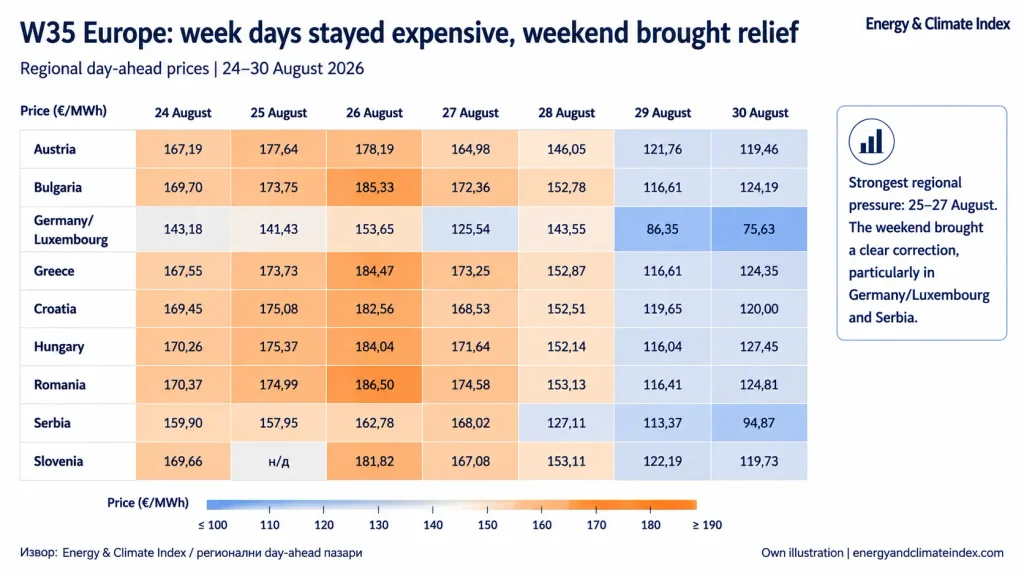
The regional picture once again followed the same logic: an expensive working part of the week and a strong correction toward the weekend. From the visible regional data, the strongest pressure was around 26 August, when a large part of the markets were in the zone of around 180 €/MWh. Bulgaria, Greece, Hungary and Romania were among the highest markets at that point, while Germany/Luxembourg remained below the Southeast European block.
Clear relief then followed on 29 and 30 August. On 30 August, Germany/Luxembourg fell to 75.63 €/MWh, Serbia to 94.87 €/MWh, while Bulgaria, Greece, Romania and Hungary remained higher than that, but far below the working-day levels. This means the regional pressure did not disappear evenly; it broke down toward the weekend, but at different speeds across markets.
European context: the Danube and generation availability remained in the background
W35 should not be tied to a single daily cause, but it cannot be separated from the wider August context. In the previous weeks, the low Danube directly affected nuclear generation in the region: Reuters reported that record-low river levels exposed the vulnerability of Paks in Hungary and Cernavodă in Romania, with Hungary forced to sharply reduce output at Paks and Romania shutting down its last operating reactor because of insufficient cooling water.
Bulgaria also entered the same risk zone: Kozloduy announced a capacity reduction of around 12% due to the low Danube water level, while the plant supplies around 35% of the country’s electricity.
This is why W35 should be read as a week in which prices remained high even after the initial shock. The regional system continued to operate under conditions of sensitive generation availability, limited flexibility and a strong difference between working days and the weekend.
MEMO: not the most extreme, but the strongest by weekly profile
W35 does not have to be the most extreme week in terms of the hourly peak, but it is very strong by weekly profile. The maximum hourly price of 249.29 €/MWh is below the extremes seen in W32, but the weekly base and peak prices are higher than in W34.
That is the core point: the price did not rise because of one dramatic hour, but because the weekly profile remained expensive.
Conclusion
W35 extended MEMO’s high summer regime. The base price reached 149.05 €/MWh, the peak price 124.50 €/MWh, while base volume rose to 47,912 MWh. This is the strongest signal of the week: prices increased, and market activity increased as well.
Regionally, working days remained expensive, especially around 26 August, while the weekend brought a strong correction. But the correction does not change the main message: the market did not return to a low-price zone.
ECI