

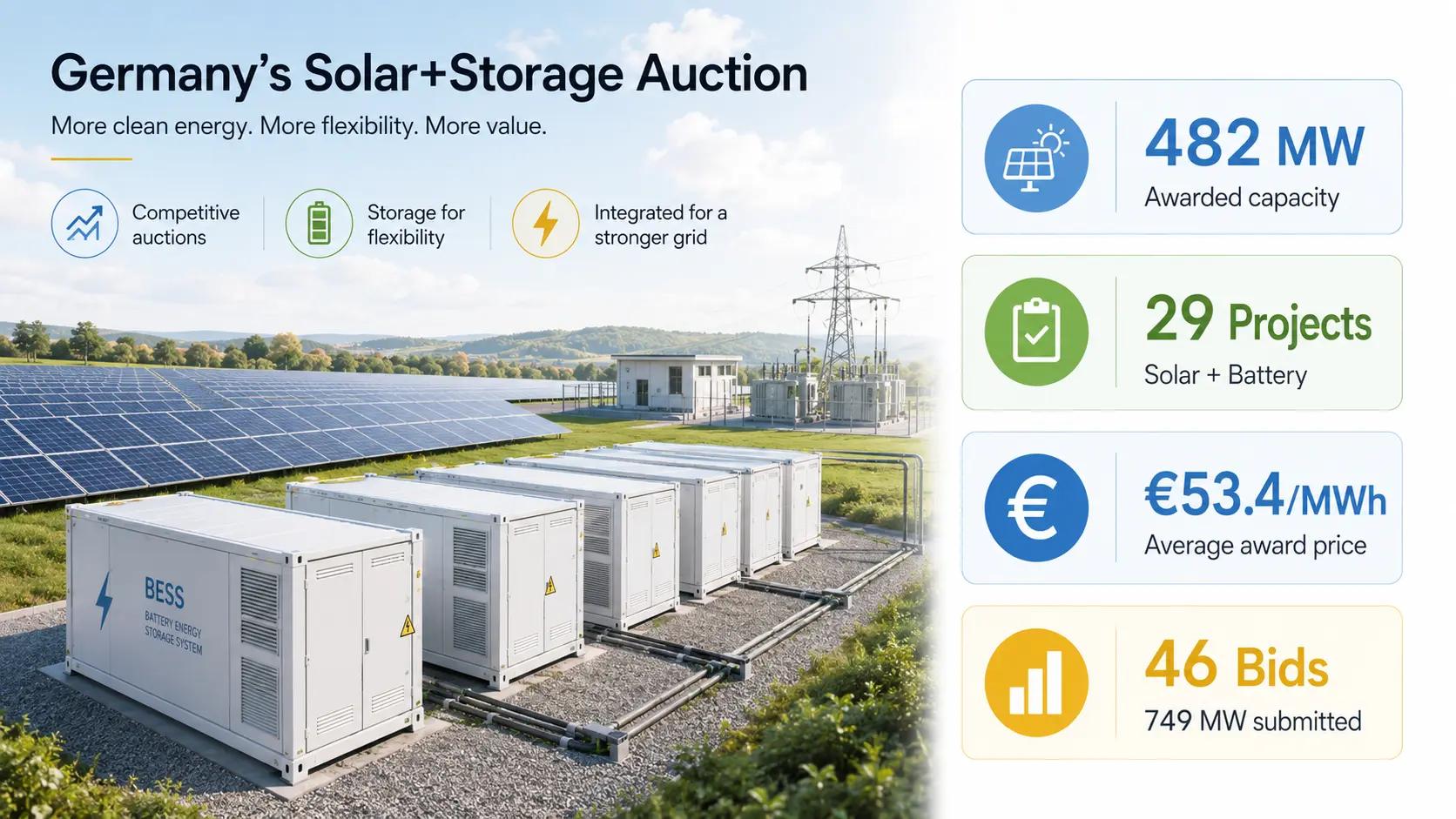
Germany has awarded contracts for 29 new projects combining solar photovoltaic plants with battery storage, with a total capacity of 482 MW. The average awarded price reached €53.4/MWh, the lowest level so far for German auctions of this type.
The tender attracted 46 bids with a combined capacity of 749 MW, showing that investor interest remains strong. Winning bids ranged from €47.5/MWh to €55.9/MWh, and all selected projects combine solar power with battery storage systems.
Batteries are becoming part of the price of solar power
The key message from the auction is that Germany is no longer supporting only new solar capacity, but solar projects that can provide greater flexibility to the electricity system.


With battery storage, part of the production can be shifted from hours of high solar generation to periods when the system needs electricity the most. This increases the value of solar power and reduces dependence on generation only during daylight hours.
Support through a one-sided CfD model
The selected projects will receive support through Germany’s sliding market premium model, which in practice functions as a one-sided CfD mechanism. Under this model, investors sell electricity on the market, and if the market price is below the auction-awarded price, the state compensates the difference through a premium.
In this case, the average reference price is €53.4/MWh. This gives investors greater revenue certainty while keeping projects exposed to market signals.
Prices continue to fall
The latest auction shows a strong decline in prices compared with previous rounds. The average price stood at €61.5/MWh in July 2025, €70.9/MWh in October 2024 and €83.3/MWh in July 2024.
Most of the awarded capacity will be developed in Bavaria, with 287 MW, followed by Schleswig-Holstein with 53 MW and Brandenburg with 51 MW.
With this auction, Germany is sending a clear signal that the next phase of solar development will not be only about building new megawatts, but about integrating storage, flexibility and market responsibility.
ECI