

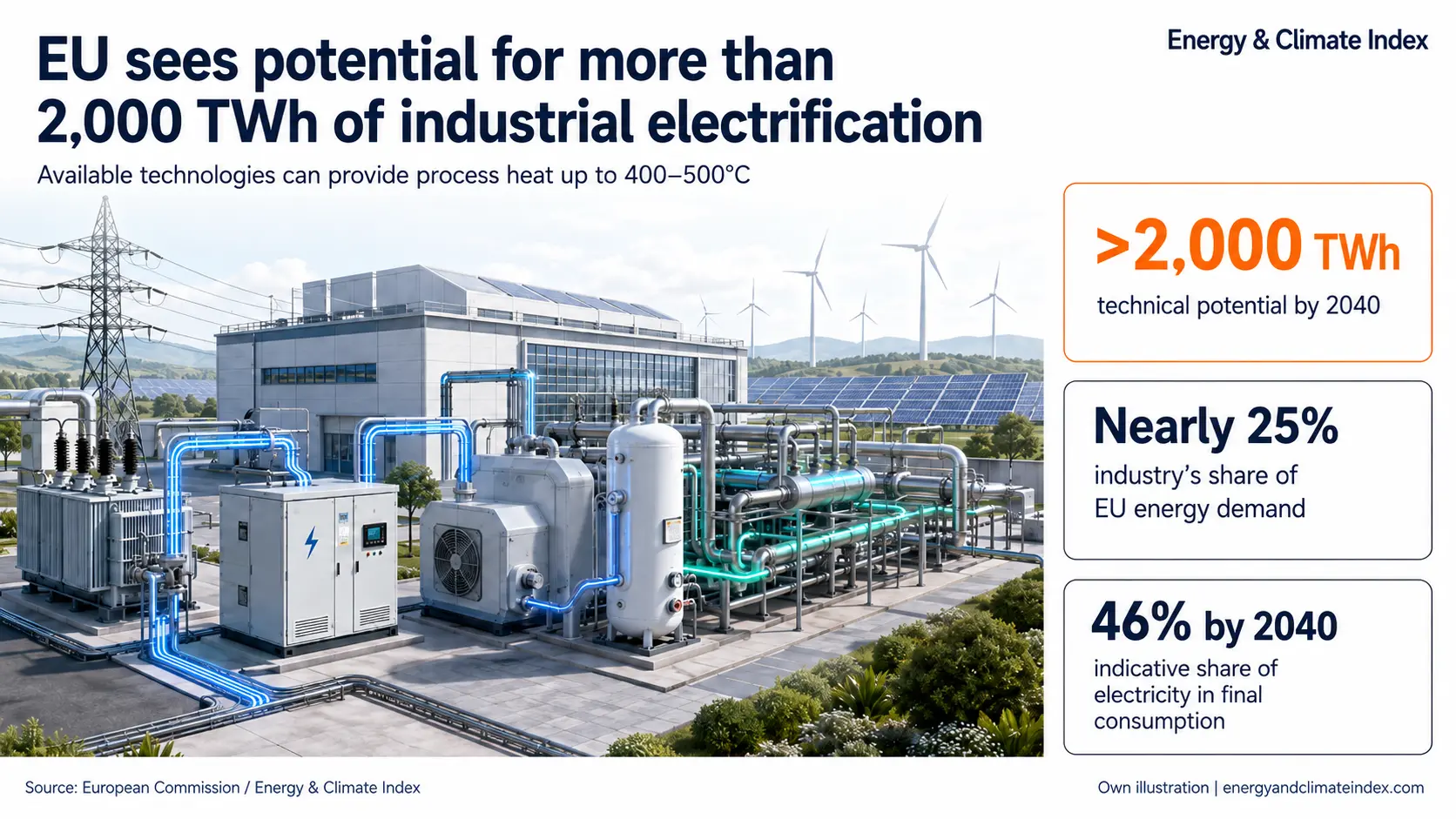
European industry has the technical potential to electrify more than 2,000 TWh of energy consumption by 2040, according to a study published by the European Commission in July 2026.
Industry accounts for almost a quarter of the European Union’s total energy demand. Although the sector has achieved significant improvements in energy efficiency, the shift from fossil fuels to electricity remains slow.
Some technologies are already commercially available
According to the European Commission, industries such as food and beverages, pulp and paper, and textiles are already well suited for electrification.


Commercially available technologies, including industrial heat pumps and electric boilers, can provide process heat at temperatures of up to 400–500°C. This means that some industrial processes can already switch from fossil fuels to electricity.
The Commission sees electrification as an opportunity to modernise European industry, improve efficiency and productivity, and strengthen its global competitiveness.
High prices and grid constraints remain the main barriers
The European Commission’s study identifies several major obstacles to faster industrial electrification:
- high electricity prices;
- grid constraints;
- substantial investment needs;
- competitiveness concerns;
- policy uncertainty.
Despite the considerable technical potential, the Commission finds that policy ambition and implementation remain uneven across EU member states.
Electricity’s share should reach 46% by 2040
Renewables accounted for 49.9% of the EU’s gross electricity consumption in 2025. However, electricity still represents only 23% of final energy consumption.
The Electrification Action Plan sets a 32% reference level for 2030 and an indicative target of 46% by 2040. According to the Commission, reaching this level could reduce the EU’s annual fossil fuel import bill by €260 billion by 2040.
The plan focuses on narrowing the cost gap between electricity and fossil fuels, accelerating the development of power grids and encouraging the adoption of technologies powered by clean electricity.
ECI