

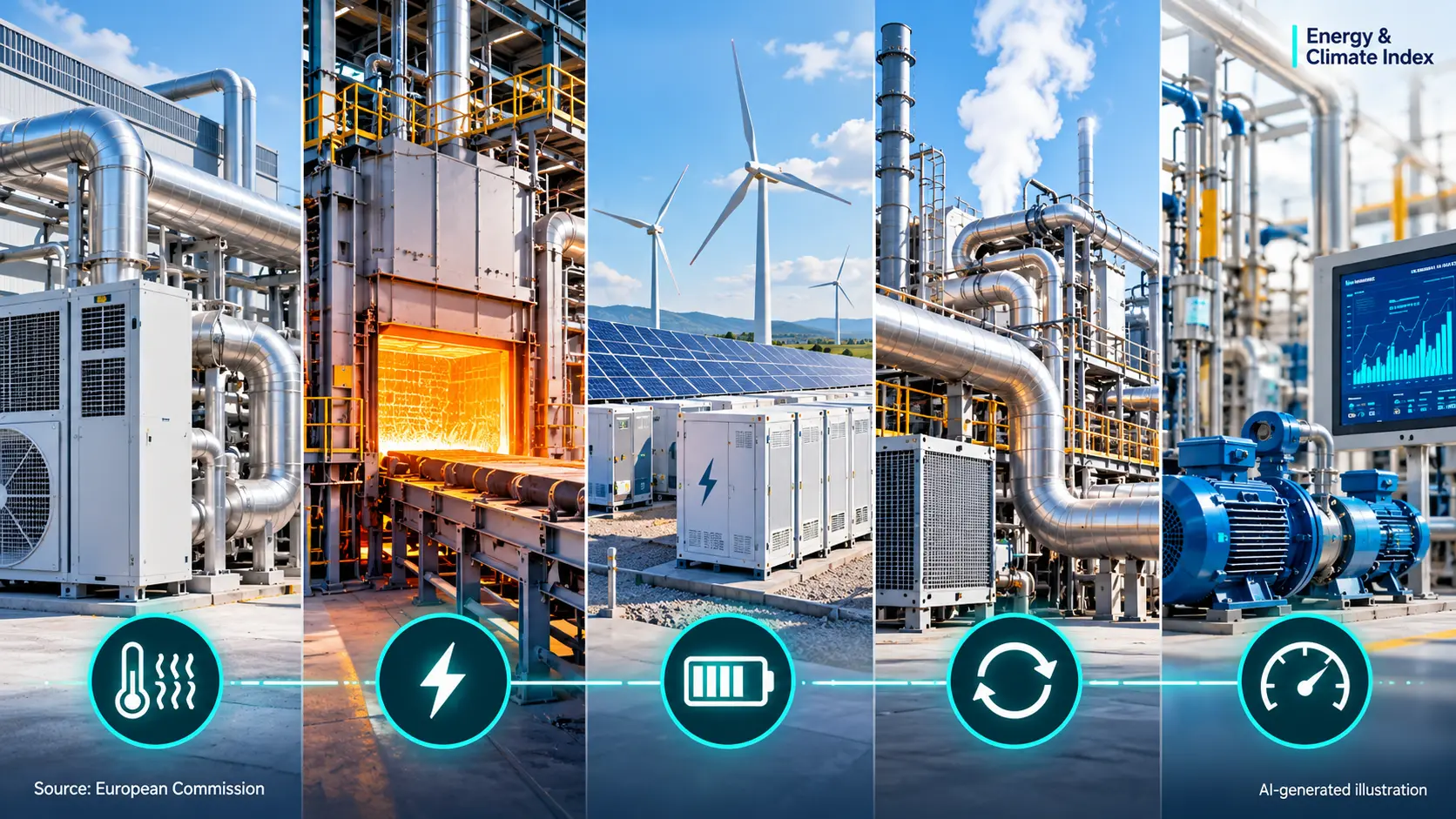
The European Commission has presented a new technological review of 189 demonstration projects across 21 European Union Member States, highlighting how electrification and energy efficiency can reduce European industry’s dependence on fossil fuels.
The projects represent investments of approximately €1 billion, including around €600 million in EU funding through programmes such as Horizon Europe, LIFE and the Innovation Fund.
The report, Industrial Electrification and Energy Efficiency – Technological Success Stories from EU Programmes, published in October 2026, identifies technologies already being tested under real industrial conditions and examines their potential for wider commercial deployment.


Five technological solutions to reduce fossil fuel consumption
Industry accounts for approximately one-quarter of the European Union’s final energy consumption. A significant share of this demand is associated with the production of heat and steam, traditionally supplied by natural gas and other fossil fuels.
The European Commission identifies five main groups of technologies capable of accelerating the transition.
The first includes industrial heat pumps and mechanical vapour recompression systems. These technologies recover lower-temperature heat and upgrade it to temperatures suitable for industrial processes, reducing energy consumption compared with conventional heat generation.
The second group covers electric furnaces and boilers, which can directly replace certain fossil fuel-based installations. Their application is particularly relevant in processes requiring controlled temperatures, where electrical heating can technically substitute existing thermal systems.
The third group focuses on demand-side flexibility, the integration of on-site renewable energy and energy storage systems.
This approach allows industrial electricity consumption to be shifted towards periods of higher renewable generation or lower wholesale electricity prices, without necessarily reducing overall production.
The fourth group involves waste heat recovery and industrial symbiosis, enabling energy that would otherwise be lost in one production process to be used in another.
The fifth group consists of established but still important energy efficiency measures, including improvements to electric motor systems, insulation, automation, sensors and energy management controls.
Fossil fuel dependence could be significantly reduced by 2040
According to the assessment presented in the report, widespread deployment of the technologies examined could halve the share of fossil fuels in industrial energy consumption by 2040.
This is not a forecast that such a reduction will automatically occur. Rather, it represents an assessment of the technological potential if these solutions are deployed on a substantially larger scale.
The report also presents 20 selected success stories from EU-funded programmes, demonstrating that some technologies have already progressed beyond laboratory research and are being tested in practical industrial applications.
However, wider deployment depends on economic conditions across individual industrial sectors. Electricity prices, grid connection costs, capital investment requirements and the ability to adapt existing production processes remain important factors.
Electrification is not equally straightforward across all industries. Processes requiring very high temperatures may face greater technical challenges when replacing fossil fuels than those relying on low- and medium-temperature heat.
From demonstration projects to industrial deployment
One of the report’s central conclusions is that technological availability alone is insufficient to accelerate industrial electrification.
Wider deployment requires competitive electricity prices, adequate grid capacity, access to financing and a predictable regulatory framework.
Industrial flexibility is becoming particularly important in electricity systems with growing shares of wind and solar generation. Production facilities capable of adjusting their electricity consumption or using thermal energy storage could potentially reduce operating costs while contributing to more efficient use of renewable electricity.
The European Commission also links industrial electrification to competitiveness. Reducing dependence on imported fossil fuels could limit industrial companies’ exposure to energy price shocks and improve the long-term predictability of energy costs.
In this context, the 189 demonstration projects do not indicate that Europe’s industrial transformation is complete. Instead, they provide a practical evidence base for identifying which technologies are ready for wider deployment and the conditions under which they can become economically competitive.
ECI.