


Jan Rosenow, Head of the Energy Programme at the Environmental Change Institute and Jackson Senior Research Fellow at Oriel College, University of Oxford, is one of Europe’s leading experts on the energy transition, electrification and energy efficiency.
As part of the new “Expert Insights” section, EnergyAndClimateIndex will present and adapt analyses, views and research from leading international experts, academic institutions and analytical centres focused on energy, climate policy and the energy transition.
In his analysis, Prof. Rosenow addresses one of the most controversial questions in European energy policy: do renewables make electricity cheaper or more expensive? His analysis shows that the answer is not straightforward and depends on whether one looks at wholesale markets, retail bills, tariff structures or the broader design of the electricity system.


Wholesale markets: renewables generally reduce prices
According to the analysis, European countries with higher shares of renewables generally have lower wholesale electricity prices. Countries such as Spain and Portugal, with renewable shares above 60%, recorded significantly lower market prices than countries such as Poland or Czech Republic, where dependence on fossil fuels and natural gas remains high.
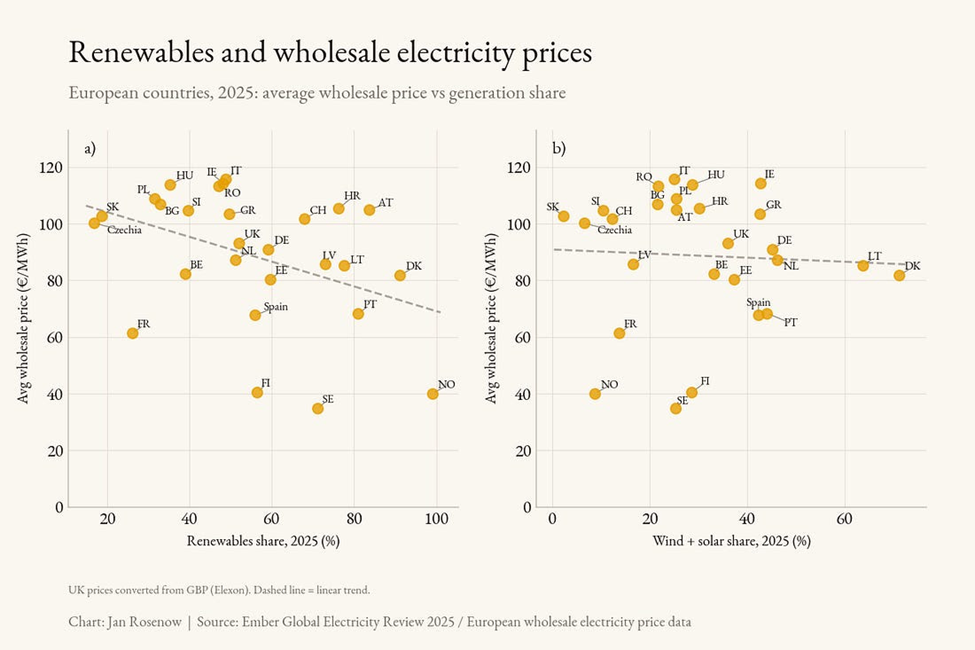
However, the analysis shows that it is not enough to look only at wind and solar shares. Hydropower, nuclear capacity, interconnections, storage and system flexibility play an equally important role.
One of the most important conclusions is that the strongest factor behind high wholesale electricity prices is not the renewables share itself, but the number of hours in which natural gas sets the electricity price. The more non-fossil capacity a system has available renewables, hydropower, storage, nuclear generation and cross-border interconnections, the less often gas becomes the marginal unit setting the price.
Retail markets: the picture becomes much more complex
When the analysis shifts to the prices actually paid by households and businesses, the relationship between renewables and electricity prices almost disappears. Norway has an almost entirely renewable electricity system and the cheapest household electricity prices in Europe, while Denmark, despite also having a very high renewables share, has significantly higher retail prices.
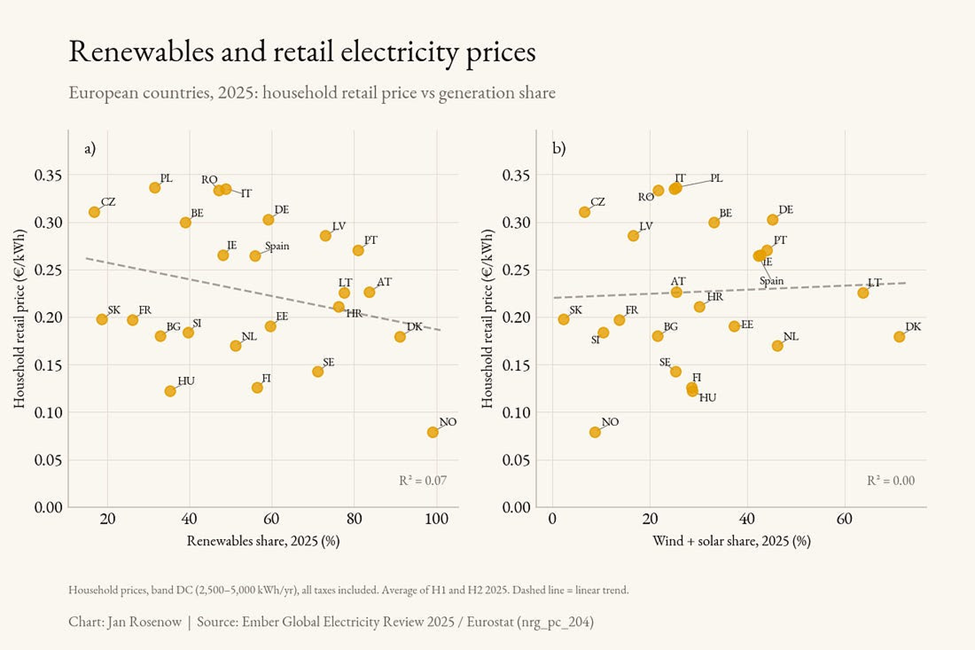
The reason is that electricity bills depend on far more than the cost of generation. In many European countries, most of the bill consists of:
- network charges,
- taxes,
- levies,
- renewable support policies,
- capacity mechanisms,
- balancing costs,
- and regulatory charges.
According to Rosenow, these “non-energy” components create a major structural problem for Europe’s energy transition.
In many countries, electricity carries the bulk of the costs associated with decarbonization and renewable support, while natural gas largely escapes those costs. The result is a paradoxical price signal: Europe politically wants electrification, electric vehicles, heat pumps and electrified industry, while at the same time making electricity relatively more expensive than gas through the tariff system.
The price gap between electricity and natural gas
According to Rosenow’s analysis, one of the biggest structural problems in the European energy system today is the way costs are distributed between electricity and natural gas.
Across most of Europe, electricity carries the largest share of decarbonization policies, renewable support schemes, grid investment costs and regulatory levies, while natural gas remains comparatively less burdened by such costs. As a result, households and industrial consumers in many European countries pay significantly more for electricity than for the same amount of energy delivered as natural gas.
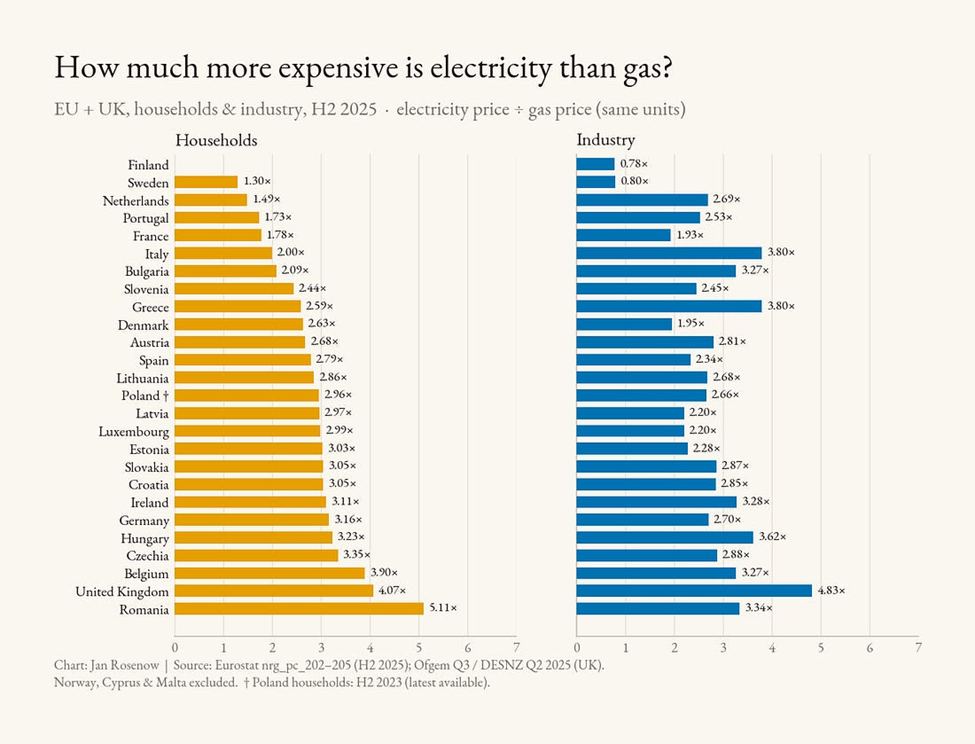
According to the data presented in the analysis, during the second half of 2025, households in some European countries paid up to five times more for electricity compared to natural gas.
For industry, the differences are even more pronounced in certain countries. In United Kingdom, the ratio reaches 4.83, while in Finland industrial electricity is actually cheaper than natural gas. Rosenow argues that these price differences are not driven only by electricity generation costs, but primarily by the way governments structure taxes, tariffs and policy mechanisms linked to the energy transition.
System costs are real, but they are not the main problem
The analysis does not ignore the system costs associated with renewables.
As wind and solar deployment increases, so do the costs related to:
- balancing,
- curtailment,
- grid expansion,
- storage,
- and system flexibility.
In Germany, curtailment compensation reached €2.8 billion in 2024, while balancing costs in United Kingdom exceed £2 billion annually.
However, Rosenow highlights two important points.
First, these costs are still not the dominant driver of high electricity bills. In most cases, taxes, network charges and legacy infrastructure costs have a much larger impact.
Second, many of these system costs are not inherently “a renewables problem”, but rather the result of delayed grid modernisation and insufficient system flexibility. In other words, the problem is not that too many renewables have been built, but that the rest of the system has not developed quickly enough.
The key debate: the problem is not renewables, but market design
Perhaps the most important conclusion of the analysis is that Europe’s debate on electricity prices is fundamentally misplaced if it focuses only on wholesale markets.
According to Rosenow, the more important questions are:
- how taxes and levies are distributed across fuels;
- whether electricity is overtaxed compared to natural gas;
- how network costs are recovered;
- whether strong enough price signals for flexibility exist;
- and whether retail markets are designed for an electrified economy.
He points out that countries such as Norway, Sweden and Finland have managed to build systems where electrification makes economic sense for both households and industry, something clearly reflected in the high adoption of heat pumps and electric vehicles.
Where is Europe heading?
The analysis concludes that three long-term trends are already working in favour of lower wholesale electricity prices:
- a decline in the number of hours in which natural gas sets electricity prices;
- a dramatic fall in the costs of solar power, wind generation and battery storage;
- and growing electrification, allowing fixed grid costs to be spread across larger volumes of electricity consumption.
At the same time, however, there is also a significant risk.
If electrification slows while grid investment continues to rise, those costs will be spread across fewer consumers, pushing electricity bills even higher. This could create a negative cycle in which high prices discourage electrification, while weak electrification further increases costs.
That is why Rosenow argues that retail market reform and tariff restructuring will become one of the key energy policy issues of the next decade.
The original analysis by Prof. Jan Rosenow can be accessed at the following link.
Viktor Andonov, M.Sc