

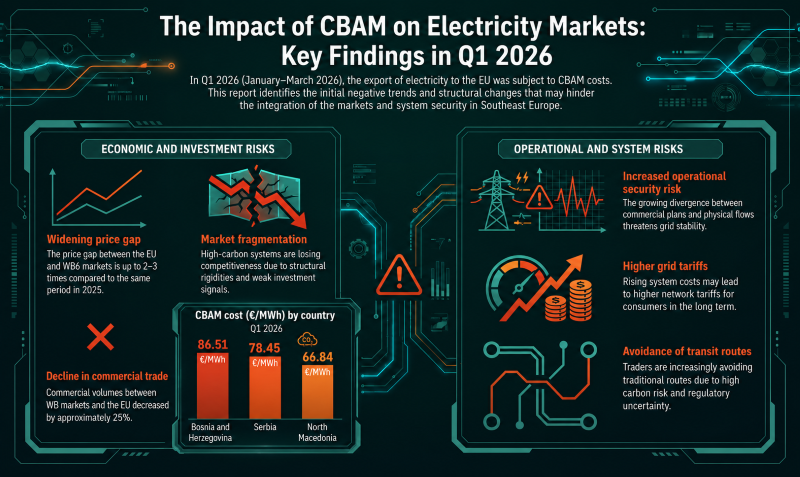
This analysis is based on the official “CBAM Quarterly Report 2026/1” published by the Energy Community Secretariat, which examines the initial effects of the implementation of the Carbon Border Adjustment Mechanism (CBAM) on electricity markets in the Western Balkan countries and neighboring European Union member states.
The New Cost of Electricity in Southeast Europe Is No Longer Measured Only in Euros per Megawatt-Hour, but Also in Carbon
Over the past two decades, the electricity market in the Western Balkans operated according to a relatively simple logic: systems with lower production costs, primarily based on coal and hydropower, exported electricity to more expensive markets within the European Union. Price differentials between regional power exchanges created room for trade, arbitrage, and substantial revenues for producers and traders.
However, the first quarter of 2026 demonstrated that this logic is beginning to change fundamentally.


With the Carbon Border Adjustment Mechanism (CBAM) entering its operational phase, the European Union has effectively introduced a new economic parameter into regional electricity trade: the carbon cost. What was previously considered primarily a political or climate-related debate is now directly affecting the profitability of every megawatt-hour moving toward the European market.
In order to simplify, electricity generated from coal is no longer “cheap” once it crosses the EU border.
When Market Logic Stops Functioning
Under normal conditions, significant price differences between two power exchanges automatically create trading flows. If electricity prices in Hungary are substantially higher than prices in Serbia, North Macedonia, or Bosnia and Herzegovina, it is economically logical for electricity to flow toward the more expensive market.
Yet this is precisely where the new CBAM effect emerges.
During the first quarter of 2026, prices on the Hungarian HUPX power exchange remained within a relatively stable range of €120–180/MWh, while prices across the WB6 zones were considerably lower and significantly more volatile. In certain hours, price differentials exceeded €30/MWh.
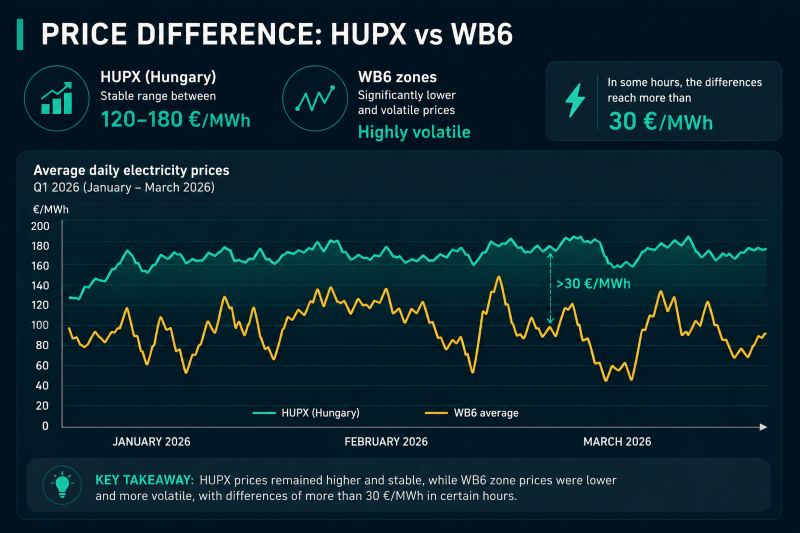
Nevertheless, the expected increase in electricity exports toward the EU did not materialize.
The reason is that traders have already started pricing carbon risk as a real economic cost. Even where price spreads initially appeared profitable, CBAM certificates effectively eliminated trading margins for electricity generated from coal.
This represents a fundamental transformation of market logic. In the past, the key parameter was simply the price of electricity itself. Today, the carbon intensity of production is becoming equally important.
In other words, the market no longer asks only “how much does electricity cost,” but increasingly “how was it produced?”
The Balkans Are Entering a “Two-Speed” Energy System
One of the most important conclusions of the analysis is that CBAM is beginning to create a region with two distinct energy realities.
On one side are low-carbon electricity systems, most notably Albania, whose electricity sector is predominantly based on hydropower. Thanks to its virtually zero-emission generation mix, Albania is gaining a significant competitive advantage under the new CBAM framework.
On the other side are countries whose generation portfolios remain heavily dependent on coal.
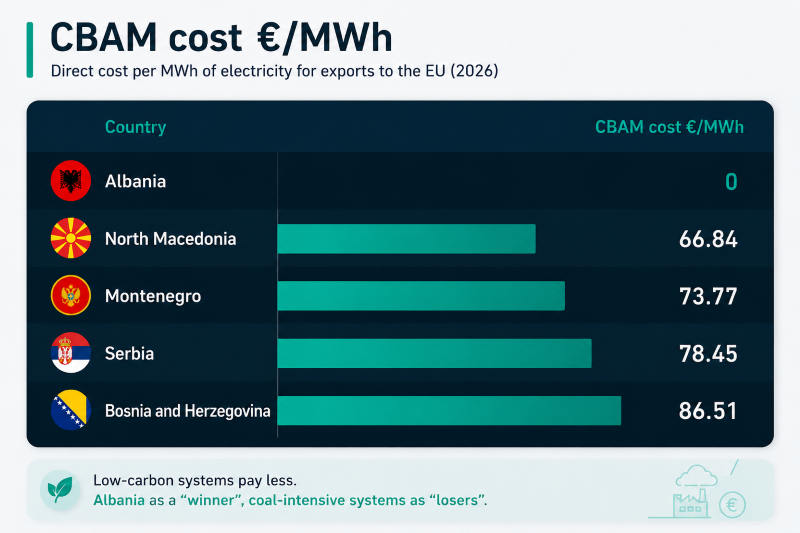
According to the analyzed Q1 2026 data, the specific CBAM costs per imported megawatt-hour differ dramatically across the region.
These figures effectively illustrate the new economic map of the regional electricity sector.
At a time when electricity producers in the Western Balkans are already operating under limited profit margins, an additional carbon-related cost of €70–80/MWh fundamentally changes the competitiveness of coal-generated electricity. This means that thermal power plants, which for decades represented the backbone of regional energy stability, are gradually becoming an economic disadvantage when exporting electricity to the European market.
Trade and Physics Are Beginning to Diverge
One of the most interesting and complex phenomena observed during the first quarter of 2026 is the growing divergence between commercial transactions and the physical flows of electricity.
From a commercial perspective, traders are increasingly avoiding certain routes due to administrative risks associated with CBAM. Transit corridors through Serbia are becoming particularly sensitive, as additional procedures and uncertainties related to carbon certificates are beginning to influence market participants’ decisions.
However, the physical laws governing electricity systems function differently.
Electricity continues to flow along the path of least resistance, regardless of where traders formally schedule transactions.
As a result, a paradoxical situation is emerging in which commercial flows and physical flows no longer fully coincide.
The analysis highlights the example of Albania, where electricity is commercially exported toward Greece, while physically part of these flows continues moving through Montenegro, Bosnia and Herzegovina, and Croatia toward Central Europe.
This phenomenon has serious implications for transmission system operators.
The greater the divergence between commercial and physical flows, the more difficult it becomes to manage the system, plan cross-border capacities, and balance the grid. Over the long term, this could also lead to higher system costs, which may ultimately be transferred to consumers through network tariffs.
Traders Are Already Redrawing the Balkan Energy Map
Perhaps the most important signal is that CBAM is already beginning to reshape the very geography of electricity trade across the region.
Traders are increasingly choosing routes with the lowest carbon and administrative risks rather than the shortest physical paths.
As a result, corridors such as Albania–Greece and Greece–Italy are gradually gaining importance, while some traditional transit routes through Serbia are becoming less attractive.
This is particularly significant because it demonstrates that CBAM affects not only prices, but also the strategic positioning of countries within the regional electricity system.
In the new reality, geographic location alone is no longer sufficient. The carbon profile of an electricity system is becoming increasingly decisive.
Is the Balkans Facing a New Energy Fragmentation?
One of the most serious risks is the possibility that CBAM, instead of accelerating integration with the European market, could temporarily create new dividing lines across the region.
Data from regional power exchanges already reveal diverging trends.
In Albania, trading volumes on ALPEX nearly doubled, while Serbia’s SEEPEX exchange recorded a decline of approximately 11%.
This indicates that low-carbon electricity systems are already beginning to attract greater liquidity and stronger interest from traders.
At the same time, coal-dependent systems are facing growing uncertainty. If this trend continues, there is a real risk that investments will gradually shift toward markets with lower carbon exposure, further deepening structural differences between regional energy systems.
What Does This Mean for North Macedonia?
For North Macedonia, the new CBAM reality represents both a risk and an opportunity.
On one hand, the country’s high dependence on thermal power generation means that the domestic electricity system will face considerable economic pressure. Coal-based electricity production is gradually becoming less competitive on the European market. On the other hand, this situation could become a catalyst for faster transformation of the energy sector.
In North Macedonia’s case, the new CBAM reality coincides with a period of accelerated transformation of the domestic electricity system. Electricity generation from photovoltaic power plants reached 1,180 GWh in 2025, representing an almost fifty-fold increase compared to 2016, while coal generation continues to decline. At a time when carbon intensity increasingly affects the competitiveness of electricity on regional markets, these developments are gaining not only energy-related, but also strategic economic importance for the country’s future integration into the European electricity market.
The development of photovoltaic power plants, battery storage systems, flexible generation capacities, and regional integration is no longer solely a climate agenda, but it is becoming an economic necessity. CBAM is effectively sending a new market signal: future competitiveness will not depend only on generation costs, but also on the ability of a system to produce low-carbon electricity.
The Beginning of a New Energy Order
The first quarter of 2026 demonstrated that CBAM is no longer a future regulatory issue, but an active factor directly influencing prices, trade flows, market liquidity, and the competitiveness of electricity systems across Southeast Europe.

Although some effects were temporarily mitigated by exceptionally favorable hydrological conditions, the Energy Community Secretariat’s Q1 2026 report clearly warns that current trends may lead to structural divergence between EU and WB6 markets, increased market fragmentation, and disruptions in the process of integration with the European electricity market.
Under such conditions, the fastest adaptation path for Western Balkan countries will not depend solely on the construction of new renewable energy capacities, but also on their ability to simultaneously implement several structural reforms.
First and foremost, the region will need to significantly accelerate the reduction of coal dependence and gradually transition toward low-carbon generation mixes, since CBAM costs directly determine the competitiveness of electricity on the European market.
At the same time, faster alignment with European carbon pricing mechanisms and gradual integration with EU ETS principles will be necessary in order to reduce the regulatory and market uncertainty already affecting cross-border electricity trade.
The report further demonstrates that the growing divergence between commercial and physical electricity flows represents a serious risk to operational system security. Consequently, WB6 countries will need to invest substantially in grid infrastructure, battery storage systems, balancing capacities, and stronger regional coordination among transmission system operators.
Particularly important will be improving cross-border coordination, joint capacity calculations, and more efficient congestion management, as the current model is creating an increasingly large gap between market signals and the physical realities of the grid.
The most important signal emerging from Q1 2026 is that the future competitiveness of electricity systems will no longer depend solely on generation costs, but increasingly on carbon intensity, system flexibility, and the degree of integration with the European market.
In the new CBAM reality, the speed of adaptation will become the key factor determining which countries position themselves as part of Europe’s energy transition and which risk remaining isolated, more expensive, and structurally uncompetitive energy systems.
Viktor Andonov, M.Sc