

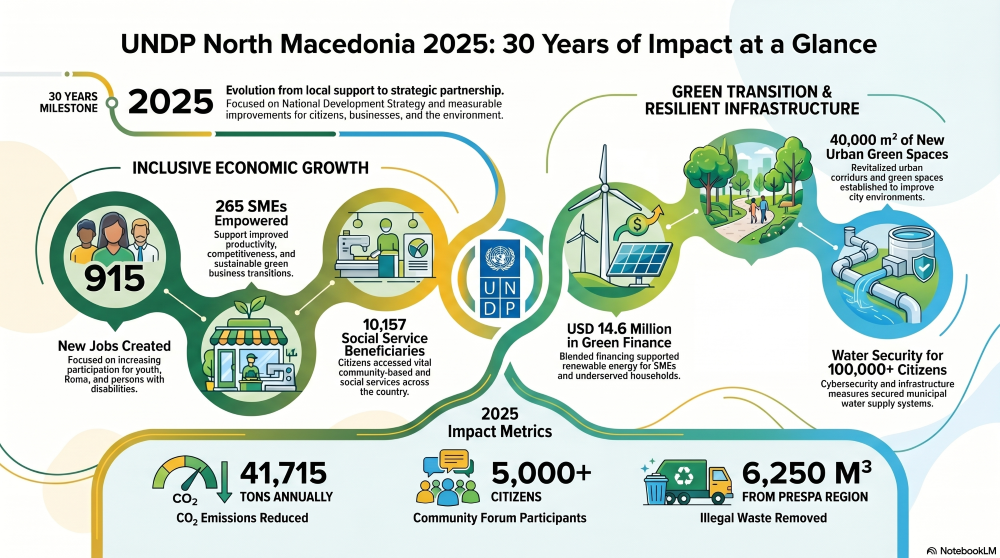
Thirty years after the beginning of cooperation between the United Nations Development Program (UNDP) and North Macedonia, 2025 may represent one of the most important turning points in the country’s climate and sustainability agenda. What once focused primarily on environmental protection has now evolved into a broader framework that combines climate policy, green finance, energy transition, urban resilience and social inclusion into a single development pathway.
The latest UNDP North Macedonia 2025 report reveals that climate action in the country is increasingly shifting from policy ambitions toward measurable implementation. While challenges remain significant, especially regarding financing, institutional capacity and long-term decarbonization, the report demonstrates that climate governance is becoming more integrated into economic planning, municipal development and social policy.
Climate governance and international alignment


One of the most important developments highlighted in the report is the completion of North Macedonia’s First Biennial Transparency Report (BTR1), covering the 2020–2022 emissions inventory period. The report represents a major institutional step toward compliance with the Paris Agreement framework and will serve as a technical foundation for the preparation of the country’s next Nationally Determined Contributions (NDC 3.0).
For a relatively small economy such as North Macedonia, the importance of the BTR process goes beyond reporting obligations. Transparent climate accounting is increasingly becoming a prerequisite for access to international climate finance, EU integration processes, and participation in future carbon-related market mechanisms.
Another important signal came through the organization of the Fourteenth International Forum on Energy for Sustainable Development (IFESD-14) in Skopje, which gathered more than 1,000 participants from 70 countries. The event positioned North Macedonia as an increasingly visible regional actor within the broader global discussion on sustainable energy transitions and climate resilience.
Green finance emerging as a key climate instrument
One of the strongest messages from the report is that climate transition can no longer depend exclusively on public budgets. The Green Financing Facility (GFF), developed with UNDP support, demonstrates how blended finance mechanisms are becoming central to accelerating climate investments in emerging economies.
In 2025 alone, the facility mobilized approximately USD 14.6 million for green investments. Of this amount, USD 13 million targeted small and medium enterprises (SMEs), while USD 1.6 million supported vulnerable households facing energy poverty.
This is particularly important for North Macedonia, where energy poverty remains one of the most underestimated dimensions of the climate transition. In many Western Balkan countries, decarbonization policies risk creating additional social pressure if citizens cannot afford cleaner technologies, building renovations or more efficient heating systems.
The report therefore correctly emphasizes that climate transition must also function as a social transition. By directing financing toward underserved households and vulnerable communities, the approach attempts to avoid the creation of a “two-speed” energy transition in which only higher-income groups benefit from green technologies.
An additional positive element is the focus on SMEs. More than 265 companies received technical support, energy-management training and digital advisory services aimed at improving sustainability performance and alignment with international green market standards. This reflects a broader European trend where supply-chain decarbonization is increasingly influencing competitiveness and export potential.
Urban climate resilience becoming a strategic priority
The report also illustrates how climate policy is increasingly moving toward the local level. Following the pilot energy-efficiency program in Skopje, similar initiatives expanded to Kavadarci, Kumanovo, Struga, Gostivar and Strumica.
While such projects may appear relatively modest individually, their cumulative importance is substantial. Energy efficiency remains one of the fastest and most cost-effective tools for reducing emissions, lowering household energy costs and improving urban air quality a particularly sensitive issue in North Macedonia during winter months.
The development of more than 40,000 square meters of urban green spaces and corridors also represents an important climate adaptation measure. Beyond aesthetics, urban greenery plays a growing role in mitigating heat island effects, improving air quality and increasing resilience against extreme weather events.
Interestingly, the report also links climate resilience with cybersecurity by integrating digital protection protocols into municipal water systems that serve more than 100,000 citizens. This reflects a broader understanding that climate resilience increasingly depends not only on physical infrastructure, but also on digital and institutional resilience.
Prespa as a model for integrated climate adaptation
The Prespa region continues to serve as one of the most important examples of integrated climate and environmental governance in North Macedonia. The report highlights a “people-centered” approach combining waste management, agricultural modernization, water protection and renewable energy integration.
Several concrete measures stand out:
- Expansion of solid waste collection services to all settlements in Resen municipality.
- Introduction of regular waste collection to 11 previously unserved settlements.
- Remediation of six illegal dumpsites.
- Deployment of agrotechnological stations across 4,500 hectares of orchards for climate-adaptive farming practices.
- Introduction of agro-photovoltaic concepts linking agriculture and solar energy production.
This multidimensional approach is particularly important because climate policy in the Western Balkans often remains fragmented between ministries, sectors and municipalities. The Prespa example demonstrates that climate adaptation, environmental protection and local economic development can be treated as interconnected processes rather than isolated policies.
Climate justice and social inclusion
One of the most notable aspects of the report is the strong emphasis on inclusiveness within climate policy.
UNDP integrated gender mainstreaming into the BTR1 process and supported the preparation of methodologies aimed at embedding gender considerations into climate actions and national planning documents.
Equally important was the outreach toward Roma communities and vulnerable social groups through targeted information campaigns linked to green financing programs.
This reflects an increasingly important global understanding that climate transition policies can unintentionally deepen social inequalities if access to financing, technology and information remains uneven.
Measurable climate impact
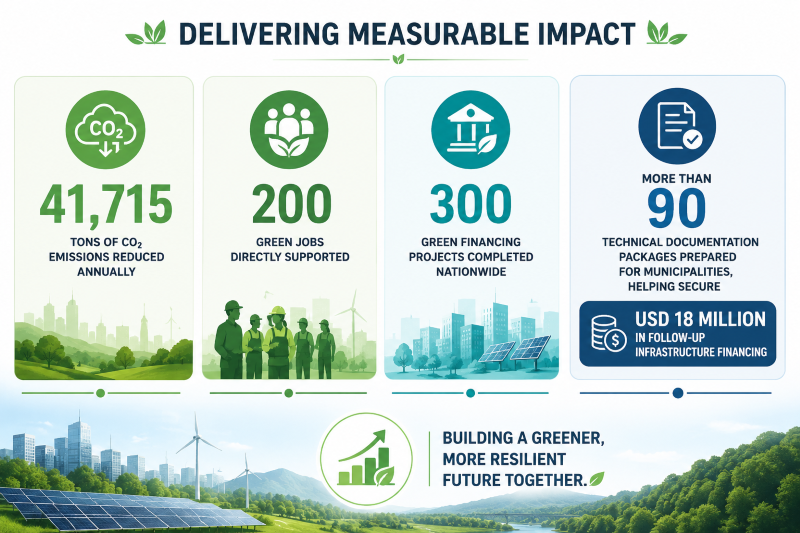
- 41,715 tons of CO2 emissions reduced annually.
- 200 green jobs directly supported.
- 300 green financing projects completed nationwide.
- More than 90 technical documentation packages prepared for municipalities, helping secure USD 18 million in follow-up infrastructure financing.
Although these figures alone will not fundamentally transform North Macedonia’s emissions profile, they indicate the growing institutional maturity of the country’s climate governance ecosystem.
From pilot projects toward structural transition
Perhaps the most important conclusion from the report is that North Macedonia’s climate transition is gradually moving beyond isolated pilot initiatives toward more systemic implementation.
The planned partnership between UNDP and the City of Skopje on green mobility, public finance planning and inclusive governance could become particularly significant in the coming years. Urban areas will likely become the central battleground of climate policy across the Western Balkans due to rising energy demand, pollution pressures and infrastructure vulnerabilities.
At the same time, the report also indirectly highlights a broader strategic reality: climate transition in the region will depend not only on renewable energy investments, but equally on governance quality, institutional coordination, access to finance and public trust. North Macedonia may still face substantial structural challenges on its decarbonization path, but the 2025 results suggest that climate policy is increasingly becoming embedded into the country’s broader economic and development model a necessary condition if the transition is to become both sustainable and socially resilient.
Viktor Andonov, M. Sc