

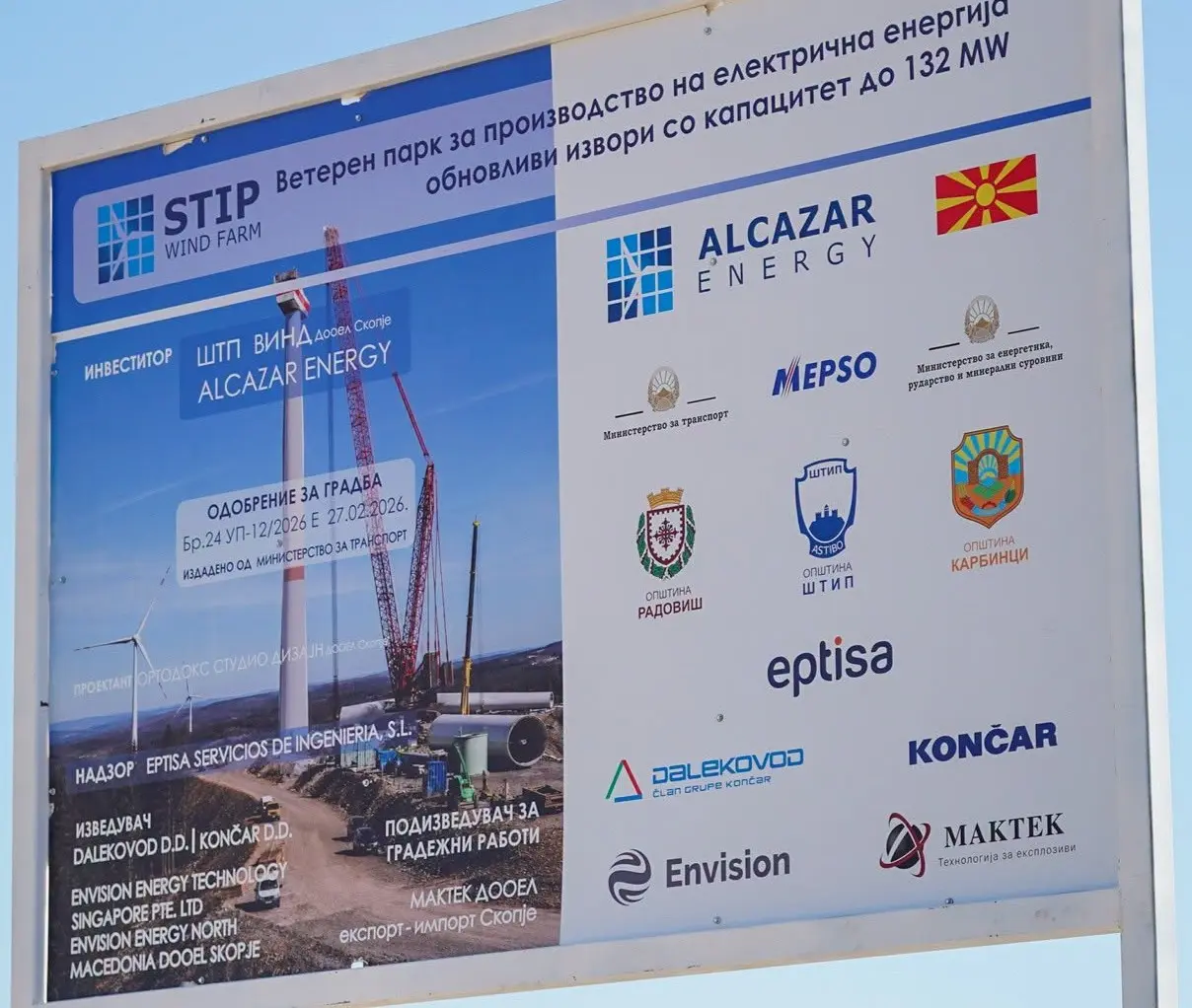
The first phase will have a capacity of 131 MW, almost matching the country’s entire existing wind power capacity. The full project is planned at 396 MW and is expected to become the largest wind farm in the Western Balkans.
Alcazar Energy Partners has reached financial close for the first phase of the Štip wind farm, securing EUR 180 million to construct 21 wind turbines with a total capacity of 131 MW.
The financing is being provided by the European Bank for Reconstruction and Development, the International Finance Corporation, Erste Bank and Sparkasse Bank. The EBRD’s contribution amounts to EUR 42 million. According to the investor, the financial close allows the project to proceed to the next stage of implementation.
The entire complex is planned to comprise 54 turbines with a total installed capacity of 396 MW, spread across the municipalities of Štip, Karbinci and Radoviš. The total investment is estimated at more than USD 500 million, while the company has announced that financing for the remaining two phases is expected to be secured soon.


Once all phases are completed, the wind farm is expected to generate around one terawatt-hour of electricity annually. According to the investor’s estimates, this would be sufficient to supply approximately 148,000 households while avoiding around 570,000 tonnes of carbon dioxide emissions each year. Nearly 300 jobs are expected to be created during construction and operation.
The project also stands out for its financing model. The electricity will be sold through a long-term agreement with an international company, without traditional state support. The EBRD describes it as the first privately developed utility-scale wind project in North Macedonia to proceed without subsidies.
Four wind farms built in North Macedonia
The scale of the Štip wind farm is best understood in comparison with the development of wind energy in the country to date. According to the Energy Regulatory Commission’s annual report, five wind power plants with a combined installed capacity of 146 MW were recorded at the end of 2025. They generated 287 GWh of electricity, accounting for 4.69% of total domestic electricity production.
However, the five power plants do not represent five separate geographical wind farms. In project terms, four wind farm complexes have been built and connected in the country:
- Bogdanci – 36.8 MW;
- Bogoslovec – 36 MW;
- Perun – 30 MW;
- Dren – 43.2 MW.
The first phase of Štip, with a capacity of 131 MW, would alone be equivalent to almost 90% of the country’s total wind power capacity recorded at the end of 2025. The full 396 MW project is 2.7 times larger than the existing wind capacity. If completed in full, and provided that the existing facilities remain operational, North Macedonia’s total wind power capacity would increase to approximately 542 MW.
North Macedonia’s expansion of renewable energy has so far been driven primarily by photovoltaic power plants. In 2025, the country had 963 MW of installed solar capacity, compared with 146 MW of wind power. Renewable energy sources accounted for 58.2% of total installed capacity but generated 46.37% of domestic electricity. This shows that adding generation capacity alone is not enough: a stronger transmission grid, energy storage, improved forecasting and additional balancing capacity are also required.
The Štip wind farm’s planned annual production of around one terawatt-hour would correspond to approximately one-sixth of North Macedonia’s total domestic electricity production in 2025. However, this would not automatically guarantee energy independence. Wind generation depends on weather conditions, while its impact on electricity imports will also depend on consumption, the availability of other power plants and the grid’s ability to accommodate the new generation.
ECI