

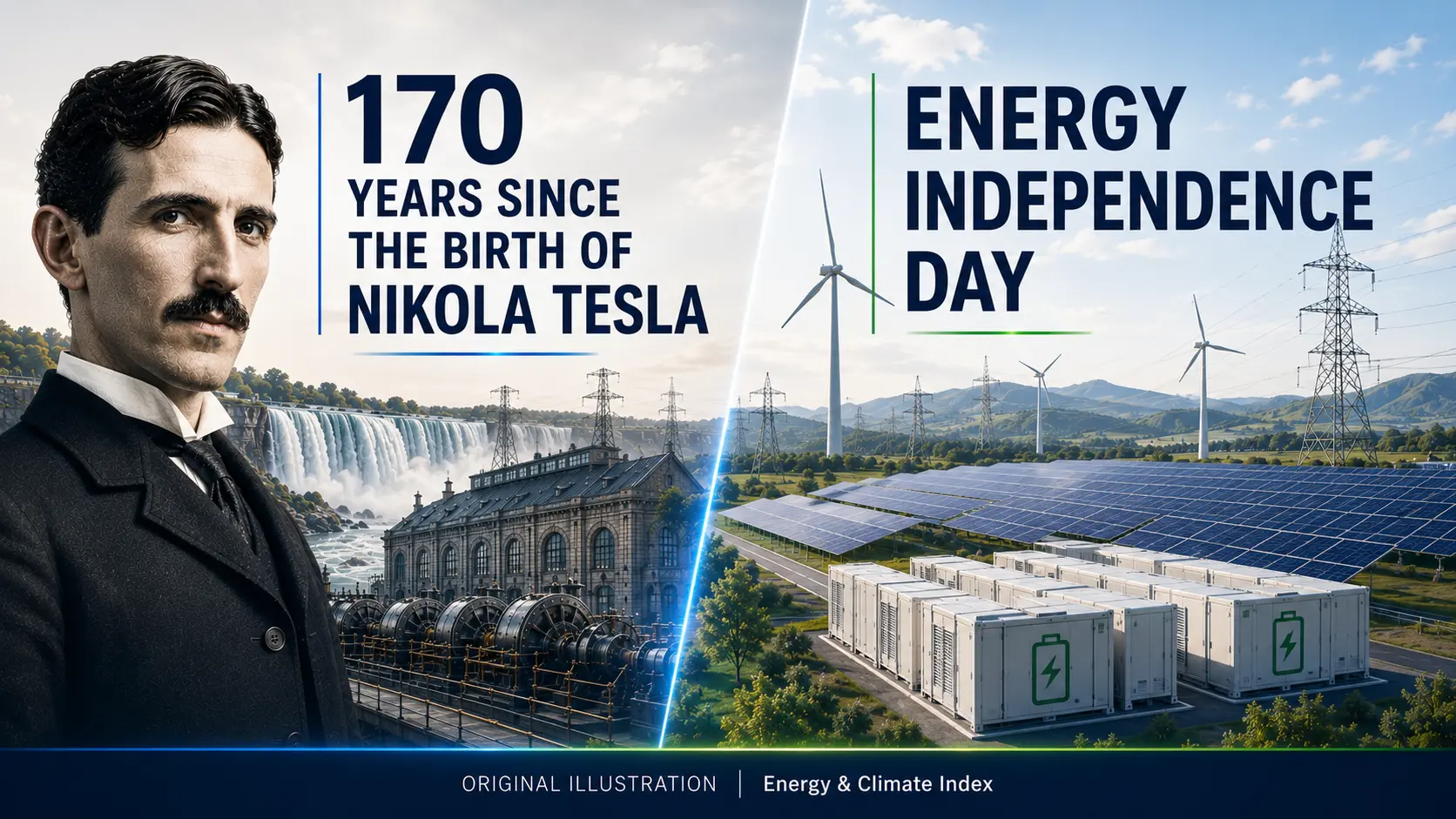
Today, 10 July, marks 170 years since the birth of Nikola Tesla, one of the greatest scientists and visionaries in the history of electrical engineering, whose discoveries and solutions for alternating current laid the foundations of the modern power system.
The same date is also dedicated to global energy independence, a concept that gained new significance in 2026 following the crisis surrounding the Strait of Hormuz and the renewed debate over the extent to which the world depends on several critical corridors for oil and gas transportation.
170 years since the birth of Nikola Tesla
Nikola Tesla was born on 10 July 1856 in the village of Smiljan, then part of the Military Frontier within the Austrian Empire and today located in Croatia. He came from a Serbian Orthodox family and was the son of Orthodox priest Milutin Tesla and Georgina Đuka Tesla, née Mandić. Although he originated from this region, he carried out the most important part of his inventive and engineering work in the United States.


His solutions for alternating current and the development of the induction motor enabled electricity to be generated, transmitted and used more efficiently at a time when direct-current systems could supply only relatively limited areas.
The most striking symbol of the practical application of his solutions became the famous hydropower plant at Niagara Falls. The facility was built around a multiphase alternating-current system, and the first electricity from the power plant was delivered in 1895.
Prof. Dr. Neven Duić, on what Nikola Tesla might think if he were alive today: “He would definitely drive a Tesla car. However, he would probably be surprised to discover that Thomas Edison was right in certain respects namely, that direct current (DC) transmission can in fact be more efficient, and that Tesla himself helped lock the world into an alternating current (AC)-based system that is now expensive to replace, while a significant part of the modern energy system is gradually moving back towards DC technologies.
On the other hand, he would certainly be proud that his vision of the mass electrification of society has become a reality.”
Although Tesla’s system enabled electricity to be transmitted over long distances, high-voltage direct current, or HVDC, is now used for very long-distance transmission and subsea connections because it can offer lower transmission losses. Alternating current should therefore not be described as the most efficient modern solution for every application, but as the foundation of the modern power grid.
The connection between the two observances, Tesla’s birthday and Global Energy Independence Day, is not only symbolic but substantial. The alternating-current system developed by Tesla enabled electricity produced in large power plants to be transformed to higher voltages and efficiently transmitted to distant cities and industrial centres. This visionary concept laid the foundations of the modern power system and opened the way towards today’s energy security and independence.
Why 10 July is also Global Energy Independence Day
Global Energy Independence Day was established in 2006 by Michael Antonovich, then a member of the Los Angeles County Board of Supervisors. The date of 10 July was selected specifically because it was Tesla’s birthday, linking his legacy with the promotion of alternative and renewable energy sources.
The original message was to reduce dependence on fossil fuels through solar, wind, geothermal and hydropower. Twenty years later, energy independence has become a broader concept. It no longer concerns only the origin of fuel, but also the capacity of an energy system to continue functioning during wars, disruptions to transport routes, extreme price increases, droughts or major grid failures.
What energy independence means in 2026
The crisis surrounding the Strait of Hormuz demonstrated the risks of allowing a large share of global energy supply to depend on a single narrow maritime corridor.
Energy independence therefore does not mean complete national self-sufficiency or a closed domestic market. For most European countries, such an approach is neither feasible nor economically justified. In 2026, independence means resilience: more domestic energy sources, diversification, strategic reserves, energy efficiency, electrification and a system capable of adapting quickly when one source becomes unavailable.
Solar and wind energy do not depend on tankers or maritime straits, but neither can they provide security on their own. Batteries, pumped-storage facilities, flexible power plants, stronger grids and demand-side management are also required.
At the same time, the electrification of transport, heating and industry is essential. A country may produce large quantities of renewable electricity and still remain highly dependent on imported oil and natural gas.
North Macedonia has abundant sunshine, but independence also depends on the grid
In 2025, North Macedonia reached 1,058 MW of installed solar capacity, compared with only 17 MW in 2016. This historic growth demonstrates that new generation capacity can be developed within a relatively short period.
However, installed capacity is not the same as secure electricity supply. Solar power plants generate most of their electricity during the day, while evening and winter demand requires other generation sources or stored energy.
North Macedonia’s energy independence therefore cannot be considered exclusively within its national borders. The electricity systems of the Western Balkans are relatively small, but their resources can complement one another: solar generation in North Macedonia, significant wind and solar potential in Serbia, hydropower flexibility in Albania, Montenegro and Bosnia and Herzegovina, and broader access to larger European energy markets. Regional electricity exchange is not the opposite of independence. It is one of the key conditions for the security and stability of smaller power systems.
Achieving this requires investment in both physical and market infrastructure. The Bitola–Elbasan interconnection should complete the electricity corridor linking Bulgaria, North Macedonia, Albania and Italy, while creating additional opportunities for cross-border exchange and the integration of renewable energy sources.
At the same time, the construction of the natural gas interconnection with Greece is a strategically important project for the entire Western Balkans. The connection will provide a direct alternative to Russian gas by opening access to gas from Azerbaijan and liquefied natural gas terminals, which is important for the energy transition and system balancing.
This project naturally connects with the planned bidirectional gas interconnector between North Macedonia and Serbia, through Klečovce and Vranje. It could position North Macedonia as an important transit route within the so-called Vertical Gas Corridor, transporting alternative gas supplies from the south towards its northern neighbors and further into Europe.
North Macedonia must therefore continue investing in its transmission and distribution grids, battery storage, wind farms, the modernization of hydropower plants and regional electricity market coupling.
One hundred and seventy years after Tesla’s birth, electricity is once again at the centre of economic and geopolitical security. His generation addressed the challenge of producing electricity and transmitting it over long distances. The challenge for today’s generation is to ensure that electricity is clean, available at every hour and sufficiently resilient not to depend on a single fuel, one power plant or one narrow corridor.
Viktor Andonov, M.Sc