

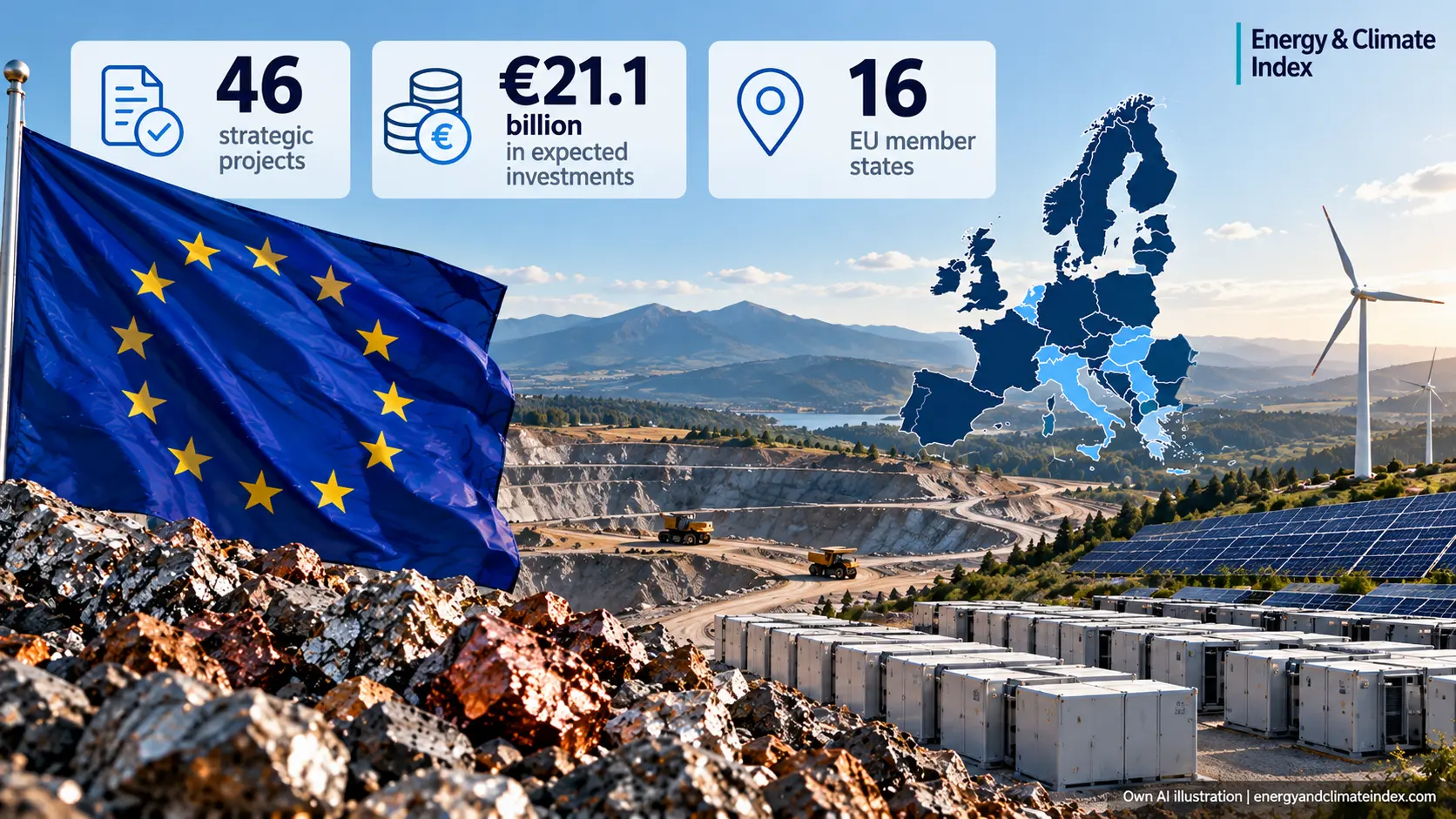
The European Commission approved a new group of 46 strategic critical raw materials projects on October 9, 2026, representing an estimated investment of €21.1 billion. The projects aim to strengthen Europe’s capacity to extract, process and recycle materials essential for battery storage systems, electric vehicles, renewable energy technologies and advanced industrial applications.
The decision forms part of the implementation of the EU Critical Raw Materials Act, which seeks to reduce the European Union’s dependence on a limited number of external suppliers and establish more secure and resilient supply chains.
Projects across 16 EU Member States
The new list includes 46 projects located in 16 EU Member States. According to the European Commission, the projects cover 15 of the 17 raw materials identified as strategically important for European industry.


Of the total, eight projects focus on extraction, 11 on processing, 19 on recycling, while another eight cover multiple stages of the value chain.
Bulgaria, Greece and Romania are among the countries hosting approved projects, highlighting Southeast Europe’s potential to play a greater role in supplying critical materials to European industry.
Strategic project status is expected to facilitate streamlined permitting procedures, improved access to financing and stronger institutional support for project implementation.
Batteries and electrification drive growing demand
The energy transition is generating increasing demand for lithium, nickel, cobalt, graphite, copper and rare earth elements.
These materials are essential components of battery energy storage systems, electric vehicles, wind turbines, electric motors and electricity networks.
European industry remains heavily dependent on imports and processing capacity in third countries, particularly China. This dependence creates significant vulnerabilities amid trade restrictions, geopolitical tensions and intensifying global competition for critical resources.
Through the newly approved strategic projects, the European Union aims to develop a larger share of its domestic supply chain, covering extraction, processing, recycling and the reuse of materials.
€21.1 Billion in expected investment, not direct EU Grants
The estimated €21.1 billion represents the investment required to implement the projects. It does not mean that the European Commission has already allocated or disbursed this amount.
Strategic project status can help developers gain access to financial institutions, private capital and relevant European financing instruments.
For the European Union, the success of this policy will depend on how quickly projects move from regulatory approval to operational extraction, processing and recycling facilities.
The development of Europe’s critical raw materials sector will be an important factor in industrial competitiveness, battery technology costs and long-term energy security.
ECI