

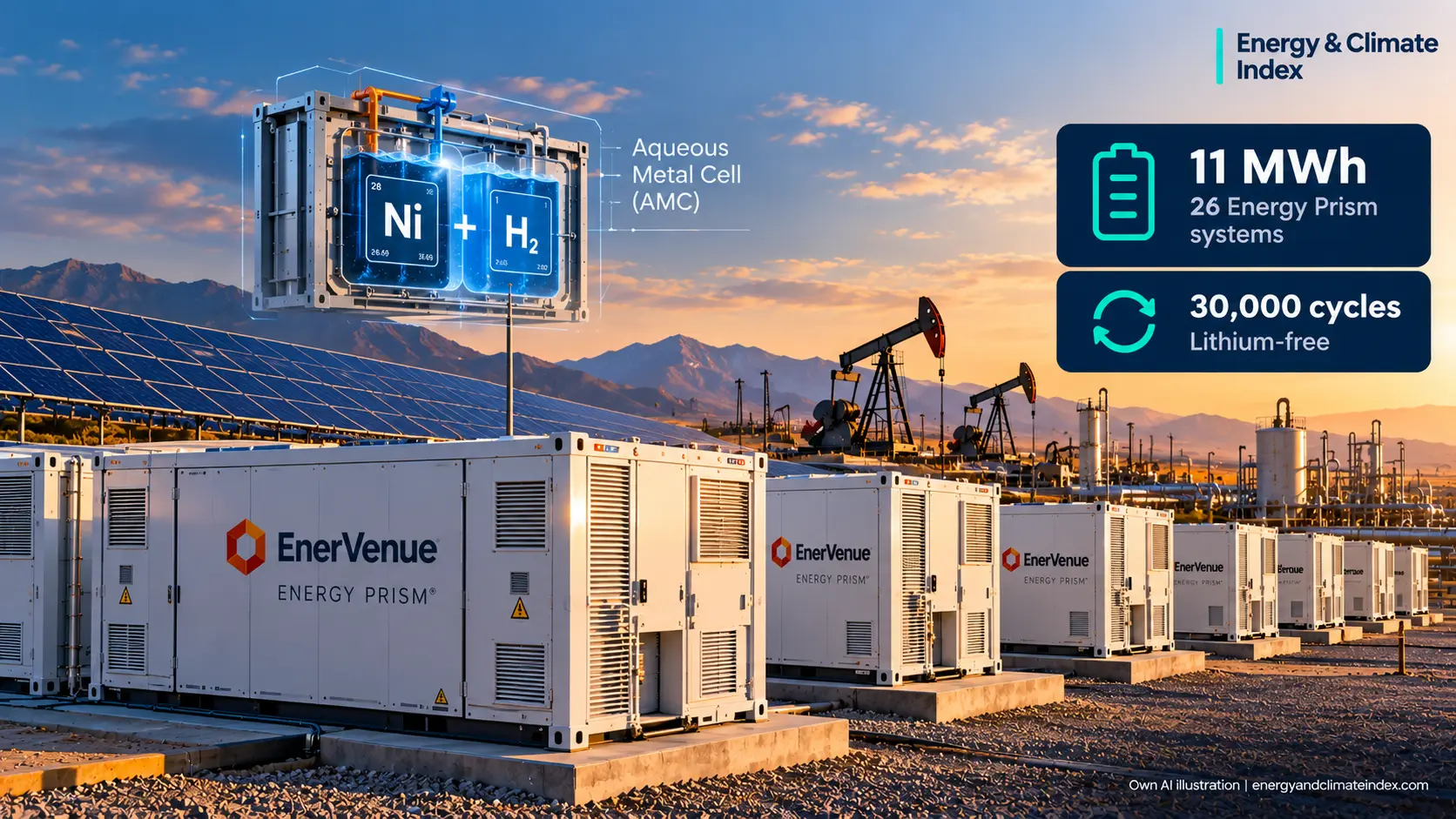
U.S.-based EnerVenue has secured its first multi-megawatt-hour commercial order for its lithium-free energy storage technology. The company will deliver 26 containerized Energy Prism systems with a total capacity of 11 MWh for an active oil field in northern China.
The system will be connected to an existing solar power plant at the site. Electricity generated during the day will be stored in the batteries and used during periods when the oil field’s operations require additional power.
The order was placed by a major Chinese oil and gas producer, although EnerVenue has not disclosed the company’s identity or the exact location of the project. The first three containers are scheduled for delivery in December 2026, with the remaining 23 expected in March 2027.


A lithium-free battery with a water-based electrolyte
At the core of the Energy Prism is the fourth generation of EnerVenue’s Aqueous Metal Cell – AMC technology. It uses nickel-hydrogen chemistry with a water-based electrolyte and does not rely on lithium.
Safety is one of the main reasons the technology was selected for this project. Oil and gas facilities have particularly stringent fire and process safety requirements.
According to EnerVenue, the water-based electrolyte is non-flammable, while the AMC cell has passed UL 9540A testing without cell-to-cell fire propagation. The company also says the technology is designed for 30,000 cycles, enabling up to three cycles per day over a 30-year period.
This positions the technology in a different segment from dominant lithium-ion BESS solutions, particularly for industrial sites where safety, intensive cycling and long operating life carry significant weight when selecting an energy storage system.
New factory in China to manufacture the systems
The cells for the project will be manufactured at EnerVenue’s new facility in Changzhou, Jiangsu Province. The company launched the production line on 24 September.
In its first phase, the facility has an annual production capacity of 250 MWh. EnerVenue plans to increase this to 1 GWh in 2027 and subsequently reach multi-gigawatt-hour scale by 2028. Once fully automated, the production line is designed to manufacture around 300 AMC cells per day.
The company already operates a smaller 150 kWh system in Jintan, Changzhou, combining renewable electricity generation with electric bus charging. However, the new 11 MWh order represents the technology’s first step into a commercial multi-megawatt-hour project.
Alternative battery technologies seek a place in the BESS market
The project is also significant in the broader race to develop alternatives to lithium-ion batteries.
Lithium-ion technology remains dominant in the global BESS market, but the rapid expansion of energy storage is creating opportunities for other battery chemistries in specific applications, particularly where high fire safety, frequent cycling and long operating life are required.
EnerVenue will now have to demonstrate that these advantages can also be delivered in the commercial operation of a larger-scale system. The project in China therefore represents an important step from demonstration technology towards industrial deployment under real operating conditions.
ECI