

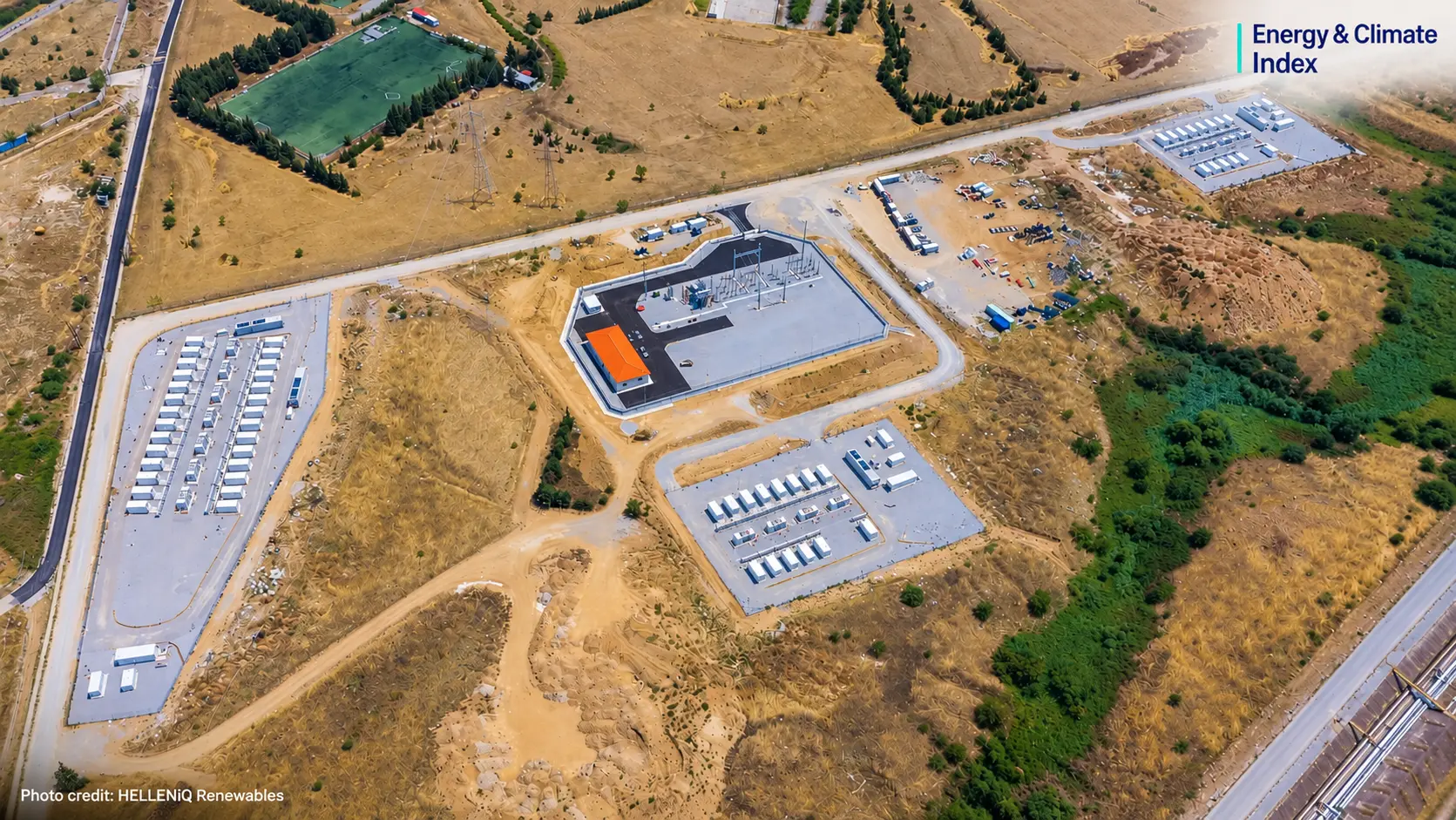
HELLENiQ Renewables, part of the HELLENiQ ENERGY Group, has completed and commissioned its first large-scale battery energy storage system at the company’s industrial complex in Thessaloniki, Greece. The investment amounts to approximately €50 million, with the facility providing 100 MW of power and 200 MWh of energy storage capacity.
Announced on October 8, 2026, the project is among the larger operational battery storage facilities in Greece and Southeast Europe. Its commissioning marks an important step towards improving electricity system flexibility and supporting the integration of renewable energy sources.
€50 Million investment with two-hour storage capacity
The battery storage complex has been developed on approximately 100,000 square metres of land within HELLENiQ ENERGY’s industrial facilities in Thessaloniki.


The project consists of three battery storage stations with a combined power capacity of 100 MW and an energy storage capacity of 200 MWh. This configuration allows the system to deliver electricity for two hours at its rated output.
The facility uses lithium iron phosphate (LFP) battery technology with liquid cooling, designed to support reliable operation and effective thermal management.
To connect the facility to the national transmission system, a new 33/150 kV substation and an approximately five-kilometre underground high-voltage cable were constructed, linking the battery complex to Thessaloniki’s electricity infrastructure.
According to the company, construction activities generated approximately 100 direct jobs.
Battery storage to strengthen Greece’s electricity system flexibility
As installed solar photovoltaic capacity continues to expand, Greece faces a growing need for electricity storage infrastructure.
During periods of high solar generation, electricity supply can significantly exceed immediate demand. Under these conditions, wholesale electricity prices decline, while some renewable generation may need to be curtailed due to network constraints.
Battery storage systems enable electricity to be stored during periods of high production and discharged when demand and market prices are higher.
In addition to shifting electricity supply between different hours, the new facility will provide flexibility and balancing services, contributing to the stability and reliability of the Greek electricity system.
This development also has regional significance for North Macedonia, given the interconnection between electricity markets and the influence of Greek solar generation on regional electricity prices.
HELLENiQ ENERGY plans additional battery storage capacity
The Thessaloniki project forms part of HELLENiQ ENERGY’s broader strategy to expand its renewable energy and electricity storage portfolio.
The company has announced that a second battery storage project in the Florina region, with a power capacity of 50 MW and an energy storage capacity of 200 MWh, is expected to be completed in the coming period.
Unlike the Thessaloniki facility, the Florina project will provide four hours of storage, allowing electricity to be delivered over a longer period at rated output.
Once the second investment is completed, the two projects will provide the group with a combined battery storage capacity of 150 MW and 400 MWh.
The development of these facilities demonstrates how battery energy storage systems are becoming an integral part of electricity infrastructure across Southeast Europe, particularly in countries experiencing rapid growth in solar power generation.
ECI