

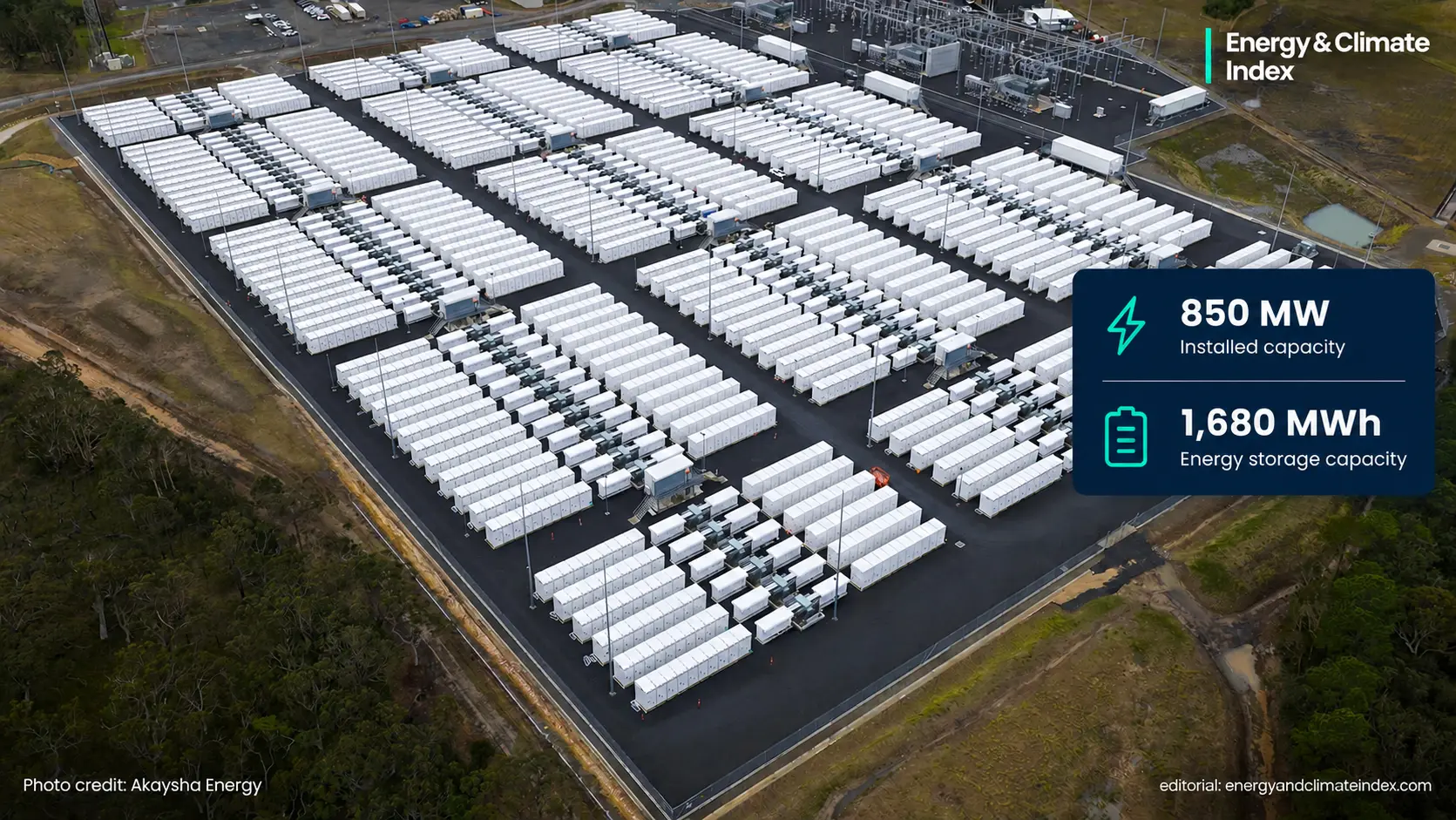
One of the world’s most powerful battery energy storage systems, the Waratah Super Battery in New South Wales, Australia, has reached full commercial operation with an installed power capacity of 850 MW and an energy storage capacity of 1,680 MWh.
Akaysha Energy announced on 28 September that the final commissioning stage had been completed, bringing the battery to its full designed capacity. The project was commissioned by the New South Wales Government, while Akaysha Energy is responsible for building, owning and operating the battery system.
Waratah was built on the site of the former Munmorah coal-fired power station, around 100 kilometres north of Sydney. The project attracted more than A$1 billion in private investment and involved approximately 1,000 people across its design and construction.


A battery acting as a “shock absorber” for the power system
Waratah was not designed solely as a conventional battery that stores electricity when prices are low and supplies it when demand is high.
It is a key component of the System Integrity Protection Scheme, or SIPS, designed to respond almost instantaneously to disturbances in the transmission network. Transgrid’s control system monitors the transmission network and can instruct the battery to inject electricity rapidly when system conditions require it.
In this way, Waratah effectively acts as a large “shock absorber” for the electricity grid, strengthening system security while allowing more renewable electricity to flow through the transmission network.
This function is particularly important for New South Wales as ageing coal-fired power stations are progressively retired and increasing volumes of wind and solar generation enter the electricity system.
From a former coal power station to one of the world’s most powerful batteries
The location of the project is itself significant: one of Australia’s largest battery systems has been developed on the site of the former Munmorah coal-fired power station.
Waratah has a nominal capacity of 850 MW / 1,680 MWh. Its role goes beyond energy arbitrage, combining large-scale storage with an automated grid-protection system capable of responding rapidly to system disturbances.
The project therefore illustrates how existing energy infrastructure sites can be repurposed as electricity systems shift from conventional thermal generation towards renewables, storage and more flexible grid infrastructure.
Batteries are becoming part of grid infrastructure
Waratah demonstrates a broader shift in the role of large-scale battery systems. BESS projects are increasingly moving beyond simply storing and trading electricity and are becoming an active component of the infrastructure used to maintain power-system stability.
In New South Wales, the combination of the battery, the automated SIPS control system and the transmission network allows existing infrastructure to be used more effectively while creating additional capacity for integrating renewable generation.
This could become one of the most important roles of large BESS projects in electricity systems with rapidly growing wind and solar capacity: not only shifting electricity from one period to another, but also providing fast system flexibility, grid security and support for higher levels of renewable energy integration.
ECI