

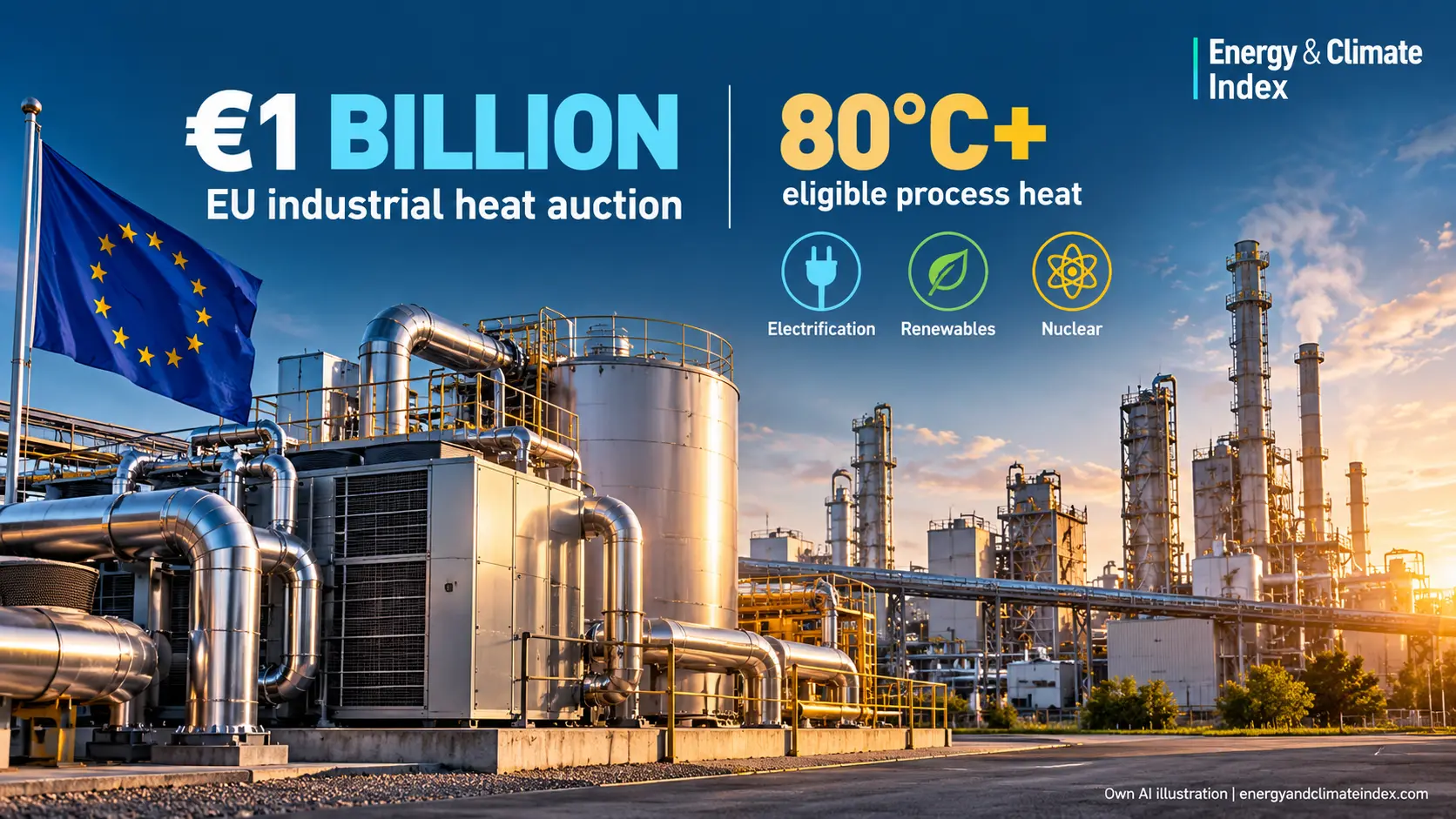
The European Commission has published the final terms and conditions for the new European auction for the decarbonisation of industrial process heat – the IF26 Heat Auction, with a planned budget of €1 billion financed through EU ETS revenues. The call is expected to open for applications in early December 2026.
The auction targets one of the most difficult segments of European industry to decarbonise. According to the European Commission, process heat production remains heavily dependent on fossil fuels and is associated with around three-quarters of industrial emissions.
Unlike traditional grants, support will be allocated through a competitive auction. Selected projects will receive a fixed premium proportional to each tonne of direct CO₂ emissions avoided, for a period of up to five years. The auction is open to projects of all sizes and industrial sectors across the European Economic Area.


From heat pumps to small modular reactors
IF26 significantly expands the range of technologies eligible for support. The first category includes electrified solutions such as industrial heat pumps, electric boilers, plasma technologies and thermal energy storage systems.
The second category covers the direct production of renewable heat, including solar thermal and geothermal energy.
A new feature of this auction is the inclusion of nuclear technologies, including small modular reactors (SMRs), for the production of industrial heat.
Process heat is essential in industries such as steel, cement, chemicals, paper, food and beverages. Many of these processes require high temperatures, making the replacement of natural gas and other fossil fuels technically and economically more complex than in other areas of the energy transition.
The Commission is also lowering the minimum eligible temperature. IF26 will support industrial heat applications above 80°C, compared with the previous auction, which was limited to projects above 100°C.
Flexibility becomes part of industrial electrification
One particularly important element is the link between industrial electrification and conditions in the electricity system.
The auction terms provide additional incentives for projects capable of flexibly managing electricity consumption and avoiding electricity use during peak-demand periods.
This is becoming increasingly important because a large-scale shift from gas to electric boilers, industrial heat pumps and electric furnaces could significantly increase electricity demand and the need for additional grid capacity.
Combining these technologies with thermal energy storage allows industry to produce and store heat when electricity is cheaper or when wind and solar PV generation is high, and use that heat later in the production process.
From a pilot auction to a €100 billion bank
The new auction follows the first European IF25 Heat Auction. It attracted 85 bids from 14 countries, requesting around €1.4 billion in support against an available budget of €1 billion. The proposed projects represented around 981 MW of electrified heat capacity.
From the first auction, 65 projects were invited to enter the grant preparation process, and the experience gained from IF25 is being used to shape the new round.
Both IF25 and IF26 have broader significance beyond the individual projects. The European Commission views them as pilot mechanisms for the future Industrial Decarbonisation Bank, through which the EU plans to mobilise €100 billion for industrial decarbonisation.
Funding for IF26 comes from EU ETS revenues, while Member States will also be able to increase the available budget through the Auction-as-a-Service mechanism.
With the new auction, the EU is effectively seeking to address three challenges simultaneously: reducing fossil fuel use in industry, accelerating electrification, and ensuring that new industrial electricity demand becomes more flexible and responsive to the needs of the power system.
ECI