

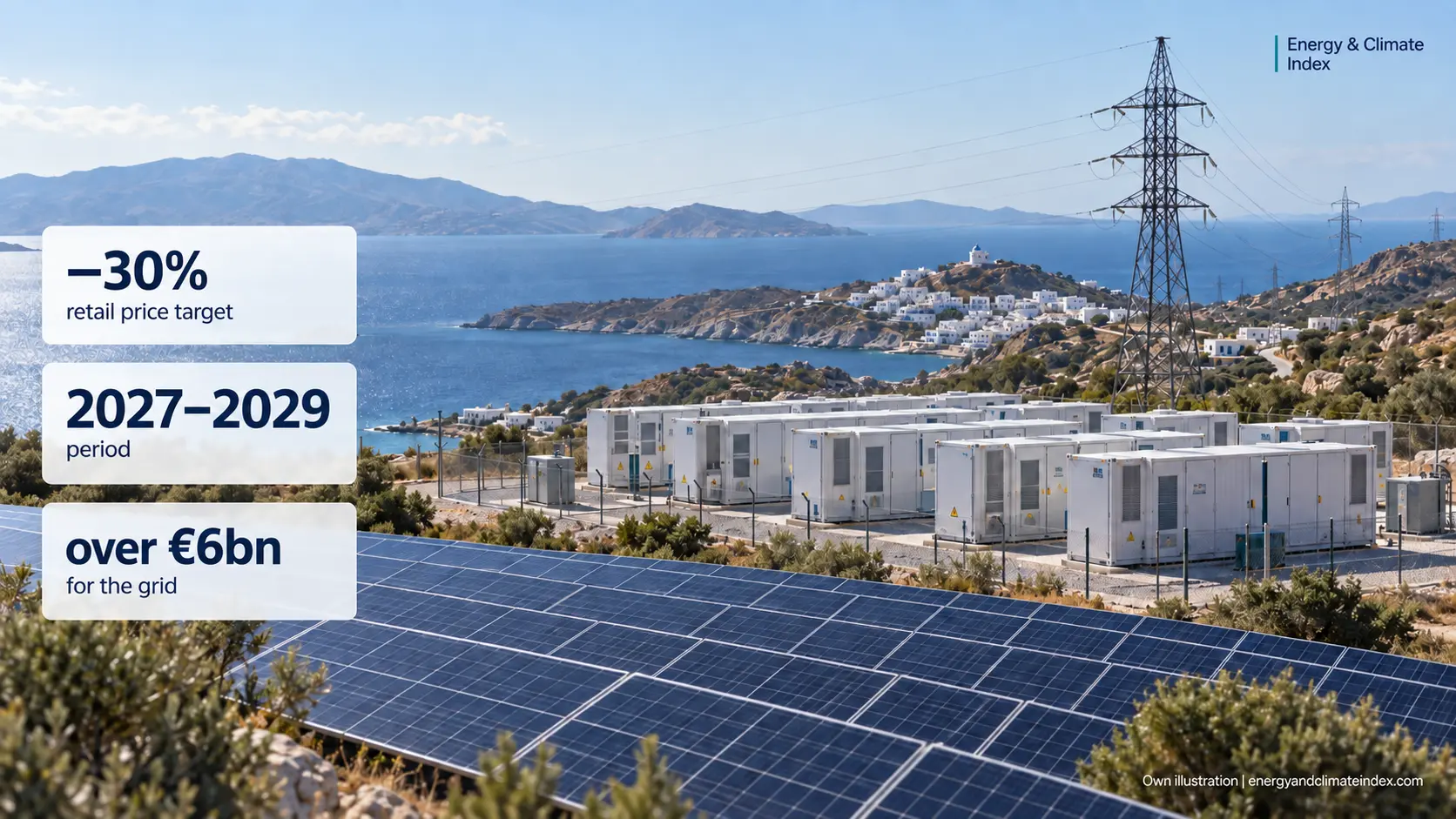
The plan relies on battery storage, more than EUR 6 billion in grid investment, island interconnections and energy-efficiency programmes
The Greek government has set a target to gradually reduce retail electricity prices by 30% between 2027 and 2029. The reduction is not designed as a one-off subsidy, but as the expected result of a broader package of investments in renewable energy, energy storage, electricity networks and lower consumption.
The target was announced by Prime Minister Kyriakos Mitsotakis at the Thessaloniki International Fair, after which the Greek government presented the detailed package. According to the official plan, the combination of cheaper domestic electricity, greater storage capacity and reduced consumption should lower both wholesale and end-user prices.
EUR 200 million for new battery projects
One of the central measures is a new EUR 200 million subsidy programme for battery energy storage systems in 2027 and 2028.


Support will cover batteries integrated with renewable energy plants, self-consumption systems and standalone battery projects. Greece has already allocated around EUR 400 million from its Recovery and Resilience Plan to batteries and pumped-storage hydropower.
The objective is to make low-cost solar and wind electricity available during periods of lower renewable generation, reducing the system’s dependence on more expensive natural gas-fired power plants.
Lower charge for six million households
From 1 January 2027, Greece will reduce the first tier of the public service obligation charge by 50% for consumption of up to 500 kWh.
The charge will fall from EUR 6.90/MWh to EUR 3.45/MWh and will apply to approximately six million residential electricity connections. The state budget will provide EUR 200 million in 2027 to support the measure.
However, this charge represents only a small part of the total electricity bill. The planned 30% reduction therefore cannot be achieved through this measure alone and will also depend on wholesale electricity market developments.
More than EUR 6 billion for electricity networks
The investment plan of Greek transmission system operator IPTO includes more than EUR 6 billion for the transmission network and island interconnections.
The interconnection of the Dodecanese islands alone is estimated at EUR 2.8 billion, while connecting the North Aegean islands will require around EUR 1.4 billion. An additional EUR 2.3 billion is planned for other grid projects.
Island interconnections should reduce the need for electricity generation from expensive oil-fired power plants, whose additional costs are currently partly covered by all consumers through their electricity bills.
ECI