

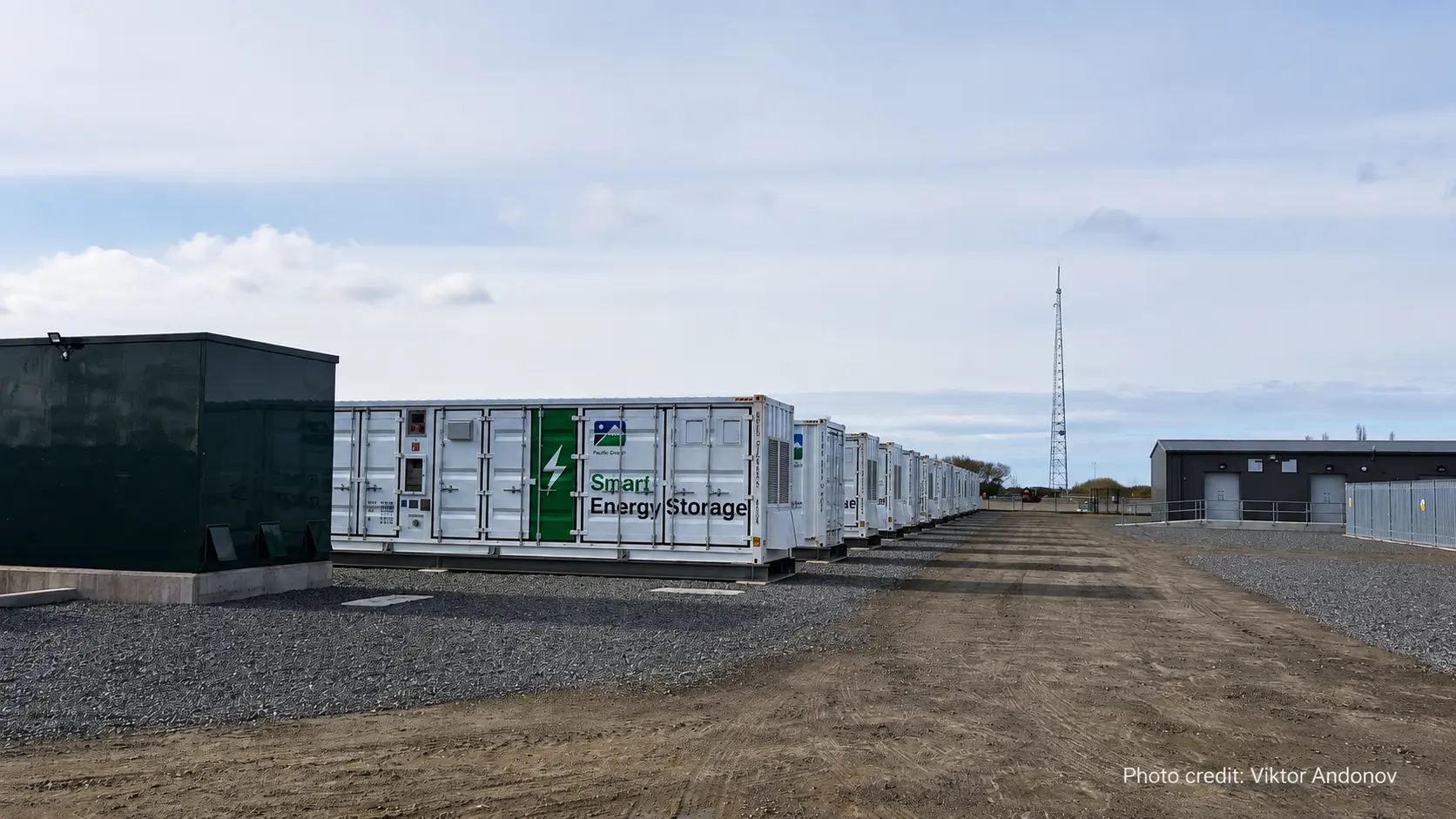
The UK government has launched a new £28 million programme to develop technologies capable of storing clean energy for more than 100 hours long enough to provide stored electricity for more than four days.
The new Ultra-Long Duration Energy Storage Challenge is part of the UK’s strategy to strengthen energy security and reduce dependence on natural gas during periods of low wind and solar generation. The programme was announced by the UK government on 20 August.
Energy stored for more than four days
Unlike battery systems that are primarily used today to cover shorter periods, the new programme is focused on technologies capable of continuously supplying electricity for at least 100 hours.


Funding will cover different technologies, including advanced batteries and underground hydrogen storage.
The aim is to store surplus low-cost electricity generated during periods of strong wind or high solar output and use it when renewable generation is low or electricity demand is high.
Reducing dependence on gas and exposure to price shocks
The UK government also links the investment to protecting consumers from future fossil fuel price shocks.
During periods of insufficient wind and solar generation, the electricity system still has to rely on more expensive sources, including natural gas-fired power plants. Long-duration storage could allow a greater share of renewable electricity already generated to be shifted from periods of surplus to periods when the system needs it most.
Particular attention is being given to underground hydrogen storage. According to estimates cited by the UK government, its deployment could reduce total UK energy system costs by between £14 billion and £50 billion between 2035 and 2050.
First £3 million for project development
As part of the programme, a competition has already been launched through Innovate UK, offering up to £3 million for feasibility studies focused on electrochemical ultra-long-duration energy storage technologies.
Projects are expected to develop solutions capable of providing at least 100 hours of continuous discharge and an operational lifetime of at least 25 years.
This represents the first phase of the programme. A second phase, expected to begin in 2027, will provide at least a further £10 million to support the development and construction of larger-scale demonstration systems.
UK opens a new market for long-duration storage
The new programme comes alongside significantly broader investment in the UK energy storage sector.
In June, Ofgem provisionally selected 16 projects for support under the UK’s cap-and-floor mechanism. Together, the projects represent 7.6 GW of power capacity and around 137 GWh of energy storage capacity, including pumped-storage hydropower, batteries, compressed-air energy storage and vanadium flow batteries.
By combining large-scale infrastructure projects with investment in technologies capable of storing energy for days, the UK is seeking to address one of the key challenges of an electricity system with a high share of renewables – how to make low-cost electricity generated today available when the system actually needs it.
ECI