

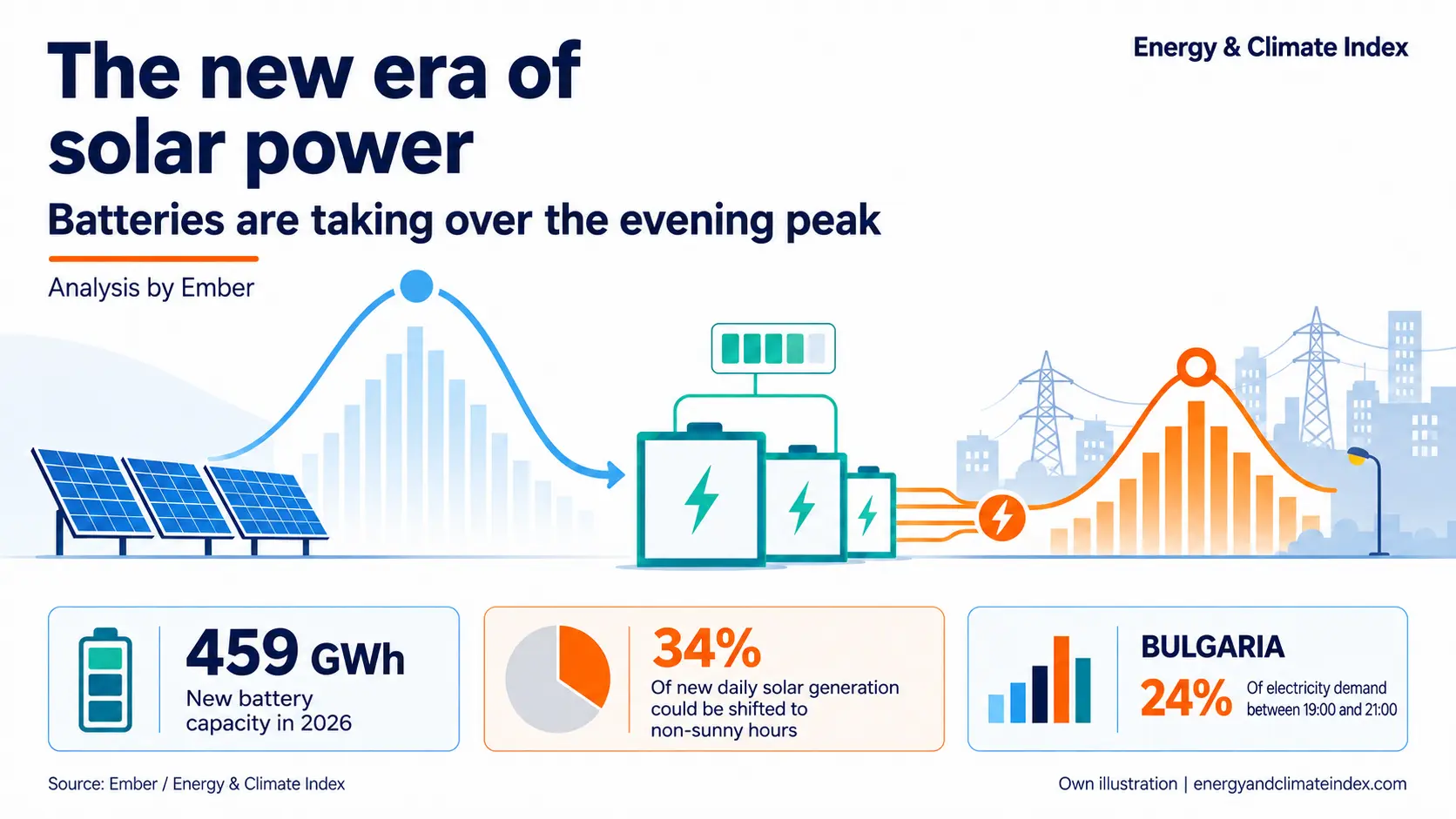
Battery storage systems are expanding fast enough to shift a significant share of solar generation from midday into the evening, according to a new global analysis by the energy think tank Ember.
Solar power supplied a record 10% of global electricity generation in the first half of 2026. Its impact was even more pronounced during the middle of the day: between 11:00 and 14:00, solar met more than a quarter of global electricity demand on average.
However, generation falls sharply after sunset, when power systems once again depend on gas, coal, hydropower and other dispatchable sources. According to Ember, the rapid deployment of batteries is beginning to fundamentally change this daily pattern.


Batteries could shift 34% of new solar generation
Around 459 GWh of new battery storage capacity is expected to be added globally in 2026, representing a 50% increase from the 307 GWh installed in 2025.
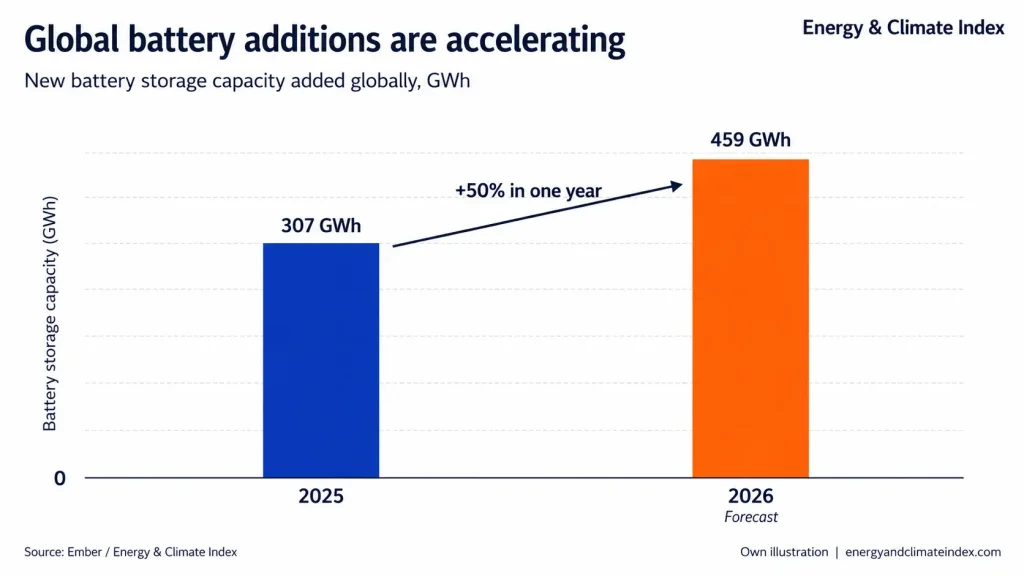
According to Ember’s calculations, new batteries could theoretically shift 34% of new daily solar generation into non-sunny hours. This proportion stood at 18% in 2025 and just 4% in 2021.
The figures show that battery deployment is gradually catching up with the expansion of solar power. Batteries do not produce additional electricity, but they change the timing and value of its delivery: they absorb low-cost electricity during periods of high solar output and return it to the system after sunset, when demand and prices usually rise.
However, the estimated 34% represents a theoretical potential. Actual utilisation depends on market rules, grid constraints, battery operating strategies and the number of daily charging cycles.
Bulgaria has become a global leader
Bulgaria’s experience is particularly important for Southeast Europe. The country added around 3 GWh of battery storage capacity in 2025, after having virtually no developed market for large-scale battery systems only a year earlier. By May 2026, its total installed capacity had increased to 8.6 GWh.
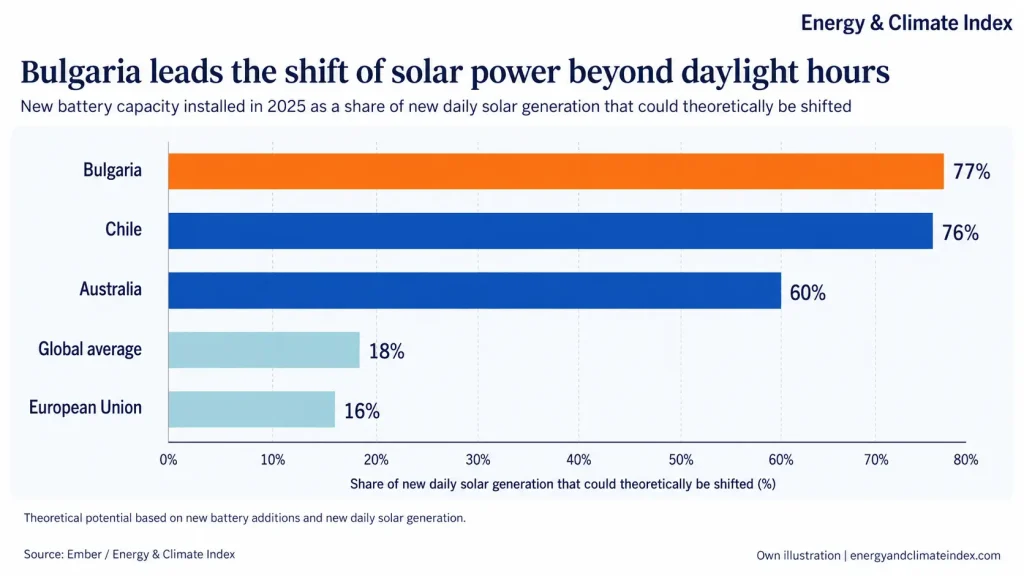
According to the analysis, the batteries installed in Bulgaria in 2025 were theoretically sufficient to shift 77% of the country’s new daily solar generation into non-sunny hours. This places Bulgaria ahead of Chile at 76% and Australia at 60%.
The transformation is already visible in the operation of Bulgaria’s electricity system. In the first half of 2023, solar power made almost no contribution to meeting evening electricity demand. By the first half of 2026, solar electricity shifted through batteries covered an average of 24% of demand between 19:00 and 21:00.
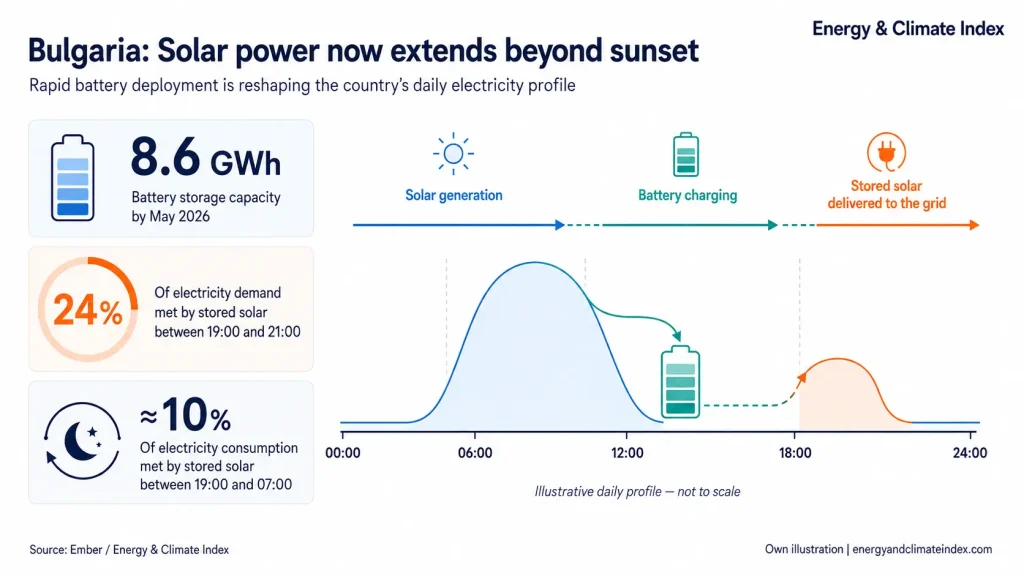
Across the broader period from 19:00 to 07:00, stored solar electricity met approximately 10% of Bulgaria’s consumption.
The European Union remains below the global average
Around 27 GWh of battery storage capacity was added across the European Union in 2025. Under Ember’s methodology, this was sufficient to shift 16% of new daily solar generation into other hours, below the global average of 18%.
The difference between Bulgaria and the EU as a whole shows that rapidly adding solar power alone is not enough. Electricity systems also require storage, flexible demand, strong interconnections and market rules that allow batteries to earn revenue from multiple services.
Short-duration battery systems still cannot provide solar electricity during every hour of the night or throughout multi-day periods of low generation. Nevertheless, their ability to cover the evening peak is already expanding the limits of solar integration and reducing the need to activate more expensive fossil-fuel power plants.
ECI