

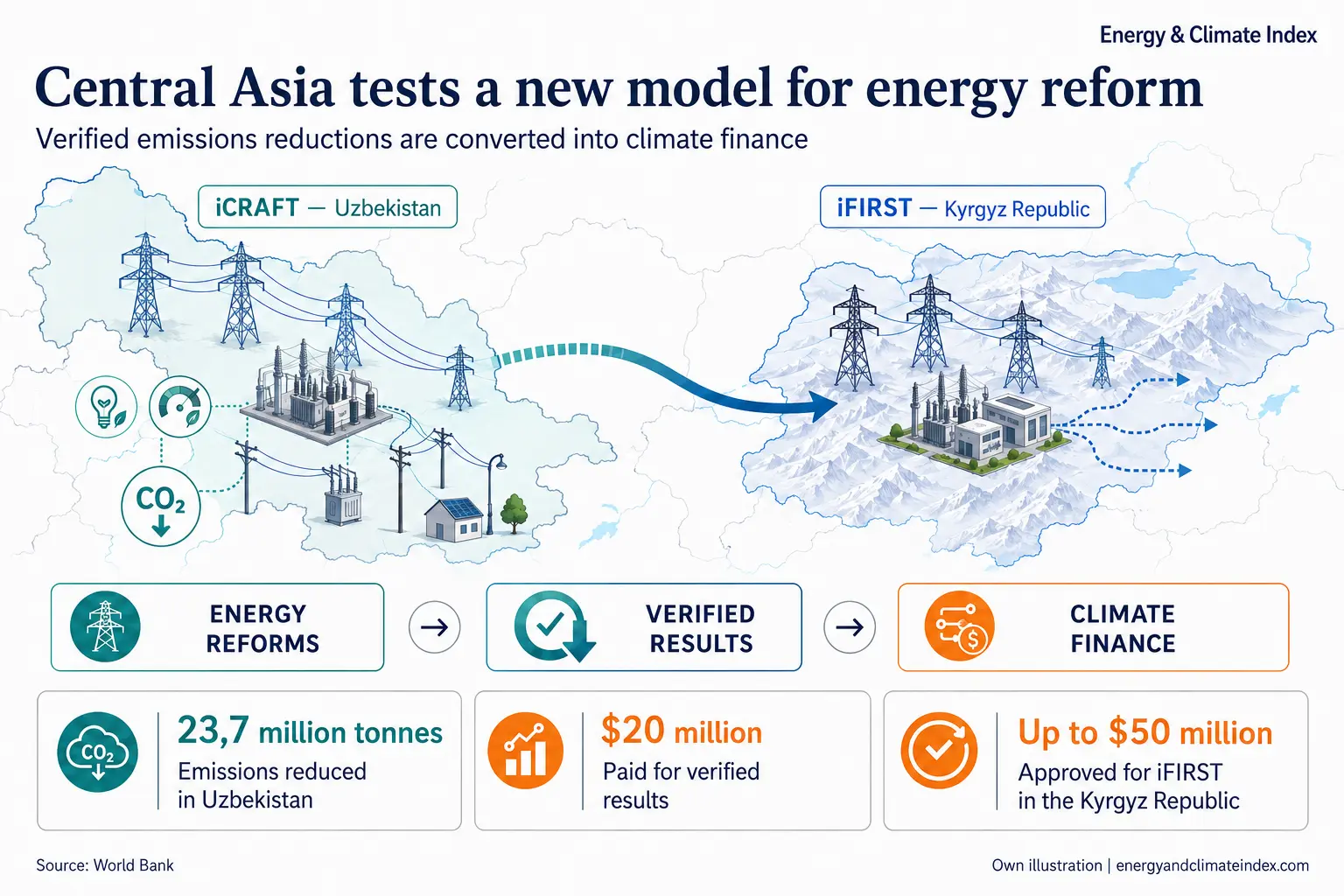
Uzbekistan and the Kyrgyz Republic are developing a model that links energy-sector reforms with measurable emissions reductions and payments through international climate finance mechanisms.
Supported by the World Bank, the approach is not limited to financing individual power plants or infrastructure projects. Instead, funding is disbursed after implemented policies are shown to have improved energy efficiency and reduced greenhouse gas emissions.
Uzbekistan receives $20 million for verified results
In 2023, Uzbekistan became the first country in the world to receive climate finance directly linked to energy policy reforms. The model is being implemented through the Innovative Carbon Resource Application for Energy Transition, or iCRAFT.


Between 2022 and 2024, reforms supported by the programme contributed to an estimated reduction of 23.7 million tonnes of greenhouse gas emissions. Based on independently measured and verified results, Uzbekistan has so far received a total of $20 million in climate and carbon finance payments.
According to the World Bank, the emissions reduction is equivalent to removing approximately 5.2 million passenger vehicles from the road for one year.
Major reform of electricity and gas prices
Uzbekistan began reforming its energy subsidies in 2022. Over the following two years, electricity prices increased by 119%, while natural gas prices rose by 90%. Adjusted for inflation, the real increases amounted to 71% for electricity and 46% for gas.
The objective is to move prices gradually towards cost-recovery levels, reduce inefficient energy consumption and provide energy utilities with more resources to maintain and modernise the system.
Alongside the reforms, the country introduced mechanisms to support vulnerable households, communicate the changes to the public and collect feedback from citizens. Uzbekistan also established an independent energy regulator.
The Kyrgyz Republic adopts the model
Following the initial results in Uzbekistan, the World Bank approved up to $50 million on 9 June 2026 for the Innovative Finance for Resilient and Sustainable Energy Transition project, or iFIRST, in the Kyrgyz Republic.
The project will support reforms aimed at encouraging more efficient electricity consumption and help the country develop the systems required to access international carbon markets. As in Uzbekistan, payments will be linked to independently verified emissions reductions.
The Kyrgyz Republic faces growing electricity demand, while historically low tariffs have limited the resources available for maintenance, modernisation and new investment. The government is therefore gradually moving tariffs closer to cost-recovery levels while maintaining targeted assistance for vulnerable consumers.
A model that could be replicated elsewhere
The iCRAFT and iFIRST programmes demonstrate how tariff reform, social protection, technical support and climate finance can be combined within a single mechanism.
Instead of receiving funding in advance based solely on planned activities, countries are rewarded for independently verified results. This gives measurable reductions in energy consumption and emissions a direct financial value.
The experience emerging from Central Asia could provide a model for other countries seeking to reform energy subsidies, improve security of supply, attract private investment and protect vulnerable households at the same time.
ECI