

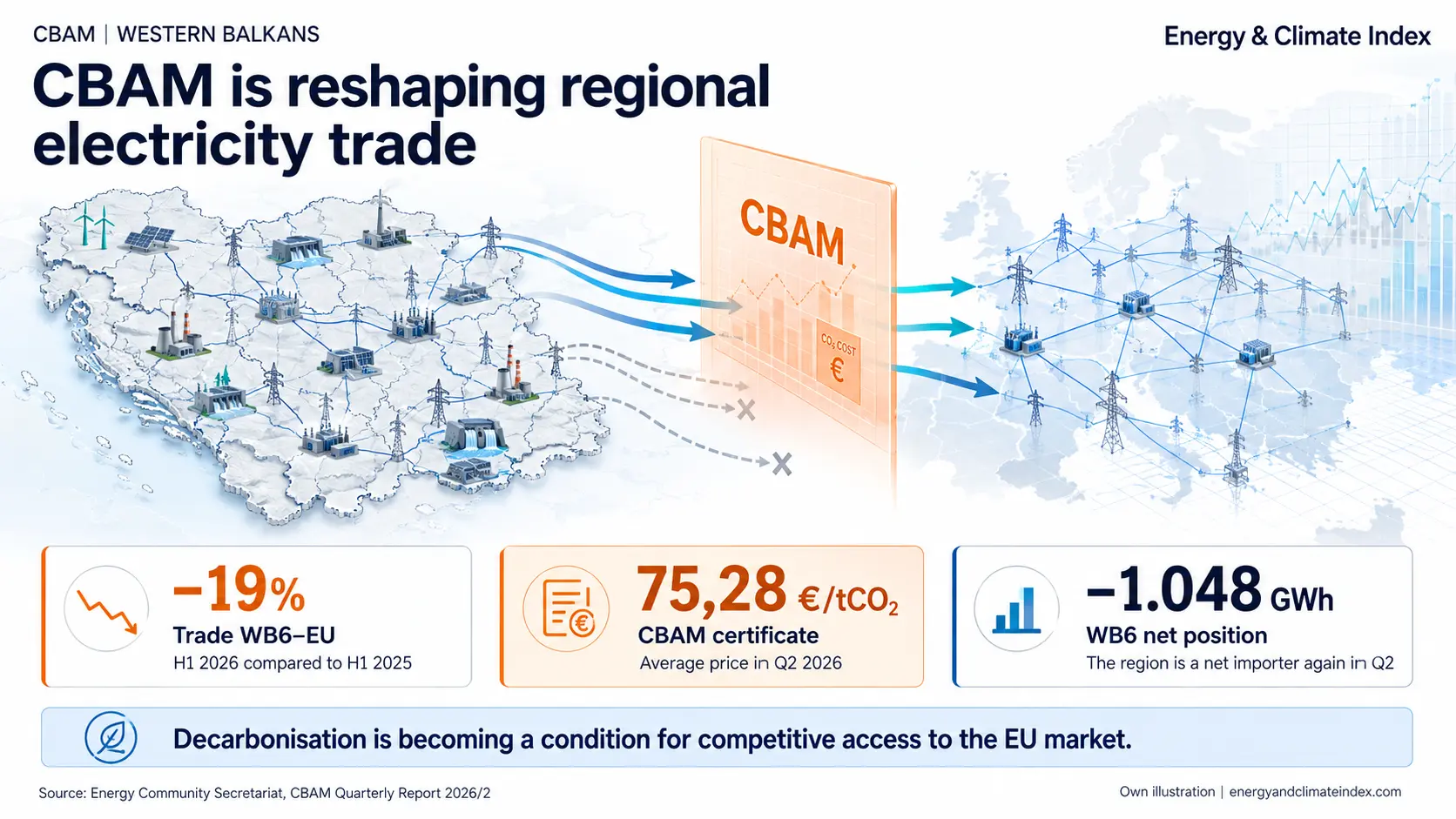
Trade with the EU fell by 19% in the first half of the year, while the region returned to a net-import position in the second quarter. This is shown by the latest quarterly report from the Energy Community Secretariat, which analyses the impact of CBAM on electricity markets and cross-border trade in the second quarter of 2026.
Electricity trade between the Western Balkans and the European Union remains below last year’s level, despite a partial easing of market pressures in the second quarter of 2026.
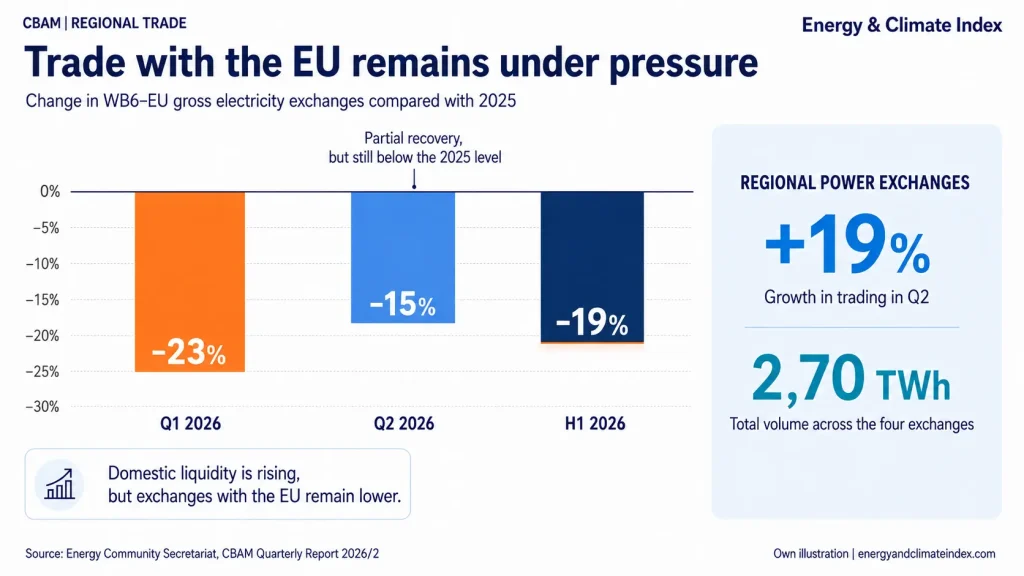
Gross WB6–EU electricity exchange in Q2 was approximately 15% lower than in the same quarter of 2025, following a 23% decline in the first three months of the year. As a result, total exchange in the first half of 2026 was down 19% year-on-year, according to the latest Energy Community Secretariat report on the impact of CBAM.


The Secretariat stresses that these developments cannot be attributed solely to the carbon mechanism. The start of CBAM’s definitive period coincided with exceptionally favourable hydrological conditions, while the Q2 market was also affected by lower EU prices, seasonal demand and stronger renewable electricity generation.
Price differences narrowed, but CBAM limits market arbitrage
Price differences between the Western Balkans and neighbouring EU markets narrowed in Q2, mainly because of falling European electricity prices.
The average price decreased to €120.9/MWh in Italy and €109.2/MWh in Hungary. By comparison, the average stood at €96.3/MWh in Serbia, €93.6/MWh in Montenegro and €91.6/MWh in North Macedonia.
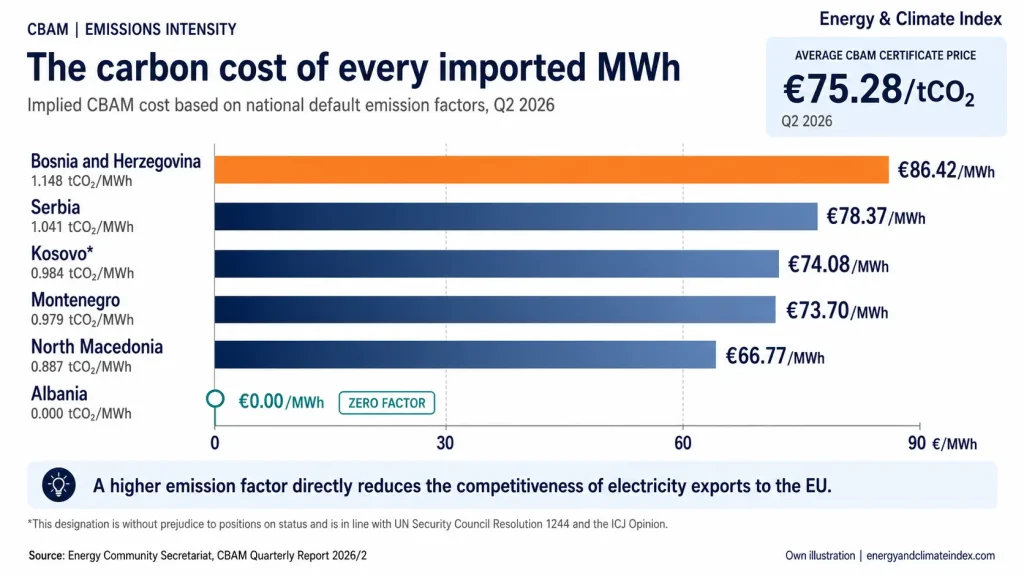
However, the price difference is often insufficient to cover the additional CBAM cost. With the average certificate price at €75.28 per tonne of CO₂, the implied cost reaches €86.42/MWh for electricity imported from Bosnia and Herzegovina, €78.37/MWh for Serbia, €73.70/MWh for Montenegro and €66.77/MWh for North Macedonia.
Albania, with a default emission factor of zero, remains the only exception in the Western Balkans.
Trade shifts towards new corridors
Following net exports of 1,247 GWh in Q1, the Western Balkans returned to a net-import position in the second quarter, recording a deficit of 1,048 GWh.
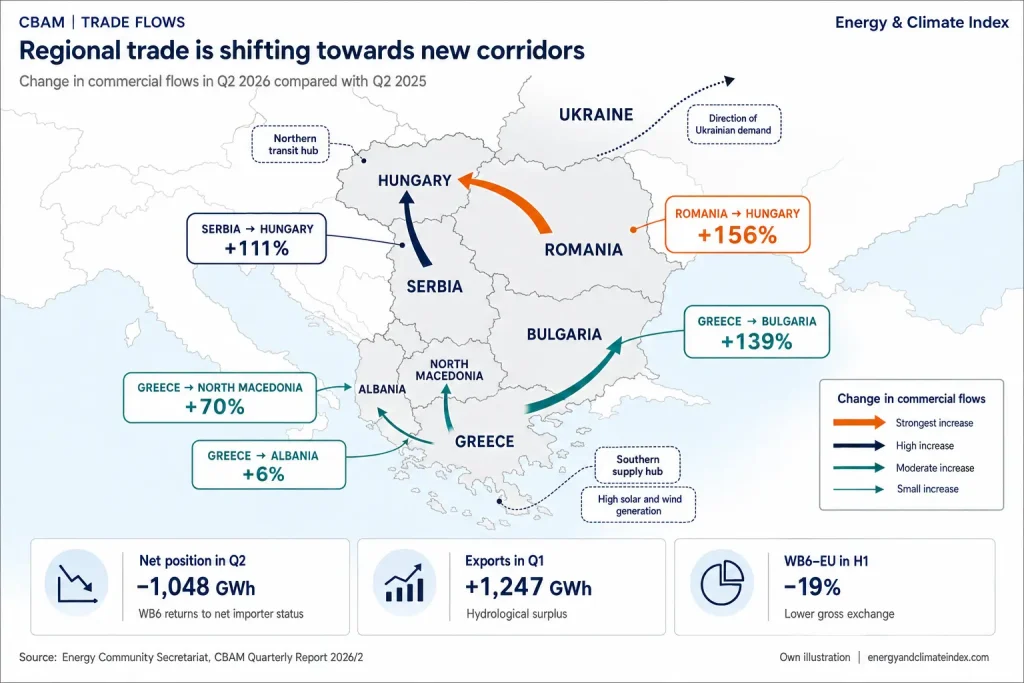
At the same time, the region’s main trading routes are changing. Commercial flows from Serbia to Hungary increased by 111% compared with Q2 2025, while flows from Romania to Hungary rose by 156%. The Secretariat links this development to electricity supplies reaching Ukraine through the Hungarian market.
Supported by high solar and wind generation, Greece strengthened its position as a southern supply hub. Its exports to Bulgaria increased by 139%, exports to North Macedonia by 70%, and exports to Albania by 6%.
Meanwhile, trading on the four Western Balkan power exchanges increased by 19% to 2.70 TWh. This indicates that domestic market liquidity is improving even as cross-border integration with the EU weakens.
Decarbonisation becomes a condition for EU market access
Coal-fired generation across the analysed region declined by 8% year-on-year in Q2 2026, while renewable generation increased by 2% and gas-fired generation by 6%.
Nevertheless, high national default emission factors continue to weaken the export competitiveness of the Western Balkans. Potential changes to the calculation methodology and more flexible conditions for demonstrating actual emissions could improve the position of renewable electricity producers.
The report concludes that it is still too early to determine whether the observed changes will become permanent. However, declining exchange with the EU, the emergence of new trading corridors and high CBAM costs already indicate that decarbonisation is becoming an economic prerequisite for competitive participation in the European electricity market.
ECI