

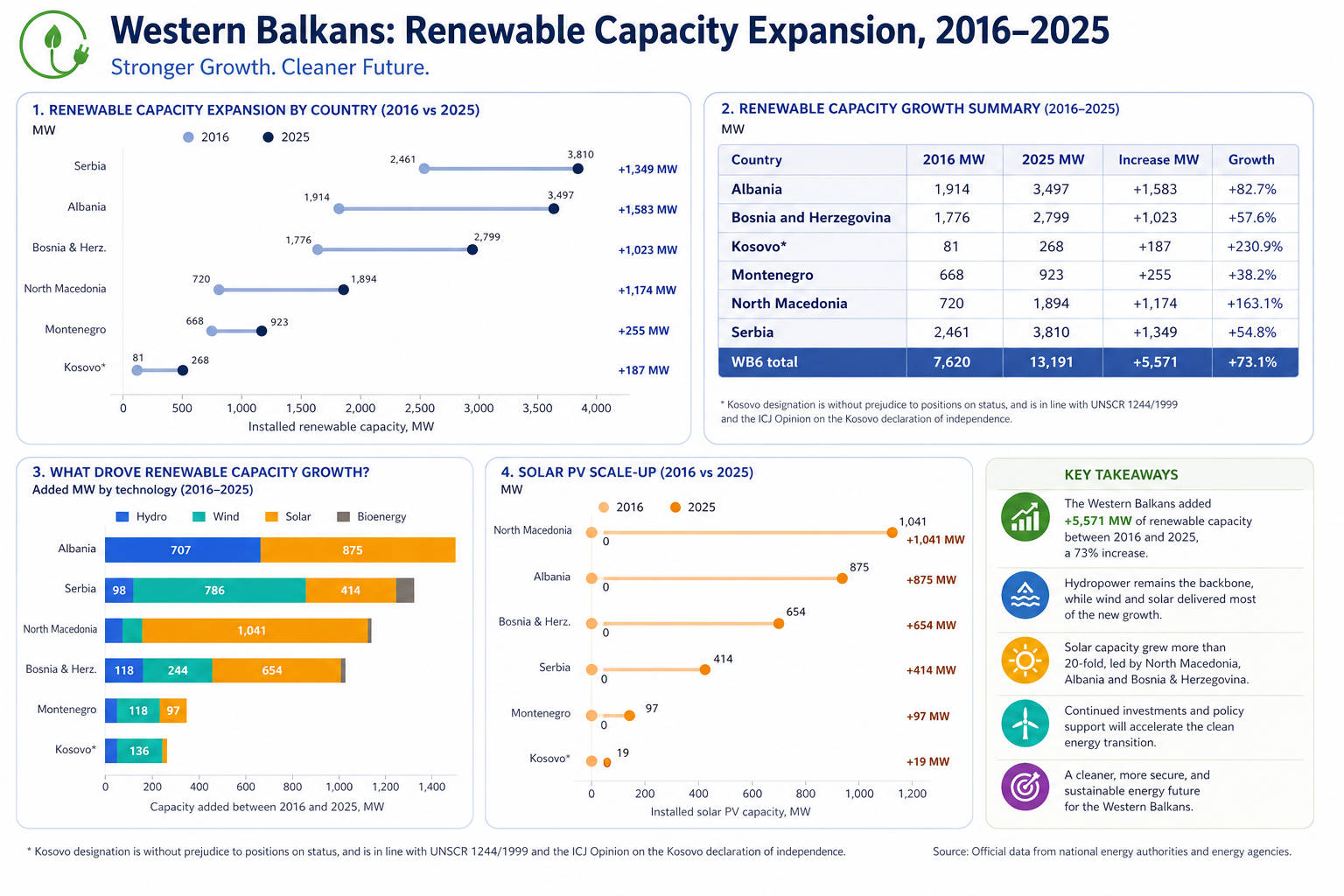
Source: International Renewable Energy Agency, Renewable Capacity Statistics 2026
1. Total Renewable Energy Capacity (2016–2025): System-Level Transformation
The evolution of renewable energy capacity across the Western Balkan Contracting Parties between 2016 and 2025 reflects astructural but asymmetric transition. The region is not starting from zero, rather, it is transitioning from an already established hydropower base toward a more diversified renewable mix.
| Country | 2016 MW | 2025 MW | Increase MW | Growth |
| Albania | 1,914 | 3,497 | +1,583 | +82.7% |
| Bosnia and Herzegovina | 1,776 | 2,799 | +1,023 | +57.6% |
| Kosovo* | 81 | 268 | +187 | +230.9% |
| Montenegro | 668 | 923 | +255 | +38.2% |
| North Macedonia | 720 | 1,894 | +1,174 | +163.1% |
| Serbia | 2,461 | 3,810 | +1,349 | +54.8% |
| WB6 total | 7,620 | 13,191 | +5,571 | +73.1% |
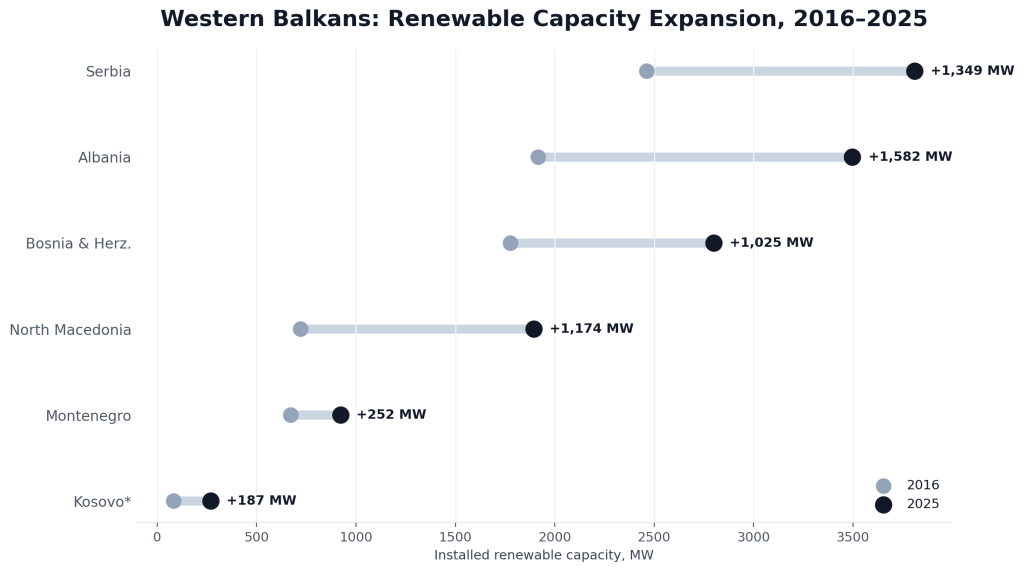
Between 2016 and 2025, total renewable capacity in the region increased by 5.6 GW, representing a 73% expansion. At first glance, this suggests a strong and successful energy transition. However, a deeper reading of the data reveals that this growth is structurally uneven and technologically concentrated.


Growth is driven by a few countries
The largest absolute increases are concentrated in:
- Albania (+1.58 GW)
- Serbia (+1.35 GW)
- North Macedonia (+1.17 GW)
This indicates that regional progress is not uniform, but rather driven by national policy frameworks, auction schemes, and investment environments.
Kosovo* shows the highest relative growth (+230%), but this is from a very low base (81 MW → 268 MW). This is a typical feature of early-stage systems:
👉 high percentage growth, limited system impact
Hydropower still dominates the system
Despite the rapid increase in capacity, the structural backbone of renewable energy remains hydropower in all countries except where solar is rapidly catching up (notably North Macedonia).
The IRENA data show strong growth in installed renewable capacity between 2016 and 2025, especially solar and wind. However, installed capacity is only one side of the story. To assess whether the energy transition is actually reducing dependence on fossil generation, the analysis must also examine electricity production by fuel.
This distinction is critical for the Western Balkans because several Contracting Parties still operate large thermal power plants. Serbia, Bosnia and Herzegovina, Kosovo*, North Macedonia and Montenegro all have significant coal or lignite-based generation assets. Therefore, the correct question is not only whether RES capacity increased, but whether thermal electricity generation declined in parallel.
The transition is accelerating after 2020
Although the table shows only 2016 and 2025 endpoints, the magnitude of increases especially in solar indicates that most of the expansion occurred in the post-2020 period, driven by:
- energy price shocks (2021–2022),
- EU alignment pressures,
- improved regulatory frameworks.
2. Development by Renewable Energy Technology: Country-Level Structural Shifts
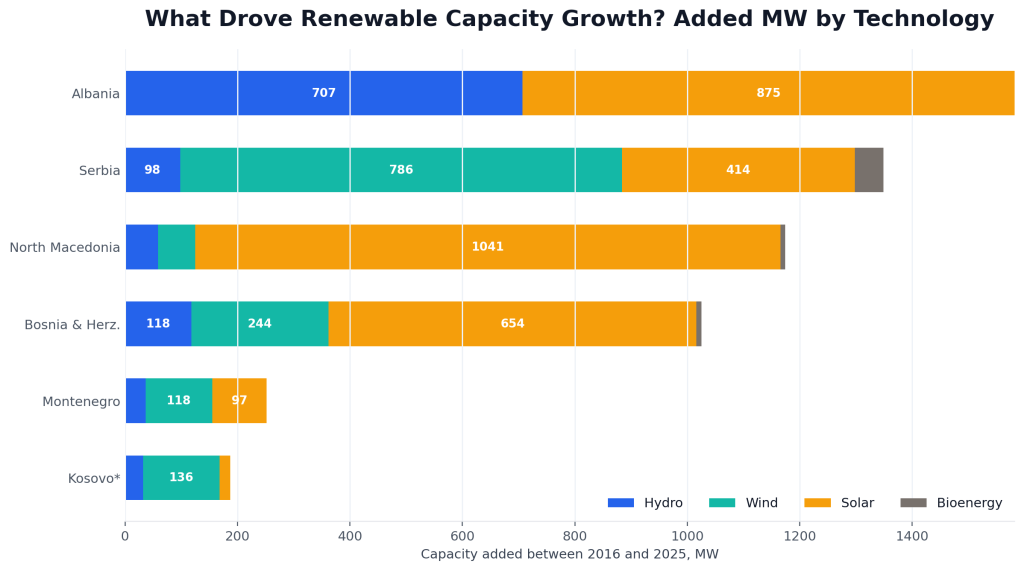
The real transformation becomes visible when disaggregating total capacity by technology. This reveals how each country is transitioning, not just how much.
Albania: From Hydro Dependence to Solar Diversification
| Technology | 2016 MW | 2025 MW | Increase |
| Renewable hydropower | 1,913 | 2,620 | +707 |
| Wind | 0 | 0 | 0 |
| Solar | 1 | 876 | +875 |
| Energy from biomass or biogas | 1 | 1 | 0 |
Albania represents a classic case of hydro-dominated systems entering solar expansion.
- In 2016, the system was almost entirely hydropower-based.
- By 2025, solar reached 876 MW, nearly matching the increase in hydro.
👉 This indicates a strategic diversification, reducing vulnerability to:
- hydrological variability,
- climate-related risks.
However, the absence of wind suggests limited technological diversification beyond solar.
Bosnia and Herzegovina: Late but Rapid Solar Entry
| Technology | 2016 MW | 2025 MW | Increase |
| Renewable hydropower | 1,760 | 1,878 | +118 |
| Wind | 0 | 244 | +244 |
| Solar | 14 | 668 | +654 |
| Energy from biomass or biogas | 1 | 10 | +9 |
Bosnia and Herzegovina show a delayed but accelerated transition phase:
- Hydropower remains dominant, with only marginal increase (+118 MW)
- Solar expanded dramatically: 14 MW → 668 MW
- Wind emerged from zero to 244 MW
This suggests:
- regulatory unlocking after 2020,
- strong investor entry in a short time frame.
However, this rapid expansion of renewable capacity has not yet been accompanied by a structural decline in coal-based electricity generation. Bosnia and Herzegovina continues to rely on lignite and coal-fired power plants as a central pillar of its electricity system, both for domestic supply and exports. Despite the increase in solar and wind capacity, thermal generation remains a key contributor to total electricity production.
This creates a dual structure in the power system:
- on one side, a rapidly expanding segment of solar and wind capacity, driven by recent investment and regulatory changes
- on the other, a persistent reliance on coal-based generation, which continues to play a stabilizing and export-oriented role
👉 Key implication:
The transition in Bosnia and Herzegovina is best understood as an early-stage shift, where renewable capacity is expanding and starting to affect the generation mix, but has not yet fundamentally displaced coal-based production.
Kosovo*: Wind-Led Transition in a Coal System
| Technology | 2016 MW | 2025 MW | Increase |
| Renewable hydropower | 78 | 110 | +32 |
| Wind | 1 | 137 | +136 |
| Solar | 2 | 21 | +19 |
| Energy from biomass or biogas | 0 | 0 | 0 |
Kosovo’s* development is structurally different:
- Growth is primarily wind-driven, not solar
- Solar remains marginal (21 MW)
However, the expansion of renewable capacity in Kosovo remains limited in scale and has not yet translated into a meaningful reduction in coal-based electricity generation.
Kosovo* continues to rely almost entirely on lignite-fired power plants as the backbone of its electricity system. While wind capacity has increased significantly between 2016 and 2025, and solar is beginning to emerge, the overall renewable base remains too small to substantially influence the generation structure.
👉 Key implication:
The transition in Kosovo is best understood as an initial diversification phase, where renewable capacity is being introduced, but the system remains structurally dominated by coal.
Montenegro: Gradual Diversification
| Technology | 2016 MW | 2025 MW | Increase |
| Renewable hydropower | 668 | 705 | +37 |
| Wind | 0 | 118 | +118 |
| Solar | 3 | 100 | +97 |
| Energy from biomass or biogas | 0 | 0 | 0 |
Montenegro follows a controlled diversification pathway:
- Hydropower remains dominant with minimal expansion
- Wind and solar are growing but still secondary
However, the expansion of renewable capacity in Montenegro does not fully eliminate the role of thermal generation in the electricity system.
Montenegro’s renewable portfolio remains dominated by hydropower, with increasing contributions from wind and solar since 2016. At the same time, the Pljevlja thermal power plant continues to play a critical role in ensuring security of supply, particularly during periods of low hydropower output.
While the growth of wind and solar capacity contributes to a more diversified generation mix, the overall system still relies on thermal generation as a balancing and reliability component.
👉 Key implication:
The transition in Montenegro is best understood as a gradual diversification process, where renewable capacity is expanding and reducing dependence on hydrological conditions, but without fully displacing thermal generation.
North Macedonia: Solar-Led Structural Shift
| Technology | 2016 MW | 2025 MW | Increase |
| Renewable hydropower | 661 | 720 | +59 |
| Wind | 37 | 103 | +66 |
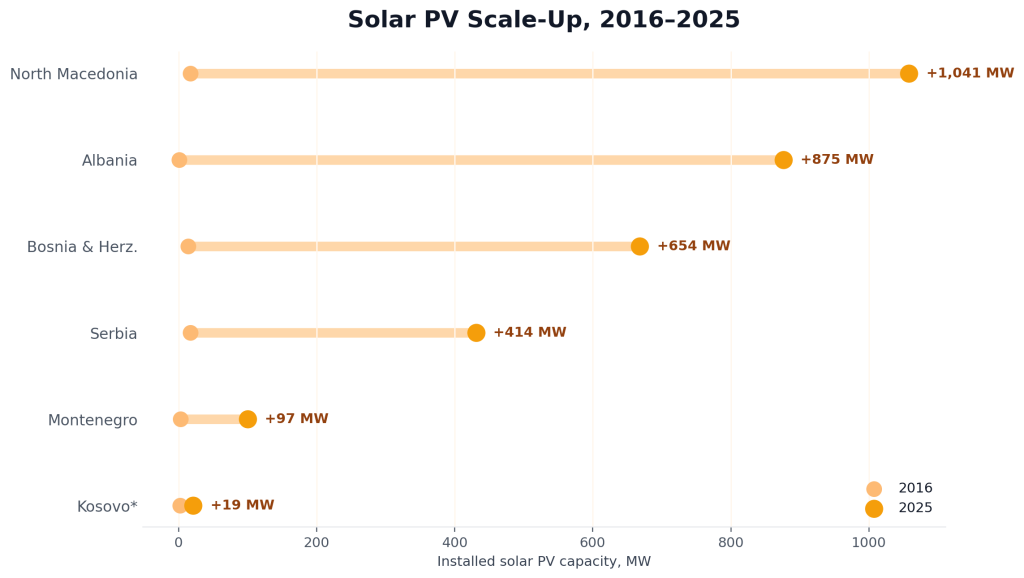
| Solar | 17 | 1,058 | +1,041 |
| Energy from biomass or biogas | 5 | 13 | +8 |
North Macedonia represents the most profound transformation in the region:
- Solar increased by over 1 GW
- It has become the dominant source of new renewable capacity
However, in contrast to other Western Balkan Contracting Parties, the expansion of renewable capacity in North Macedonia is increasingly reflected in changes in the generation structure.
North Macedonia has experienced the most significant growth in solar capacity in the region between 2016 and 2025, exceeding 1 GW of installed PV. At the same time, the role of lignite-based generation has weakened compared to previous years, due to a combination of ageing thermal units, reduced operational reliability, and structural constraints in domestic coal production.
Historically, it was common to characterize North Macedonia’s electricity system as being heavily dependent on lignite, with around 80% of domestic generation originating from coal-fired power plants; however, this is no longer the case, as recent data indicate that lignite-based generation now accounts for only around 40% of total domestic electricity production.
While thermal power plants remain part of the system, their role is becoming less dominant, with renewable generation particularly solar playing an increasingly important role in the overall electricity mix.
👉 Key implication:
North Macedonia represents the most advanced case of transition in the region, where renewable capacity expansion is beginning to translate into a partial structural shift away from coal-based generation.
Serbia: Balanced Multi-Technology Growth
| Technology | 2016 MW | 2025 MW | Increase |
| Renewable hydropower | 2,416 | 2,514 | +98 |
| Wind | 17 | 803 | +786 |
| Solar | 17 | 431 | +414 |
| Energy from biomass or biogas | 11 | 62 | +51 |
Serbia shows the most balanced renewable expansion:
- Wind is the dominant growth driver (+786 MW)
- Solar follows (+414 MW)
- Bioenergy also contributes
👉 This indicates:
- diversified policy support,
- stronger system integration capability,
- more mature market structure.
However, the expansion of renewable capacity in Serbia has not yet translated into a structural reduction in coal-based electricity generation.
Serbia has recorded significant growth in renewable capacity between 2016 and 2025, particularly through wind and, more recently, solar. This expansion has contributed to a more diversified generation portfolio and increased the share of variable renewable energy in the system.
At the same time, lignite-fired power plants continue to provide the majority of domestic electricity generation and remain the backbone of the power system, particularly for baseload supply. The role of thermal generation has therefore remained largely stable, despite the increase in renewable capacity.
👉 Key implication:
The transition in Serbia is best understood as a diversification of the generation mix, where renewable energy is expanding and gaining importance, but without yet fundamentally displacing coal-based generation.
Across the Western Balkan Contracting Parties, the period 2016–2025 marks a transition from static renewable systems to dynamic expansion, but with clear structural patterns:
1. Hydropower remains the foundation
All countries retain hydro as the core of installed RES capacity.
2. Solar is the dominant growth driver
Except in Kosovo* (wind-led) and Serbia (balanced), solar accounts for the largest capacity additions.
3. Transition pathways differ significantly
- Solar-led systems: North Macedonia, Albania
- Balanced growth: Serbia
- Hydro-dominant with late solar surge: Bosnia and Herzegovina, Montenegro
- Wind-led early transition: Kosovo*
Most capacity additions are concentrated in the last 3–5 years, indicating:
- policy acceleration,
- strong investment cycles,
- emerging system stress potential.
Concluding insight
The data demonstrate that the Western Balkans are no longer in an early renewable adoption phase, but have entered a rapid expansion phase driven primarily by solar and wind.
However, the heterogeneity of national pathways suggests that the region is not converging toward a single model, but rather evolving into multiple transition models, each with distinct system and market implications.
Viktor Andonov, M.Sc in electrical engineering
Former energy advisor to the Prime Minister of the Government of Republic of North Macedonia