

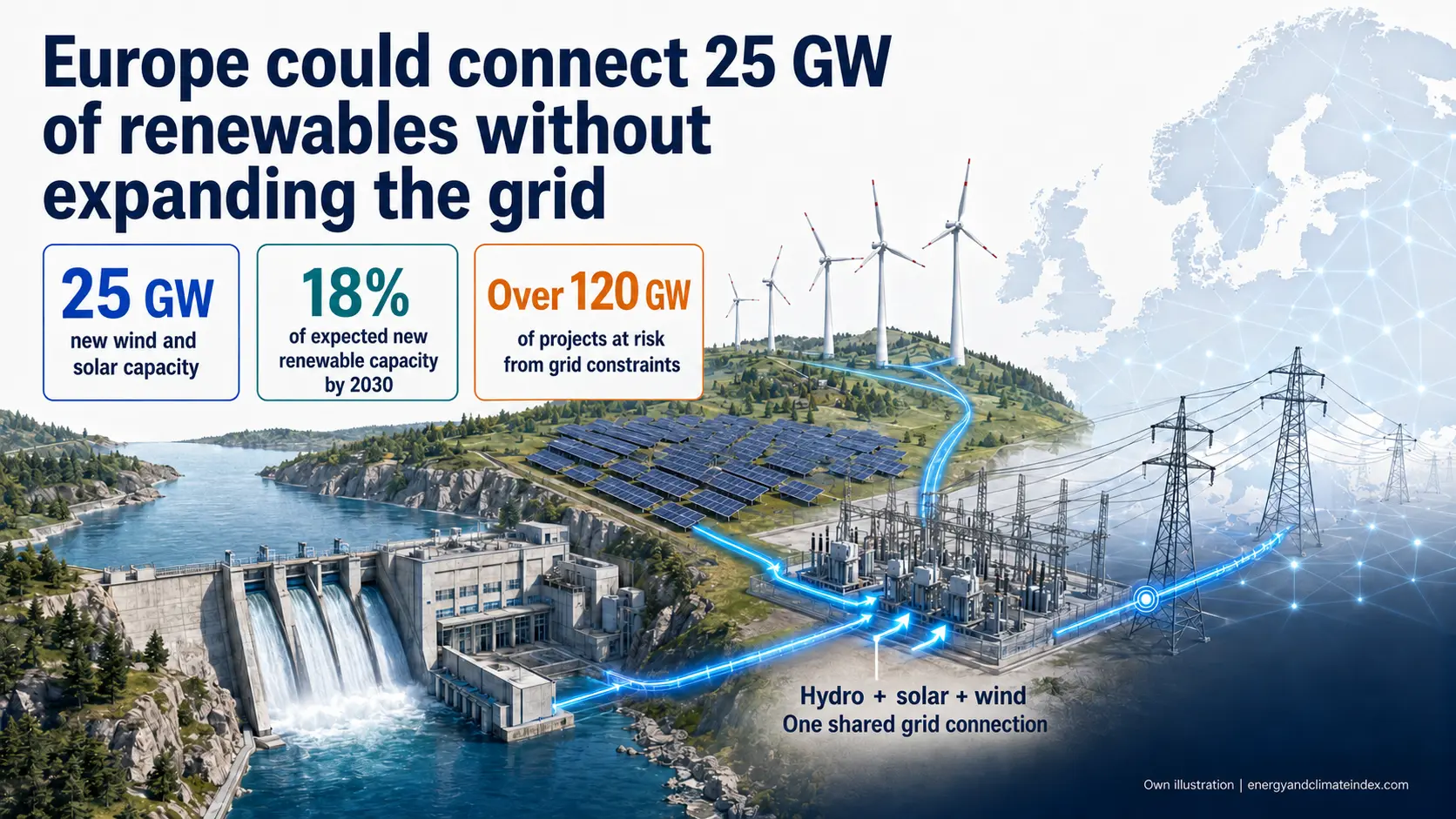
Europe could integrate an additional 25 GW of wind and solar capacity without building new grid capacity by sharing the existing grid connections of hydropower plants, according to an analysis by energy think tank Ember, reported by Euronews.
The proposed solution is based on hybridization, with combining different generation technologies, such as hydropower, solar, wind and battery storage, behind a single connection point to the electricity grid.
This approach could allow new wind and solar power plants to become operational faster while improving the utilisation of existing grid infrastructure.


More than 120 GW of projects face grid constraints
Europe’s electricity grid is struggling to keep pace with the rapid development of renewable energy. It was originally designed for a centralised system in which electricity generation was largely supplied by major coal-fired power plants.
According to previous Ember estimates, more than 120 GW of planned renewable energy projects are at risk due to grid bottlenecks and insufficient capacity.
These constraints do not affect only new projects. The output of existing wind and solar power plants is also curtailed during certain periods because the grid cannot absorb all the electricity they produce.
At the same time, solar and wind generation depends on weather conditions and does not always coincide with changes in electricity demand. As a result, part of the available clean electricity remains unused.
Hydropower plants as the basis for hybrid projects
Ember says hydropower plants are particularly well suited to hybridisation because much of their grid connection capacity remains underused during the day.
Hydropower plants can rapidly adjust their output to the needs of the electricity system. When solar and wind generation is high, they can operate at reduced capacity. Hydropower output can then be increased during the morning and evening, when electricity demand is typically higher.
By connecting a solar or wind power plant at the same grid connection point, the different sources can share the available capacity without exceeding the maximum permitted export limit.
According to Ember, this approach could, on average, double the utilisation of existing grid connection infrastructure.
Seven countries could integrate an additional 25 GW
The analysis covers Austria, Bulgaria, France, Italy, Portugal, Romania and Spain – countries with significant hydropower capacity.
Across these seven countries, hybridisation could enable the integration of 25 GW of new wind and solar capacity without requiring additional grid capacity.
This potential represents around 18% of the new renewable energy capacity expected to be installed in the analysed countries by 2030.
This does not mean the projects would require no investment or technical intervention. The key advantage is that their connection would not depend on the prior construction of additional transmission capacity, which generally takes considerably longer to deliver.
Regulation remains the main obstacle
Although the technical solution is already available, its implementation depends on national rules governing grid connections and electricity system operation.
Of the seven countries analysed, only Portugal and Spain have specific rules for hybrid energy projects. The other countries still lack sufficiently clear regulatory frameworks.
Ember is calling for national legislation covering hybrid projects, as well as faster prioritization within grid connection procedures. This could allow part of the planned renewable capacity to be developed without waiting for long-term grid expansion projects to be completed.
Hybridisation does not eliminate the need for new transmission lines, battery storage systems and the broader modernisation of Europe’s electricity infrastructure. However, it offers an immediate way to use the existing grid more efficiently and reduce the number of renewable energy projects stranded in connection queues.
Source: Euronews
ECI