

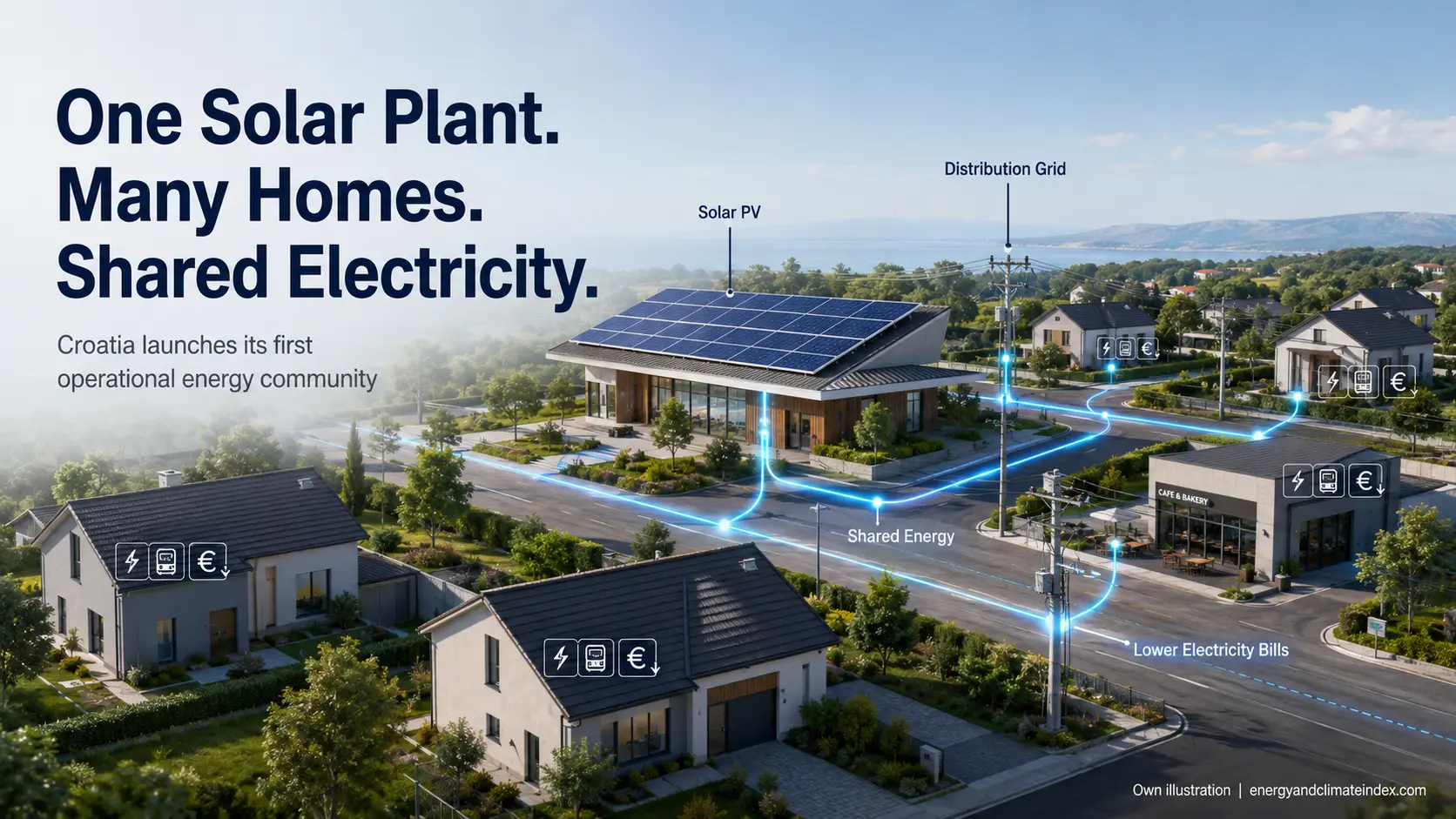
Croatia has taken an important step toward a more decentralized electricity system. In Špičkovina, near the town of Zabok, the country’s first operational energy community has officially started sharing electricity generated by a jointly owned solar power plant. The project was developed by the North-West Croatia Regional Energy and Climate Agency (REGEA) as part of the European SHAREs project.
The solar power plant, with an installed capacity of 64 kW, has been installed on the roof of the local Volunteer Fire Department (DVD) building in Špičkovina. The energy community currently consists of 17 members, including households, a small business owner and the volunteer fire department itself.
Electricity generation began on 1 June, while the official electricity-sharing scheme became operational in July, allowing members to directly benefit from lower electricity bills through a regulated energy-sharing mechanism.


What does electricity sharing actually mean?
Unlike the traditional model, where each household installs its own rooftop photovoltaic system, members of an energy community jointly invest in a single solar power plant and share the electricity it generates.
The electricity is physically fed into the distribution grid, while each member receives their allocated share through the supplier’s settlement system. This allocated electricity is then reflected as a reduction in the member’s electricity consumption and monthly bill.
Several years from concept to implementation
Although Croatia had already transposed the European framework for energy communities into national legislation, the technical, administrative and settlement mechanisms needed for electricity sharing had not previously been implemented in full.
“The European Union recognizes energy communities as one of the key instruments of a just energy transition. The idea is simple: citizens jointly produce, share and use renewable energy, reducing costs and increasing their independence from external suppliers. Croatia transposed this framework into national legislation, but until Špičkovina, no one had implemented it fully,” said REGEA Director Julije Domac.
The Špičkovina project is therefore significant not only because of the solar power plant itself, but because it demonstrates that electricity generated at one location can be formally allocated and shared among several members through the electricity system. According to REGEA, the allocation is carried out using a predefined static sharing key.
A model expected to expand across Croatia
The project was implemented through cooperation between REGEA, the City of Zabok and the European SHAREs project.
From the outset, the initiative was designed as a pilot model that could be replicated in other Croatian cities and municipalities, including Karlovac and Samobor, supporting the wider deployment of citizen-led renewable energy projects.
Why is this important for North Macedonia?
North Macedonia’s new Renewable Energy Sources Law also introduces the legal framework for energy communities and electricity sharing.
Croatia’s experience demonstrates that adopting legislation is only the first step. The real challenge lies in establishing operational market rules, settlement mechanisms and technical systems that allow citizens to share electricity and directly benefit from joint investments in renewable energy projects.
ECI