

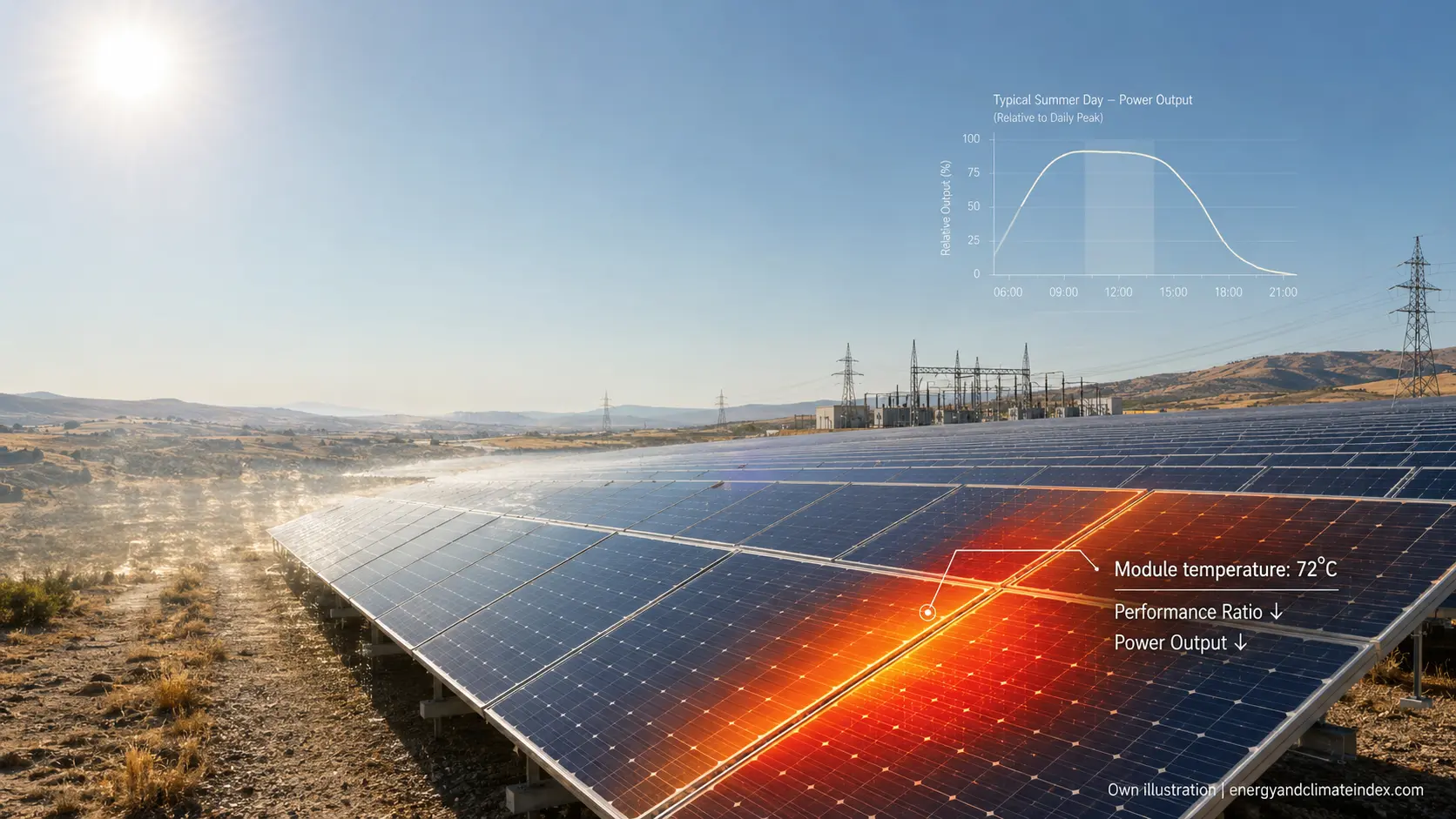
A new scientific study shows that heatwaves affect not only electricity demand but also the performance of photovoltaic power plants. Despite intense solar radiation, extreme temperatures can significantly reduce their performance during the hottest hours of the day.
The study, Analysis of Photovoltaic Power Plant Resilience under Iberian Heatwaves, published in the International Journal of Climate Change Strategies and Management, analyzes real operational data from three photovoltaic power plants on the Iberian Peninsula during four heatwaves in 2024 and 2025.
The researchers compared the actual performance of the plants with expected generation based on PVsyst simulations and ERA5-Land meteorological data.


The largest losses occur during the hottest hours
The analysis found that the most extreme case was recorded at the Amibil photovoltaic plant in Spain, where the performance ratio (PR) temporarily declined by 90.4% during the 2024 heatwave.
However, the study emphasizes that these extreme reductions were short-lived and do not imply that daily electricity generation falls by the same magnitude.
The largest daily generation loss was observed at the Zebro photovoltaic plant in Portugal during the 2025 heatwave, when electricity production was 17.6% lower than expected.
Climate change is creating new challenges for solar energy
The authors explain that although heatwaves are typically associated with strong solar irradiance, elevated module temperatures reduce the electrical efficiency of photovoltaic panels. In addition, under extreme conditions, inverter protection mechanisms may be activated, further limiting electricity output during the hottest part of the day.
The researchers conclude that as heatwaves become more frequent and more intense, operators and investors will need to place greater emphasis on the resilience of photovoltaic systems.
This includes selecting more heat-resistant equipment, deploying more advanced control systems, and using forecasting models that account for extreme weather conditions rather than relying solely on long-term average climate data.
The study highlights that climate change will not only affect hydropower generation and electricity demand, but will increasingly become a key consideration in the planning, design, and operation of solar power plants.
ECI