

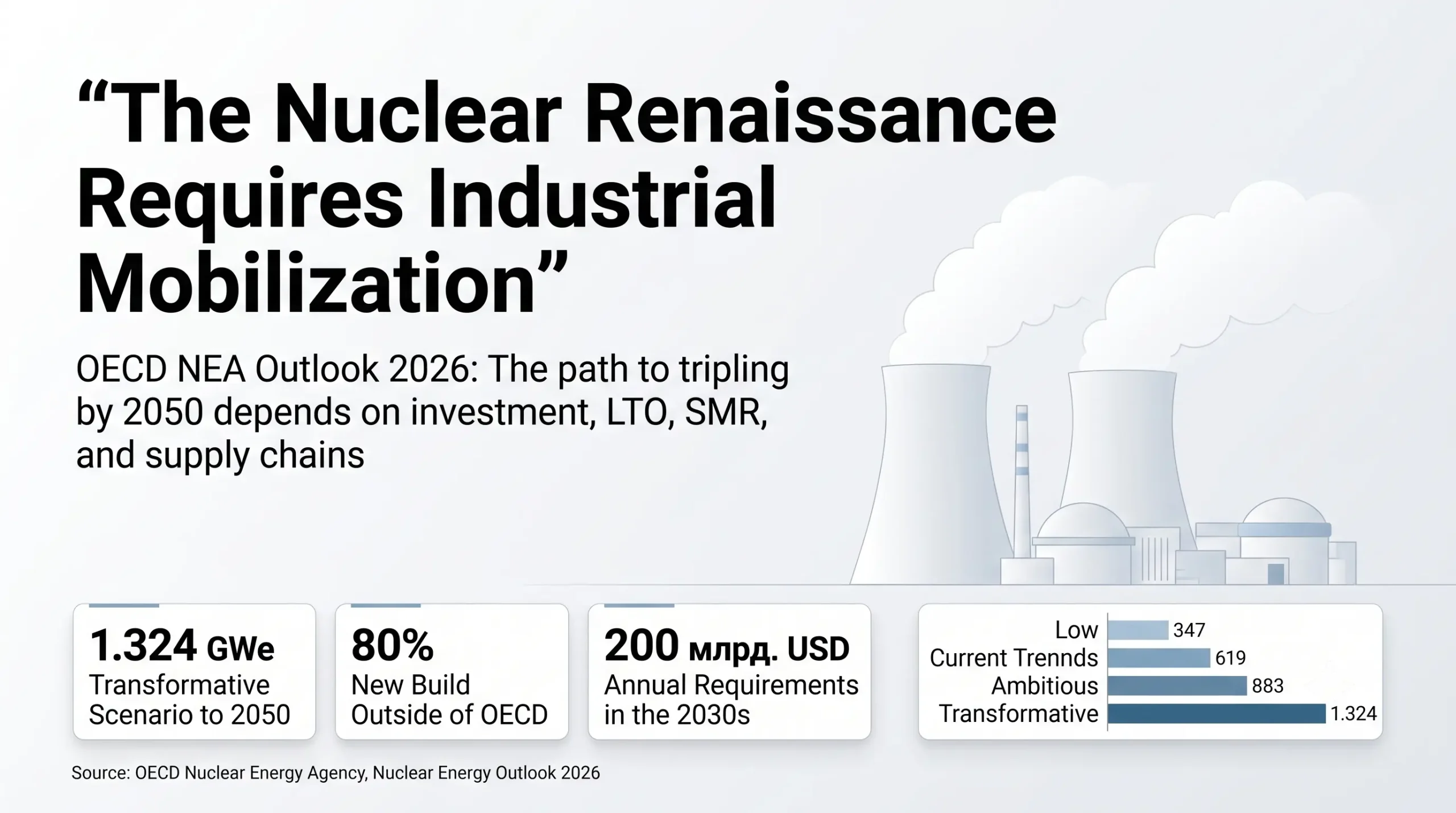
Тhe new nuclear energy outlook by the OECD Nuclear Energy Agency shows that ambition exists, but delivery remains the biggest challenge
Global nuclear capacity could more than triple by 2050, but only if countries move quickly to overcome the main industrial, financial and regulatory barriers.
This is one of the key messages from the new report Nuclear Energy Outlook: Global Installed Capacity to 2050 and Beyond by the OECD Nuclear Energy Agency (NEA).
The report comes at a time when nuclear energy is returning to the centre of global energy policy. The reasons are clear: energy security, decarbonisation, rising electricity demand, the growth of artificial intelligence and the need for stable low-carbon power that can operate regardless of weather conditions.


Four scenarios for the future of nuclear energy
NEA analyses four possible scenarios for the development of global nuclear capacity by 2050. In the low scenario, the world would reach only 347 GWe, as the retirement of existing reactors would reduce the impact of new projects.
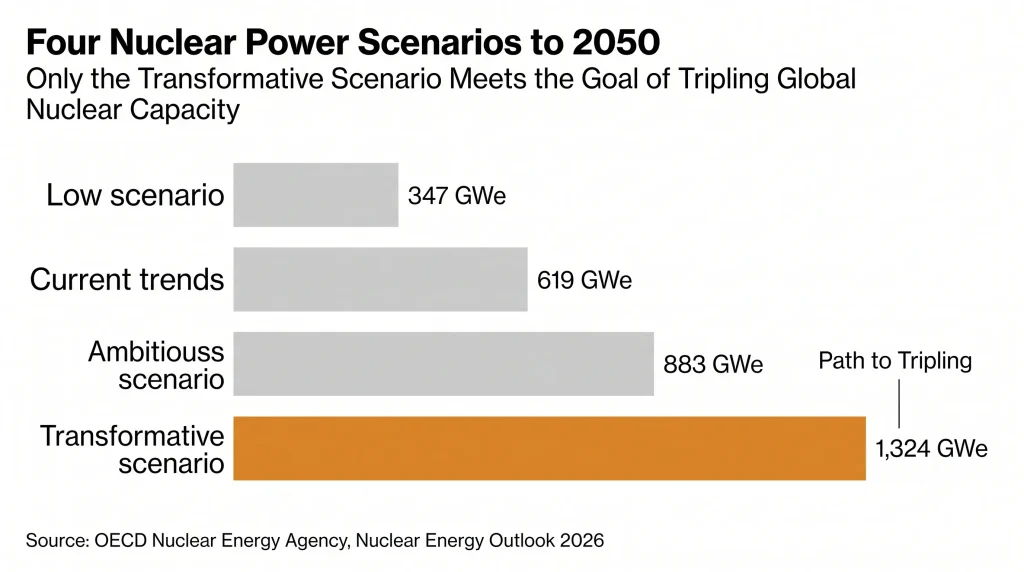
Under the current trends scenario, global capacity would reach 619 GWe, mainly driven by projects outside OECD countries. The ambitious scenario projects growth to 883 GWe, with a larger role for new large-scale reactors and small modular reactors.
Only the transformative scenario leads to around 1,324 GWe by 2050, which would mean more than tripling today’s global nuclear capacity.
The centre of new nuclear construction is shifting outside the OECD
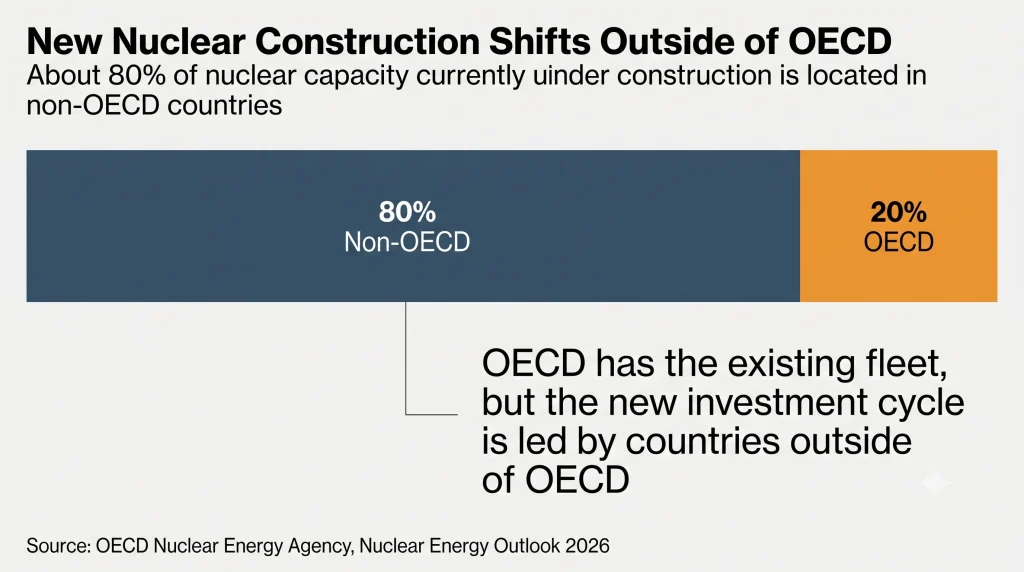
The report also points to an important geographical shift. Although OECD countries today hold around 78% of global nuclear capacity, most new nuclear construction is taking place outside the OECD.
Of around 70 GWe of nuclear capacity currently under construction worldwide, about 80% is in countries outside the OECD. China is the leading example, with more than 33 GWe of capacity under construction.
This shows that the nuclear renaissance has not only a climate and energy dimension, but also a strong industrial and geopolitical dimension. Countries that are building continuously today will have greater technological, export and strategic advantages tomorrow.
LTO and SMR as key instruments
NEA emphasises that the future of nuclear energy will not depend only on new construction. Long-term operation of existing reactors, known as LTO, remains one of the most important instruments for preserving stable low-carbon power.
In parallel, small modular reactors, or SMR technologies, are seen as an opportunity for new industrial markets: data centres, the chemical industry, replacement of coal-fired capacity, industrial steam and off-grid solutions. However, their large-scale deployment still depends on licensing, financing, serial production and securing a reliable fuel supply chain.
Ambition will not be enough without money, skills and supply chains
The main message from the Nuclear Energy Outlook is that the nuclear renaissance will not happen simply because countries have set targets. Real industrial mobilisation is required.
NEA warns that countries will need to secure much larger investments, stronger supply chains, a trained workforce, faster regulatory procedures and new financing models.
In the transformative scenario, capital requirements for nuclear investment in OECD countries could approach USD 200 billion per year in the 2030s.
Therefore, the question of nuclear energy is no longer only a question of technology. It is becoming a question of industrial capability.
The nuclear renaissance will be led by those who can deliver
The new report by the OECD Nuclear Energy Agency shows that nuclear energy is once again becoming an important part of the global energy strategy.
But at the same time, it sends a clear warning: the goal of tripling nuclear capacity by 2050 will remain only a political ambition unless it is transformed into real projects, financial instruments, trained engineers, manufacturing capacity and delivered megawatts.
In the new nuclear era, the advantage will not belong only to the countries that talk the most about nuclear energy, but to those that build it the fastest.
ECI