

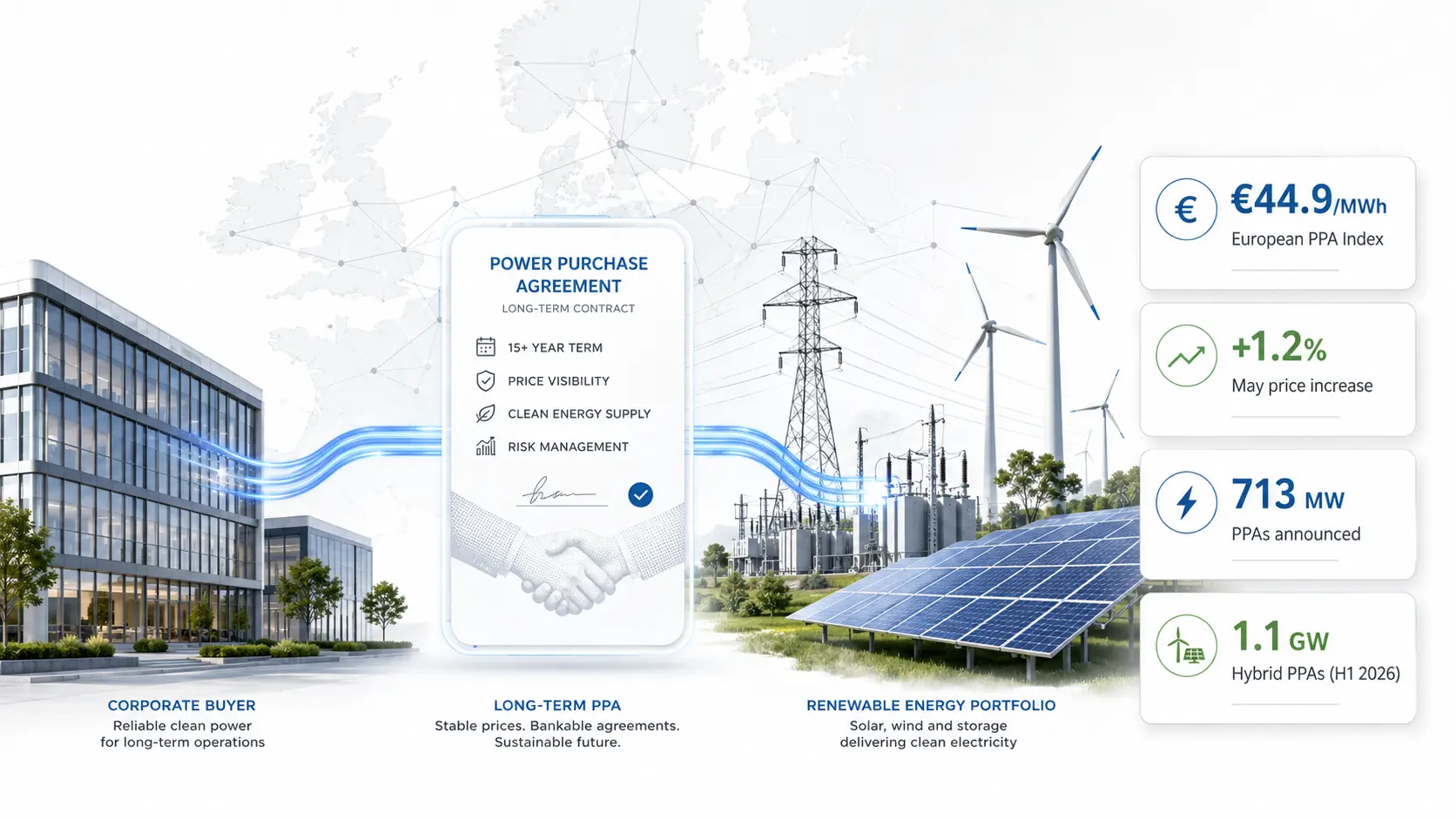
May brought a modest recovery in European power purchase agreement (PPA) prices, record interest in hybrid solar-wind contracts, and slower activity in battery storage deals.
Europe’s corporate power purchase agreement (PPA) market recorded a modest price rebound in May after several months of correction, while investors increasingly turned to hybrid renewable energy projects combining solar and wind generation. According to the latest analysis by Swiss consultancy Pexapark, reported by pv magazine, the EURO Composite Index rose by 1.2% to €44.9/MWh, indicating a gradual stabilisation of the European PPA market.
Prices increased across most European markets
PPA prices increased across all major European markets monitored by Pexapark. Italy recorded the strongest monthly gain (+2.7%), while the Nordic region experienced the second-largest increase, driven by higher natural gas prices and less favourable hydrological conditions.


According to Pexapark, although price movements were less volatile than in March and April, geopolitical developments continue to influence market expectations across Europe’s energy sector.
Hybrid PPAs are becoming increasingly popular
A hybrid PPA is a long-term electricity supply agreement that combines generation from both solar and wind power plants within a single contract, providing a more stable and predictable renewable electricity profile.
During May, 17 new PPAs with a combined contracted capacity of 713 MW were publicly announced.
The largest transaction was signed between Trafigura and Nadara, covering a portfolio of five solar plants and eleven wind farms in Spain with a combined capacity of 434 MW under a ten-year agreement.
According to the analysis, this represents Europe’s largest multi-technology PPA since the second quarter of 2024. During the first half of 2026, publicly announced hybrid PPAs have already reached 1.1 GW, more than doubling the 435 MW recorded during the same period last year.
The growing trend suggests that corporate buyers and project developers increasingly favour diversified renewable portfolios, allowing for more stable electricity generation and reduced exposure to weather-related variability.
Battery storage activity slows, but the market continues to mature
In May, only four battery storage agreements were announced, representing a combined capacity of 350 MW and 1.3 GWh.
Despite the lower number of transactions, the first half of 2026 marks a record period for Flexibility Purchase Agreements (FPAs), indicating that Europe’s energy storage market continues to mature with a stronger emphasis on commercial market-based models rather than traditional subsidy schemes.
The largest agreement announced during the month was signed in Poland, covering a standalone 300 MW / 1,200 MWh battery energy storage system under a ten-year contract featuring a minimum revenue guarantee combined with a profit-sharing mechanism.
Regulatory reforms continue across Europe
Alongside market developments, several European countries continue introducing regulatory reforms aimed at accelerating investments in renewable energy and battery storage.
Romania has introduced stricter grid connection rules to discourage speculative capacity reservations while proposing a new Modernisation Fund support scheme offering grants of up to €69,000 per installed MWh for standalone battery projects with at least two hours of storage.
Meanwhile, the UK government has approved reforms to its Contracts for Difference (CfD) scheme and Capacity Market, designed to accelerate investment in low-carbon technologies, strengthen renewable energy supply chains, and improve long-term electricity system reliability.
The European PPA market is entering a new phase
Recent market developments suggest that the European PPA market is gradually entering a new stage of maturity. Rather than relying on single-technology projects, investors and corporate buyers are increasingly adopting hybrid renewable portfolios that combine solar and wind generation to deliver more stable electricity output and better manage price risk.
At the same time, battery storage projects are increasingly being developed through market-driven commercial models, highlighting the growing maturity of Europe’s flexibility market. For investors, this creates a broader range of business opportunities, while corporate electricity buyers benefit from greater long-term supply security.
Source: PV Magazine
ECI