

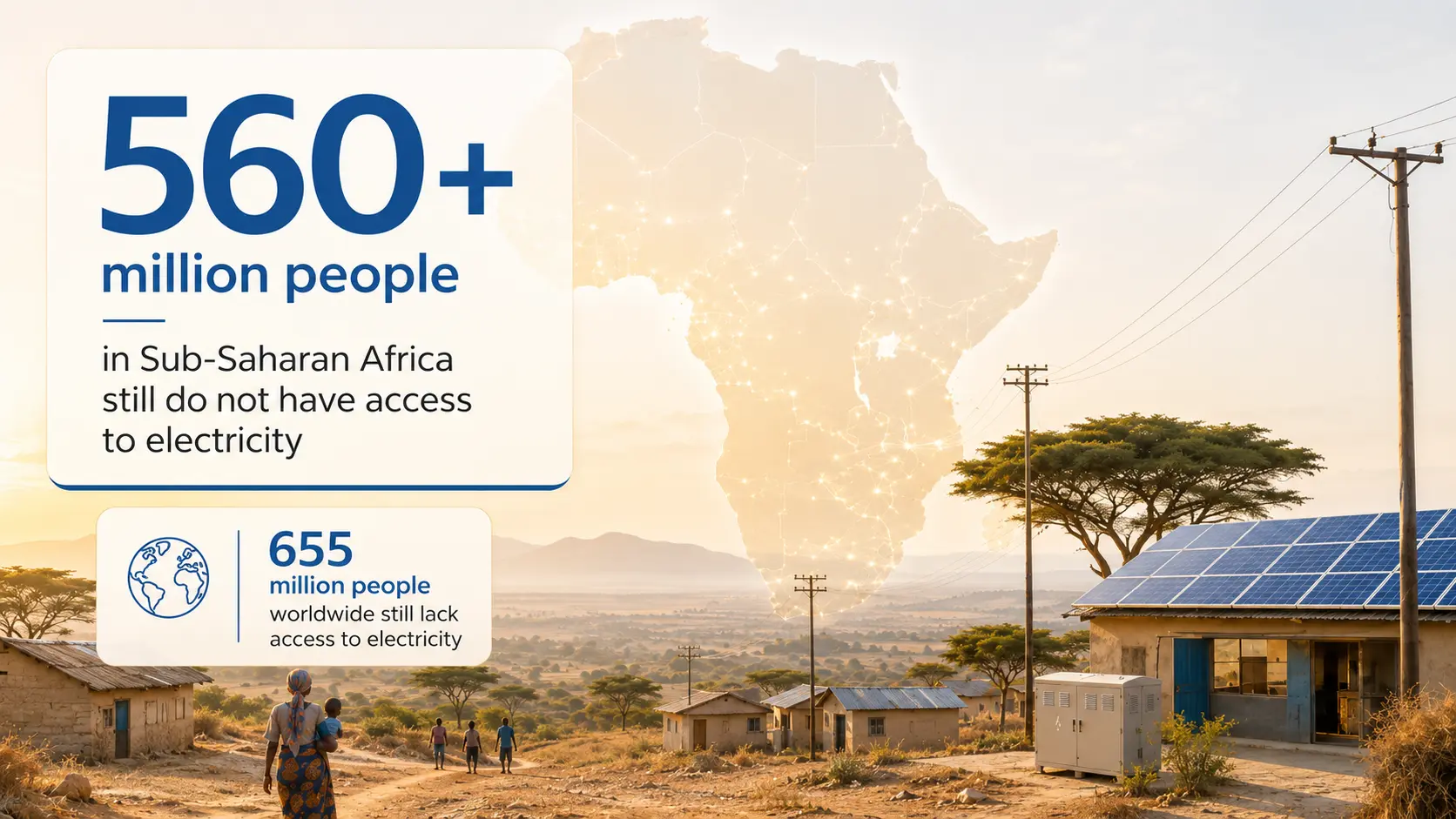
More than 560 million of them live in Sub-Saharan Africa, while two billion people worldwide still rely on polluting fuels and technologies for cooking, according to the latest data from the International Energy Agency.
In the 21st century, 655 million people worldwide still do not have access to electricity. Most of them, more than 560 million people, live in Sub-Saharan Africa, showing that energy poverty remains one of the world’s major development and social challenges.
This figure represents around 8% of the global population, meaning that roughly one in every thirteen people on the planet lives without electricity.


According to the International Energy Agency, the latest data show that the world is not moving fast enough towards the goal of universal access to modern, affordable and sustainable energy by 2030.
The report “Tracking SDG7: The Energy Progress Report 2026”, cited by the IEA, shows that the global electricity access rate stagnated at 92% in 2024.
Although many regions of the world are moving closer to universal access, progress in Sub-Saharan Africa has slowed significantly, and it is precisely there that most of the population still living without electricity is concentrated. According to the IEA, to achieve the 2030 target, the pace of electrification must triple to 1.3% per year.
The problem does not end with access to electricity. Around two billion people worldwide still use polluting fuels and technologies for cooking, posing a serious risk to their health and quality of life.
In Sub-Saharan Africa, 970 million people do not have access to clean fuels and technologies for cooking.
According to the data cited by the IEA, without stronger action, 1.8 billion people could still depend on fuels such as wood, charcoal, kerosene and coal for everyday cooking by 2030.
Energy poverty is not only an infrastructure problem
The IEA warns that affordability remains one of the main barriers to expanding access to electricity.
Even where infrastructure exists, many households cannot afford the costs of connection, internal wiring or basic energy services.
Therefore, according to the agency, targeted subsidies, innovative financing mechanisms and least-cost electrification solutions will be crucial to ensure that the most vulnerable communities are not left behind.
This makes energy poverty a much broader issue than simply building grids and power plants.
It is connected to poverty, health, education, economic activity and the ability of local communities to develop.
The lack of reliable and affordable energy means limited access to lighting, digital services, healthcare facilities, schools, small businesses and basic conditions for a dignified life.
Renewables are growing, but they are not reaching everyone equally
The positive part of the report is that renewable energy continues to grow strongly.
Renewables already account for more than 30% of global electricity consumption, while renewable power generation capacity has reached a global record of 544 watts per capita.
But behind this global figure lie major differences between rich and poor countries.
In low-income countries, renewable capacity stands at only 33.6 watts per capita, while in high-income countries it reaches 1,224 watts per capita.
This shows that the energy transition is not only about the global growth of solar, wind and other renewable capacities.
The key question is where these capacities are being built, who benefits from them and whether they are truly reaching the communities that need access to modern energy the most.
Financing remains a weak point
International public financial flows supporting clean energy in developing countries reached USD 24.6 billion in 2024, only a slight increase from USD 24.4 billion in 2023.
However, financial support for the least developed countries declined. According to the IEA, they received USD 3.7 billion in 2024, an 11% decrease compared with the previous year.
The structure of financing is an additional problem. Around 80% of international public financing for clean energy in 2024 was provided in the form of debt, while grants accounted for 13%.
For low-income countries with high borrowing costs, this means that access to clean energy often remains constrained not only by technology, but also by financial conditions.
A faster pace is needed by 2030
According to the IEA, the solutions exist. Distributed renewables, off-grid solar systems and mini-grids are already providing access to electricity for hundreds of millions of people and can be cost-effective solutions for remote and rural areas.
For clean cooking, the agency points out that electric cooking, bioethanol and biogas are becoming increasingly important solutions.
But the main message of the report is that the current pace is not enough. If the world wants to meet the target of universal energy access by 2030, stronger political leadership, better coordination between sectors, more investment and a clear focus on the countries and communities most at risk of being left behind in the global energy transition will be needed.
Otherwise, the energy transition will continue to advance globally, but without solving the most basic question: that hundreds of millions of people in the 21st century still do not have access to electricity.
ECI