

Wind Energy Is Becoming a Key Part of the Energy Transition
Global Wind Day is marked on 15 June, as a global initiative that highlights the role of wind energy in clean electricity generation, energy security and reducing dependence on fossil fuels.
According to Global Wind Day, this date is marked every year on 15 June and is dedicated to the benefits of wind energy and the need to accelerate capacity growth.
Official IRENA data for 2025 show that wind energy continues to grow, although at different speeds across regions. Globally, total installed wind capacity reached 1,291 GW at the end of 2025. During the year, around 159 GW of new wind capacity was added.


North Macedonia Has 103 MW of Installed Wind Capacity
In North Macedonia, installed wind energy capacity reached 103 MW in 2025. This is an increase from 73 MW in 2024, or 30 MW of additional capacity in one year.
In practical terms, this means that the country has finally moved beyond the long period in which wind capacity was limited to the first phase of the Bogdanci wind farm. However, compared with the solar expansion, wind still has a much smaller share in the domestic renewable energy portfolio.
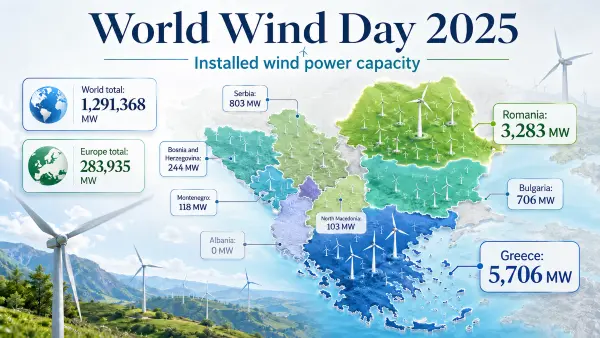
In the regional context, North Macedonia remains among the countries with modest wind capacity. In 2025, Serbia reached 803 MW, Bosnia and Herzegovina 244 MW and Montenegro 118 MW, while North Macedonia had 103 MW. Albania still has no installed wind capacity.
The difference is even larger in the wider neighbourhood: Greece has 5,706 MW, Romania 3,283 MW and Bulgaria 706 MW. These figures show that wind energy already has a serious role in the regional electricity mix, but also that North Macedonia still needs to open the next phase of development through new projects, better grid planning and faster grid connection procedures.
Europe Reached Almost 284 GW
At the end of 2025, Europe had 283,935 MW, or almost 284 GW, of installed wind capacity. In 2024, Europe’s wind capacity stood at 270,056 MW, which means that around 13.9 GW of new wind capacity was added in 2025.
Most of Europe’s wind capacity remains onshore. According to IRENA, Europe had 245,337 MW of onshore wind capacity and 38,598 MW of offshore wind capacity in 2025.
Germany remains the leading European country by installed wind capacity, with 77,808 MW in 2025. It is followed by France with 25,655 MW, Spain with 32,848 MW, the United Kingdom and other major European markets.
The World Reached 1,291 GW of Wind Energy
Globally, wind energy is already one of the three largest renewable sources by installed capacity. At the end of 2025, the world had 5,149 GW of renewable energy capacity.
Of this total, solar energy accounted for 2,392 GW, hydropower for 1,296 GW, and wind energy for 1,291 GW.
Onshore wind remains dominant. In 2025, the world had 1,199,987 MW of onshore wind capacity, while offshore wind reached 91,380 MW.
This shows that offshore wind is growing, but the global market is still mainly onshore. This is also important for countries such as North Macedonia, where the potential is exclusively onshore and depends on spatial planning, grid connections, balancing and investment certainty.
Editorial Office