

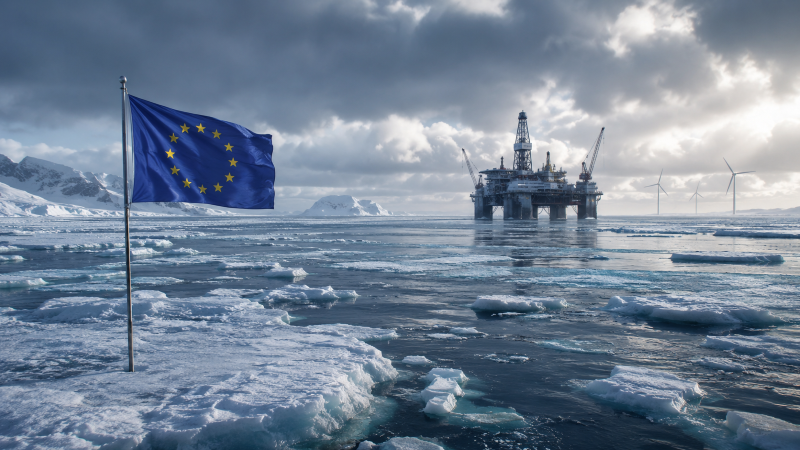
Financial institutions, trade unions and climate scientists are calling on the European Commission to maintain its existing position against new fossil fuel extraction projects in the Arctic, warning of environmental, security and economic risks.
A Nordic coalition made up of financial institutions, trade unions and climate scientists has urged the European Union to remain firm in its policy against new oil and gas drilling in the Arctic. The appeal was sent to the European Commission at a time when Brussels is reviewing its Arctic strategy, as the region gains increasing geopolitical, energy and climate significance.
In an open letter addressed to five European Commissioners, the signatories warn that any weakening of the EU’s position would send the wrong signal at a time when Europe should be reducing its dependence on fossil fuels, not opening up new long-term sources of oil and gas. Since 2021, the EU has supported a global ban on new oil and gas drilling projects in the Arctic as part of its Arctic policy, primarily due to environmental risks.


The Arctic as a Climate and Security Risk
The coalition warns that the Arctic is one of the most vulnerable regions in the world. According to the signatories, the region is warming four times faster than the global average, while pushing fossil fuel extraction further north would create serious risks for marine ecosystems, particularly in the southern Barents Sea.
In addition to climate and environmental consequences, the letter also points to growing security risks. Due to its proximity to Russian territory and the Northern Sea Route, new oil and gas infrastructure in the Arctic could become a potential target for sabotage and hybrid threats. The signatories warn that if energy from the Norwegian Arctic becomes central to European energy security, this could increase the EU’s vulnerability.
Energy Security or a New Dependence?
Supporters of Arctic drilling present it as a way to strengthen Europe’s energy security. However, the Nordic coalition argues that this logic is economically and temporally problematic.
According to the coalition, the development of new projects on the Norwegian continental shelf takes around 13 years. This means that new fields approved today would reach full production only around 2040. In addition, the letter cites Rystad Energy estimates suggesting that economically viable resources in the Barents Sea are 78% lower than official Norwegian government forecasts.
The coalition also warns that new commercial volumes of liquefied natural gas would require long-term gas purchase agreements lasting 20 to 25 years. Such an approach, according to the signatories, could lock Europe into fossil fuel dependence beyond the deadline for achieving climate neutrality by 2050.
The Alternative: Electrification, Grids and Renewable Energy
Instead of new investments in fossil fuels in the Arctic, the coalition is calling on the European Commission to accelerate the development of domestic renewable energy, electrification, energy efficiency and the modernisation of electricity grids. According to the signatories, these measures represent a more effective path towards Europe’s long-term energy security.
The message is clear: European energy security should not be built through new fossil fuel infrastructure in one of the planet’s most vulnerable regions, but through reducing demand for imported fossil fuels and accelerating the clean energy transition.
Industry Calls for a Different Approach
Norwegian energy company Equinor, however, opposes a general ban on oil and gas exploration and production in northern regions. The company argues that the EU should develop a policy that takes into account the importance of northern areas for energy security, stability and preparedness, while noting that activities in Norway take place within a strict and democratically based regulatory framework.
The European Commission has stated that the update of the Arctic strategy is still at an early stage and that no final conclusions have yet been reached. The Commission emphasizes that tackling climate change, protecting the environment and supporting sustainable economic development remain important objectives of the EU’s Arctic policy.
Editorial Office