

In a decisive move for Balkan energy security, Croatian Prime Minister Andrej Plenković and the Chairwoman of the Council of Ministers of Bosnia and Herzegovina, Borjana Krišto, have officially signed the agreement for the construction of the Southern Interconnection gas pipeline. The signing took place in Dubrovnik during the Three Seas Initiative Summit, following urgent approvals from both governments.
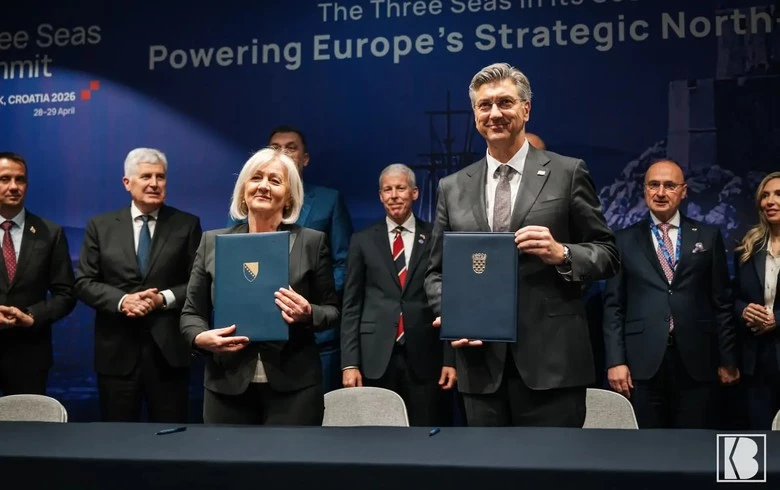
Source: Council of Ministers of Bosnia & Hercegovina
Project Scope and Infrastructure
The Southern Interconnection is designed to physically link the national gas networks of both countries, creating a resilient and interconnected energy market aligned with EU policies.


- Route: The pipeline will run from Split and Zagvozd in Croatia to Posušje, Tomislavgrad, Kupres, Bugojno, and Travnik in Bosnia and Herzegovina.
- Expansion: Additional branches are planned for Mostar, Livno, Jajce, Čapljina, and Tuzla, ensuring wide-scale coverage.
- Supply Source: The project leverages the strategic LNG terminal on the island of Krk, positioning Croatia as the primary gateway for natural gas entering Southeast Europe.
Economic and Technical Framework
- Financing: Each country is responsible for the construction and financing of the section within its own territory.
- Viability: The project will proceed based on market demand and binding capacity allocations to ensure economic sustainability.
- Future-Proofing: Beyond natural gas, the infrastructure is being designed to be hydrogen-ready, supporting long-term decarbonization and the transition away from coal.
A Milestone for Regional Energy Sovereignty
The signing of the Southern Interconnection agreement is more than a technical infrastructure project, rather it is a geopolitical necessity for the Western Balkans.
- Currently, Bosnia and Herzegovina relies on a single supply route and source. This pipeline introduces diversification, effectively ending energy dependency and providing the country with multiple options for gas procurement.
- This deal solidifies Croatia’s status as a regional leader in energy. By utilizing the Krk LNG terminal, Croatia is not just a transit country but a central anchor for the energy stability of its neighbors.
Despite the official signatures, a serious concern remains regarding the internal political implementation within Bosnia and Herzegovina. The project is currently caught in a tug-of-war over institutional control.
- Disagreements persist over whether the pipeline should be managed by the existing state-owned company (BH-Gas) or a newly proposed entity based in Mostar. This ethnic-political friction has already drawn criticism from the U.S. and the EU, who warn that creating fragmented, ethnically-controlled energy companies could lead to corruption and further delays.
- If these internal disputes are not resolved, the Southern Interconnection risks becoming a stalled project, potentially mirroring the delays seen with the East Interconnection. Such a stalemate would not only threaten energy security but could also stall Bosnia’s EU accession process, as energy diversification is a non-negotiable condition for integration.
The Southern Interconnection is an essential blueprint for the Western Balkans, demonstrating how cross-border cooperation can overcome historical dependencies. However, it also serves as a warning that Infrastructure alone is not enough. Without political unity and transparent management, even the most strategic projects can fall victim to internal instability.