

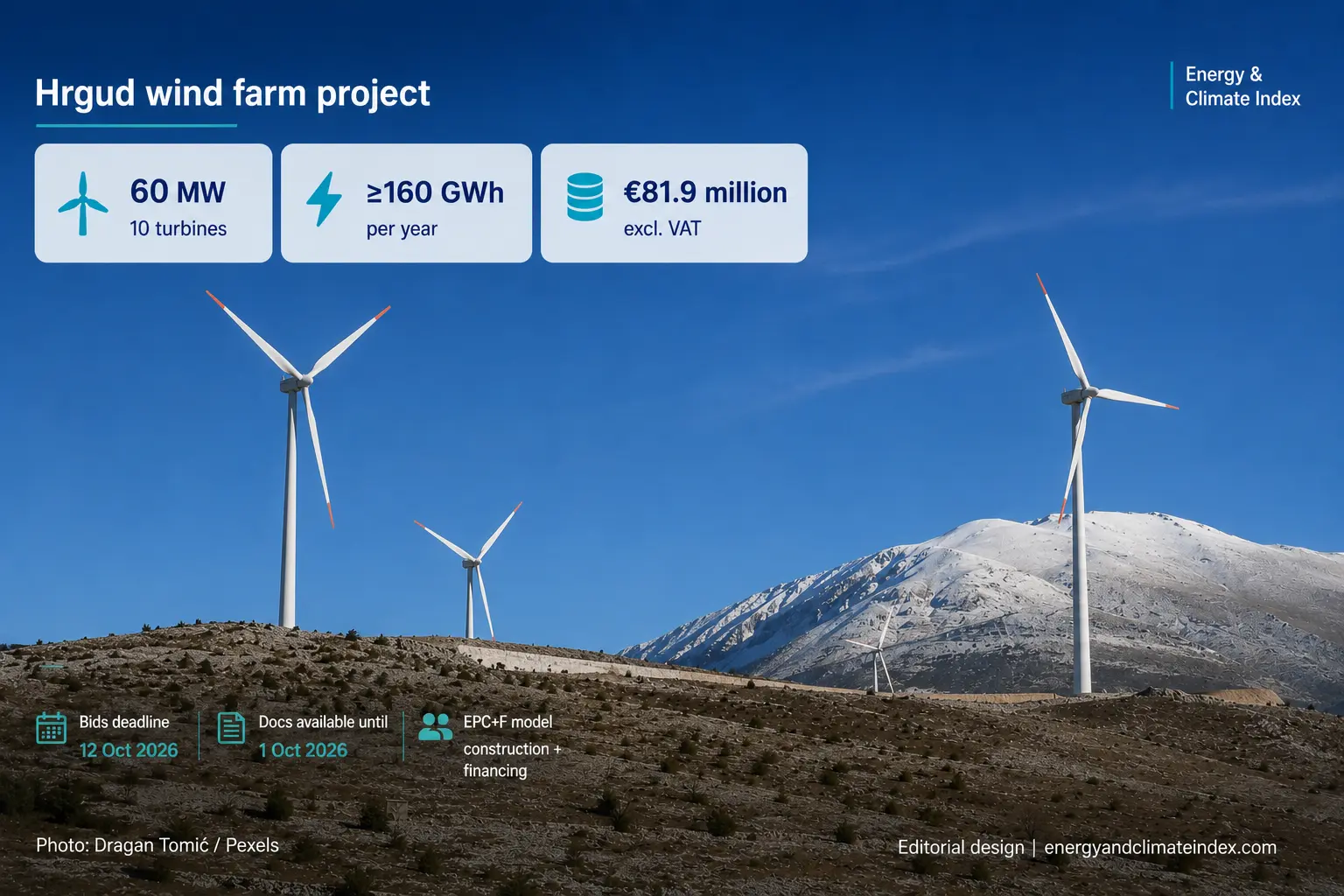
Elektroprivreda Republike Srpske (EPRS) is reviving the Hrgud wind farm project near Berkovići, almost 11 years after the concession was awarded, this time with a larger capacity and a different financing model.
EPRS launched a procedure on 27 August for the construction of the 60 MW wind farm and associated infrastructure. The estimated procurement value is BAM 160.1 million excluding VAT, equivalent to approximately €81.9 million. Including VAT, the value reaches around BAM 187 million.
However, one of the most significant elements of the new procedure is the EPC+F model. EPRS is not simply looking for a company to design and build the wind farm. The selected partner will also be expected to provide financing for the project.


From 48 MW to 60 MW
Hrgud has undergone substantial changes during more than a decade of development.
The original configuration envisaged 16 wind turbines with a total installed capacity of 48 MW and expected annual electricity generation of approximately 126 GWh.
The redesigned project is larger. It envisages 10 more powerful wind turbines with a combined capacity of 60 MW and expected annual generation of at least 160 GWh. The new 60 MW configuration was also confirmed during the project’s environmental impact assessment procedure in late 2025.
Compared with the original project, installed capacity has therefore increased by 25%, while planned annual electricity generation is around 27% higher.
Financing becomes part of the bid
The financing structure represents one of the most important changes in the latest attempt to develop Hrgud.
The original project was developed with financial support from German development bank KfW, but that financing model was subsequently abandoned. EPRS is now incorporating the provision of financing directly into the procedure for selecting its project partner.
Price will account for 60% of the bid evaluation, but EPRS will also assess the share of financing that bidders can provide, the proposed interest rate, repayment period and other financing conditions.
Other criteria include the warranty period, the wind farm’s expected capacity factor and the implementation schedule.
In practice, EPRS is looking for a partner that will assume a substantially broader role than a conventional construction contractor.
One contract for the entire project
The selected partner will be responsible for implementing the project as a whole, from engineering and procurement of wind turbines to civil and electrical works, installation, testing and commissioning.
The project also includes the necessary supporting infrastructure, including access and internal roads, turbine installation platforms, a transmission line, substation and other electrical and civil infrastructure.
Interested companies can obtain the documentation until 1 October, while the deadline for submitting bids is 12 October 2026.
The procurement procedure was initiated following a decision by the EPRS Supervisory Board dated 20 July 2026.
After more than a decade during which Hrgud went through changes in both its technical configuration and financing model, the current procedure represents another attempt to move the project from long-term development into actual construction.
If the partner selection and subsequent implementation are successful, Hrgud would add 60 MW of wind capacity to the EPRS generation portfolio and provide at least 160 GWh of new renewable electricity generation annually.
ECI