

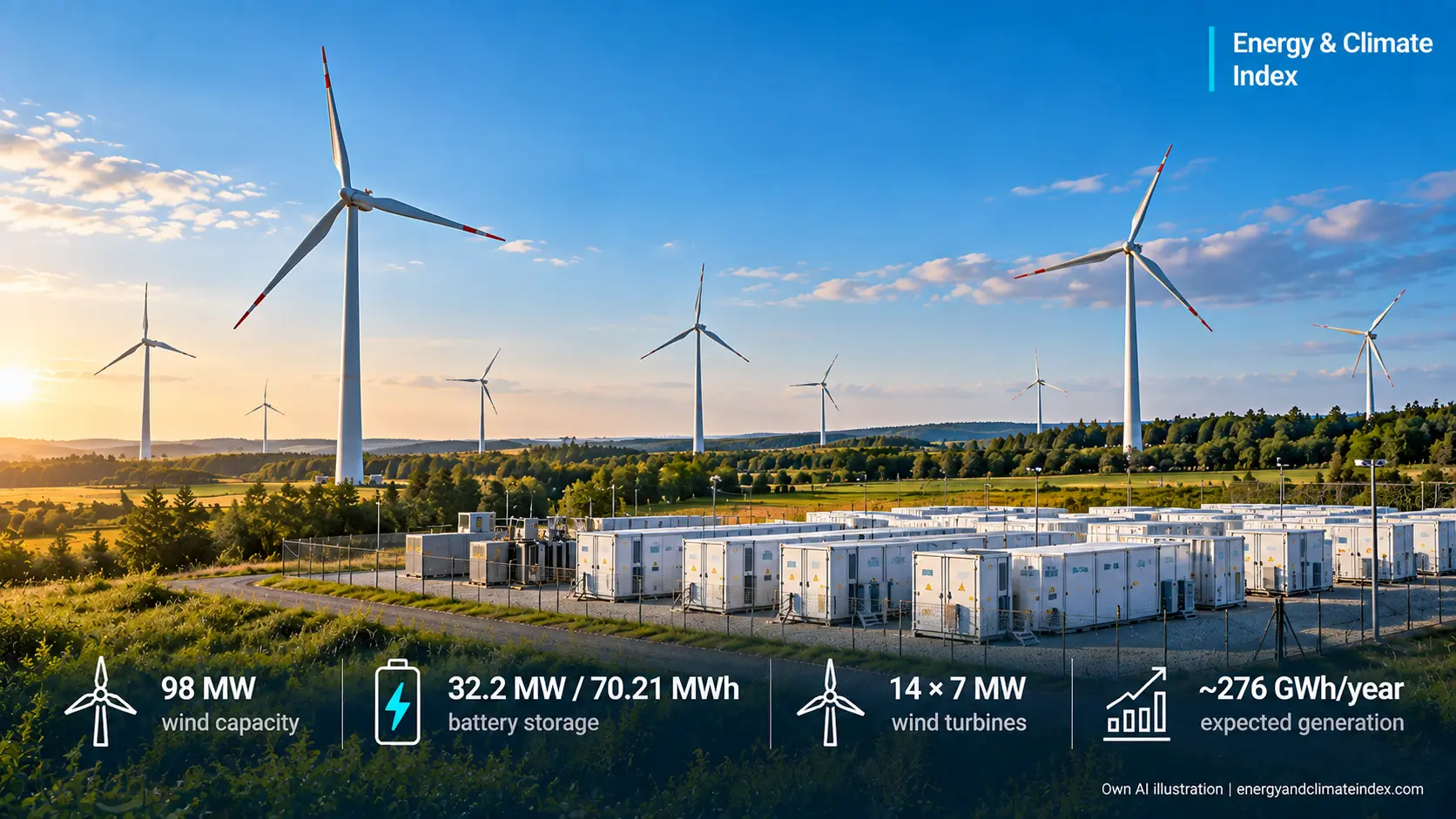
PNE and ENERCON are developing an integrated energy park in Germany that will combine a wind farm with around 98 MW of capacity, a battery energy storage system and a dedicated substation.
The Beerfelde project will be developed in the Oder-Spree district of Brandenburg and represents one of the larger German projects in which wind generation and battery storage are being developed together from the outset.
The planned battery system will have a power capacity of 32.2 MW and an energy storage capacity of 70.21 MWh, while the wind component will comprise 14 ENERCON E-175 EP5 E2 turbines, each rated at 7 MW.


Wind, batteries and grid infrastructure in one project
PNE is responsible for developing the wind farm, while ENERCON will supply both the wind turbines and the battery energy storage system. The project will also include its own substation.
The aim is to make better use of the available grid connection capacity. When wind generation is high and all of the electricity cannot be immediately delivered to the grid, part of the output can be stored and supplied later.
This allows the same grid infrastructure to be used more efficiently while making wind generation more flexible in response to the needs of the electricity system.
Around 276 GWh of electricity per year
According to the project data, the 14 wind turbines are expected to generate approximately 276,400 MWh of electricity annually.
ENERCON will deploy its Wind+Storage concept, under which electricity generation and storage are treated as a single integrated system. The battery will be able to absorb part of the wind output during periods of high generation and return it to the grid when market and system conditions are more favourable.
The battery therefore serves not only as an electricity storage facility but also as a source of additional flexibility and a tool for optimising how the electricity generated by the wind farm is marketed.
A new model for wind projects
Beerfelde illustrates a shift in the way new renewable energy projects are being planned. The challenge is no longer simply how much new generation capacity can be built, but also how efficiently that capacity can be integrated into the existing electricity grid.
The combination of 98 MW of wind capacity, a 32.2 MW/70.21 MWh battery system and dedicated grid infrastructure is intended to improve utilisation of the grid connection while providing greater flexibility in electricity generation and delivery.
PNE and ENERCON also see the project as a model for future integrated wind and battery developments, as rapid renewable energy expansion increases the importance of storage and flexibility across European electricity systems.
ECI