

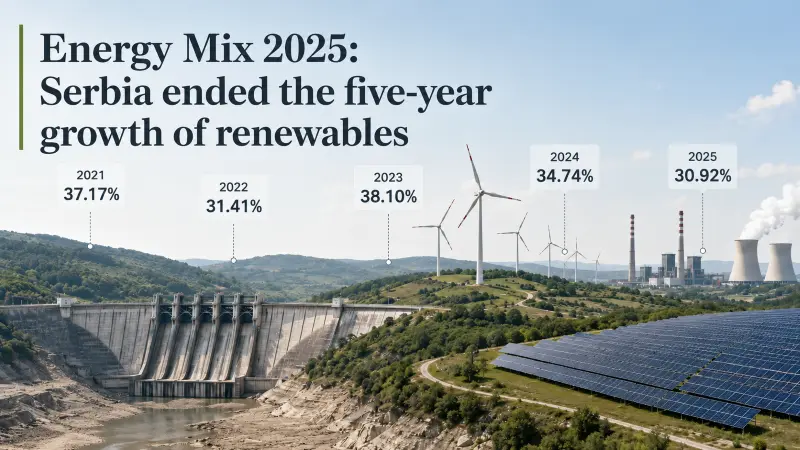
Despite the growth of wind and solar power plants, the share of renewable energy sources in electricity generation remains highly dependent on hydrological conditions.
Data from the Energy Agency of the Republic of Serbia’s 2025 Annual Report show that the share of renewable energy sources (RES) in electricity generation has fluctuated significantly over the past five years, without a clear and continuous upward trend.
Between 2021 and 2025, the share of renewables in total electricity generation ranged from 30.92% to 38.10%, indicating that Serbia’s power system remains heavily dependent on hydropower production and hydrological conditions.


Significant fluctuations in the share of renewables
According to the Agency’s data, the share of renewable energy sources in total electricity generation was:
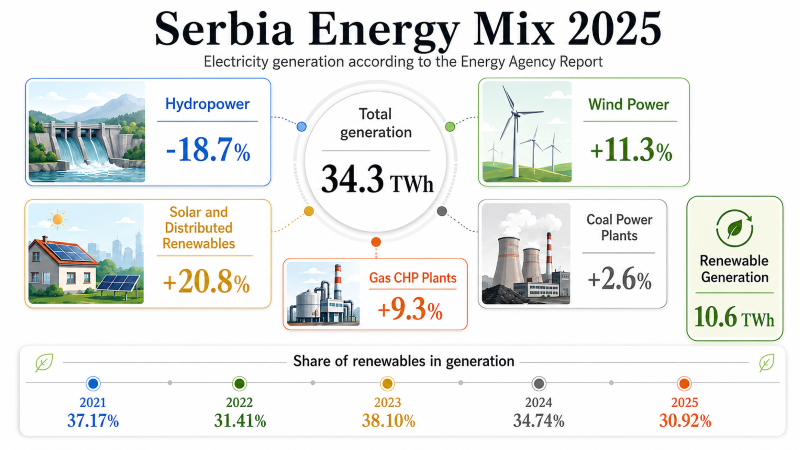
- 37.17% in 2021
- 31.41% in 2022
- 38.10% in 2023
- 34.74% in 2024
- 30.92% in 2025
At the same time, the share of renewables in gross electricity consumption ranged from 29.87% to 41.58%, further confirming the system’s sensitivity to weather and hydrological conditions.
Hydropower generation declined sharply in 2025
In 2025, Serbia generated 34.3 TWh of electricity, while gross electricity consumption reached 35.5 TWh. Renewable energy generation amounted to 10.6 TWh, representing approximately 30% of gross electricity consumption.
The key factor behind the lower share of renewables was the significant decline in hydropower generation.
According to the Energy Agency, electricity production from large hydropower plants connected to the transmission system was 18.7% lower compared with 2024 due to unfavorable hydrological conditions.
This once again confirms that hydropower remains Serbia’s most important renewable energy source and has a direct impact on the sector’s annual performance.
Generation by technology: coal remains dominant, hydropower records a sharp decline
In 2025, Serbia generated 34.30 TWh of electricity, while gross electricity consumption amounted to 35.51 TWh.
According to the Energy Agency, generation from coal-fired power plants increased by 2.6%, generation from gas-fired CHP plants rose by 9.3%, while electricity production from hydropower plants connected to the transmission system declined by 18.7% due to unfavorable hydrological conditions.
Wind and solar continue to expand
Unlike hydropower, other renewable technologies continued to grow.
In 2025, electricity generation from wind farms increased by 11.3%, while generation from other power plants connected to the distribution network, including solar installations and prosumers, increased by 20.8%.
At the same time, an additional 220 MW of wind capacity was connected to the transmission network during the year, representing one of the most significant renewable energy expansions in recent years.
ECI