

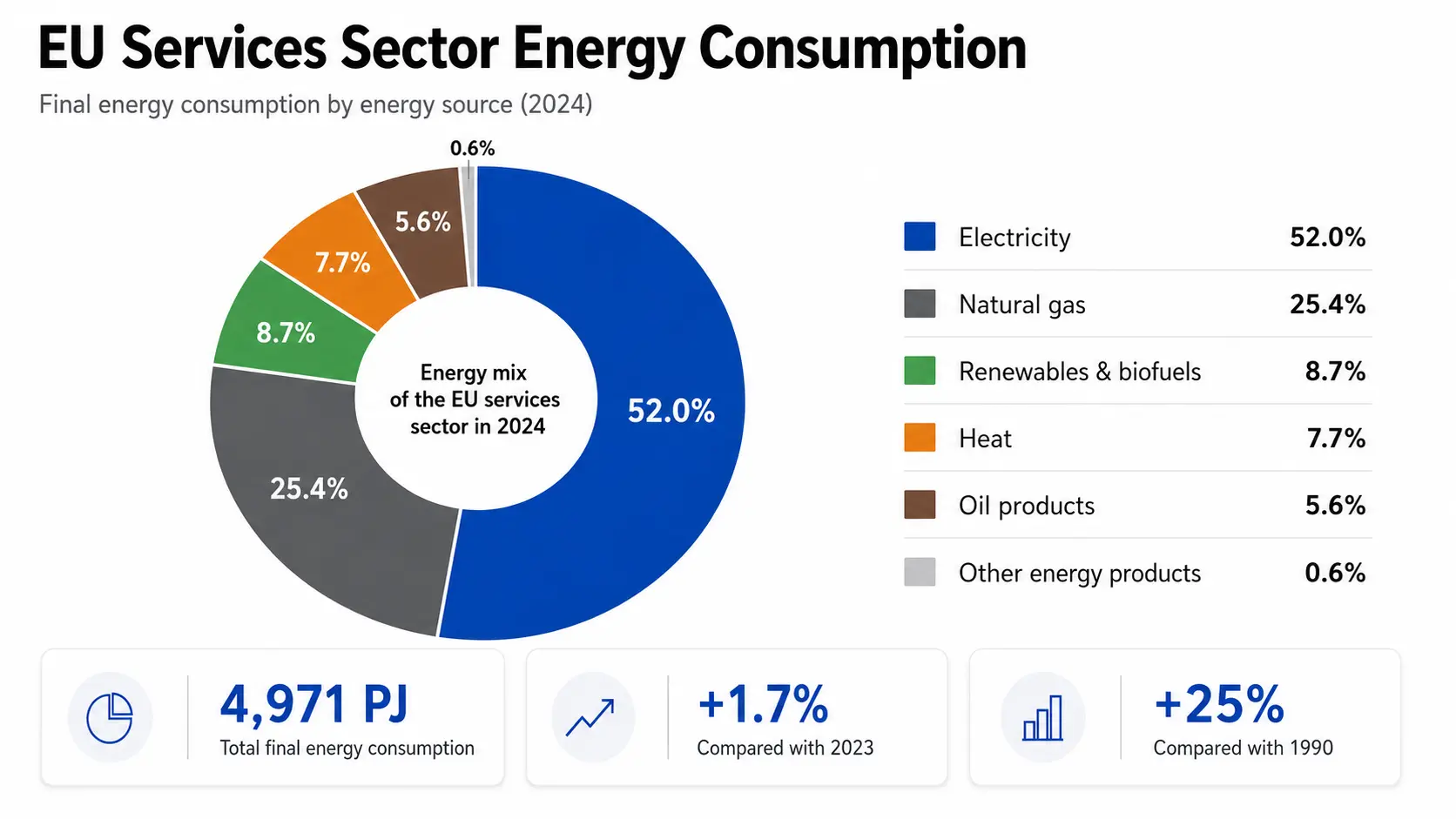
Electricity remained by far the most important energy source in the European Union’s services sector in 2024, accounting for 52% of total final energy consumption. New Eurostat data show that electrification continues to reshape energy consumption across the European economy, while natural gas still plays a significant role in the sector.
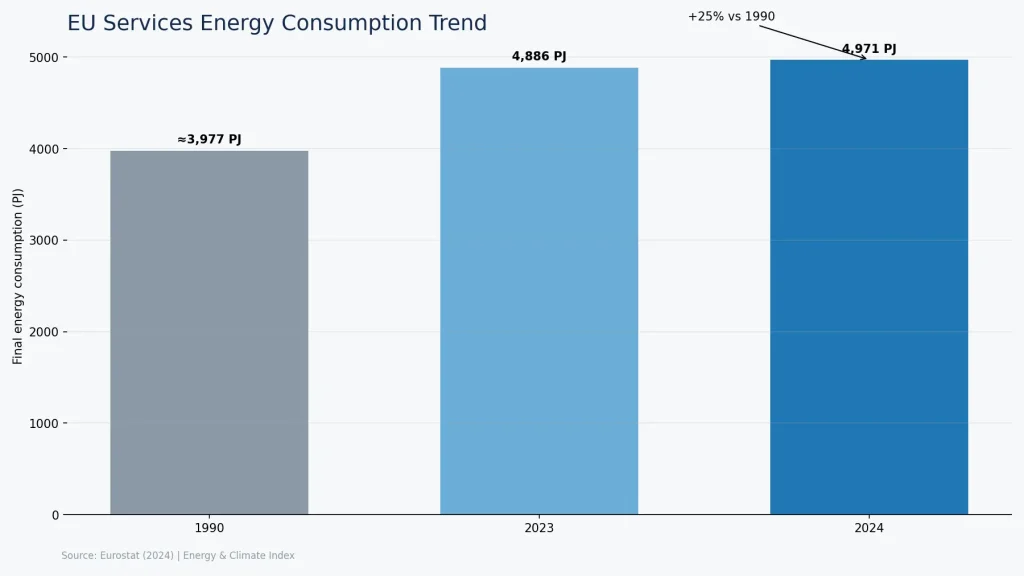
According to Eurostat, final energy consumption in the EU services sector reached 4,971 petajoules (PJ) in 2024, representing a 1.7% increase compared with 2023. Compared with 1990, energy consumption was 25% higher, highlighting the long-term growth in energy demand within one of the most important segments of the European economy.
The services sector accounted for 13.5% of the European Union’s total final energy consumption. Although it remained behind transport, households and industry, the sector represented a significantly larger share than agriculture, forestry and fisheries.


Electricity Is by Far the Dominant Energy Source
The energy consumption structure shows that electricity continues to dominate the European services sector. In 2024, it supplied 52% of the sector’s total energy needs.
Natural gas ranked second with a 25.4% share, followed by renewable energy sources and biofuels at 8.7%. Heat accounted for 7.7%, while oil products represented 5.6%. Other energy products contributed just 0.6%.
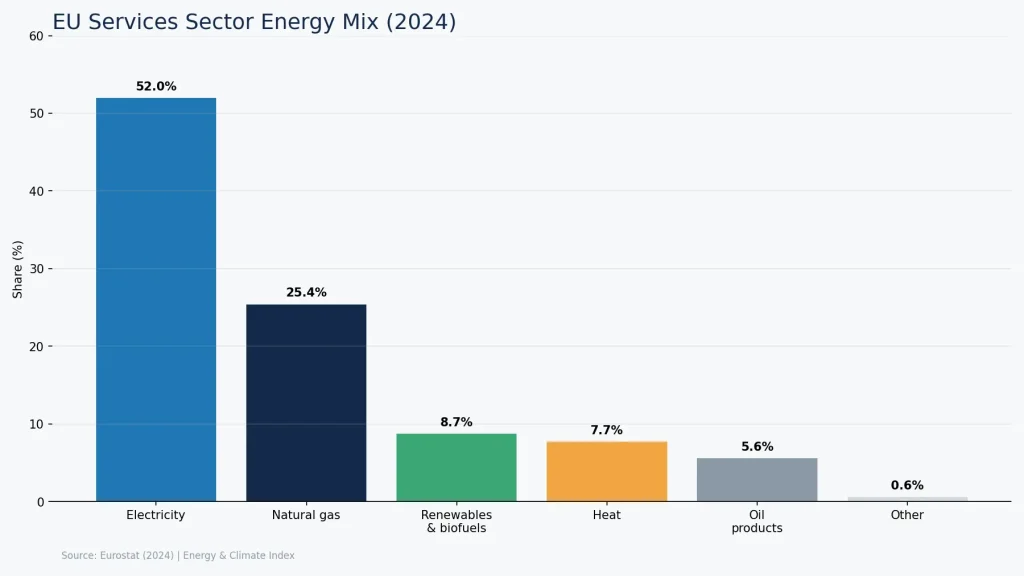
This structure demonstrates that electricity has become the primary energy carrier in service-related activities, while the use of liquid fuels and other conventional energy sources continues to decline.
Electrification Is Playing an Increasingly Important Role
The data indicate that the European services sector which includes office buildings, shopping centres, healthcare facilities, hotels, restaurants and numerous other commercial activities—is becoming increasingly dependent on electricity.
This trend is consistent with the European Union’s broader policies aimed at decarbonisation, improving energy efficiency and gradually replacing fossil fuels with clean electricity generated from renewable energy sources.
At the same time, the fact that natural gas still supplies more than one-quarter of the sector’s energy needs shows that a significant share of heating systems and commercial operations continues to rely on gas infrastructure.
Retail Trade Is the Largest Energy Consumer
Wholesale and retail trade was the largest energy consumer within the EU services sector in 2024, using 1,021 PJ, equivalent to 21.2% of total sectoral energy consumption.
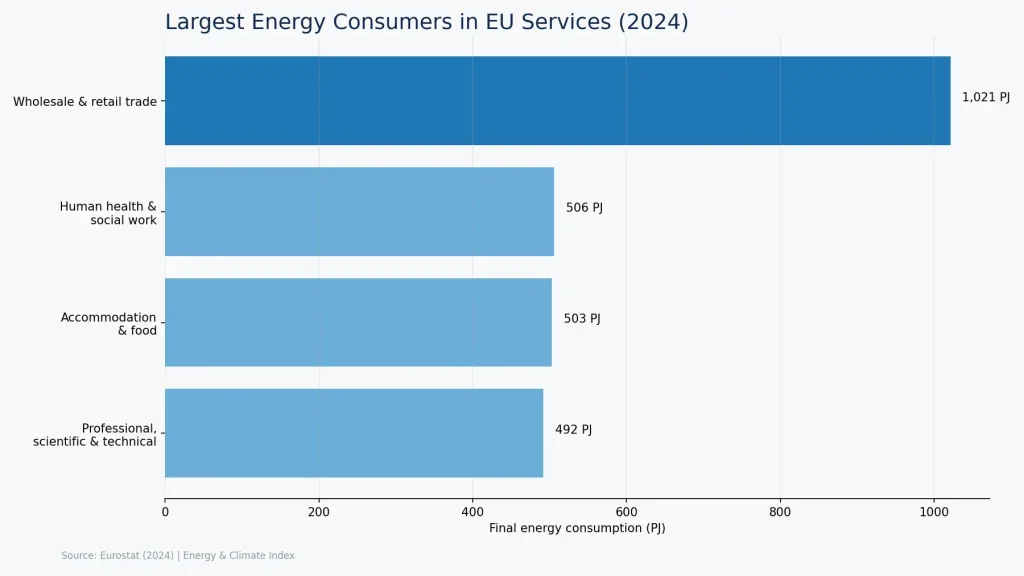
It was followed by:
- Human health and social work activities – 506 PJ
- Accommodation and food service activities – 503 PJ
- Professional, scientific and technical activities – 492 PJ
Together, these four groups of activities account for the largest share of energy consumption in the European services sector, reflecting their economic importance, the large number of buildings they occupy, and their substantial demand for lighting, heating, cooling and digital infrastructure.
Room for Further Electrification
Although electricity already dominates energy consumption in the services sector, the current energy mix indicates that there is still considerable potential for further electrification.
The gradual replacement of gas-based heating systems with heat pumps, modern HVAC systems and more efficient electric technologies, together with the continued expansion of renewable electricity generation, is expected to further increase electricity’s share of energy consumption in the European services sector in the coming years.
The latest Eurostat data confirm that the services sector is already one of the most electrified parts of the European economy and that its ongoing transformation will play an important role in achieving the European Union’s energy and climate objectives.
ECI