

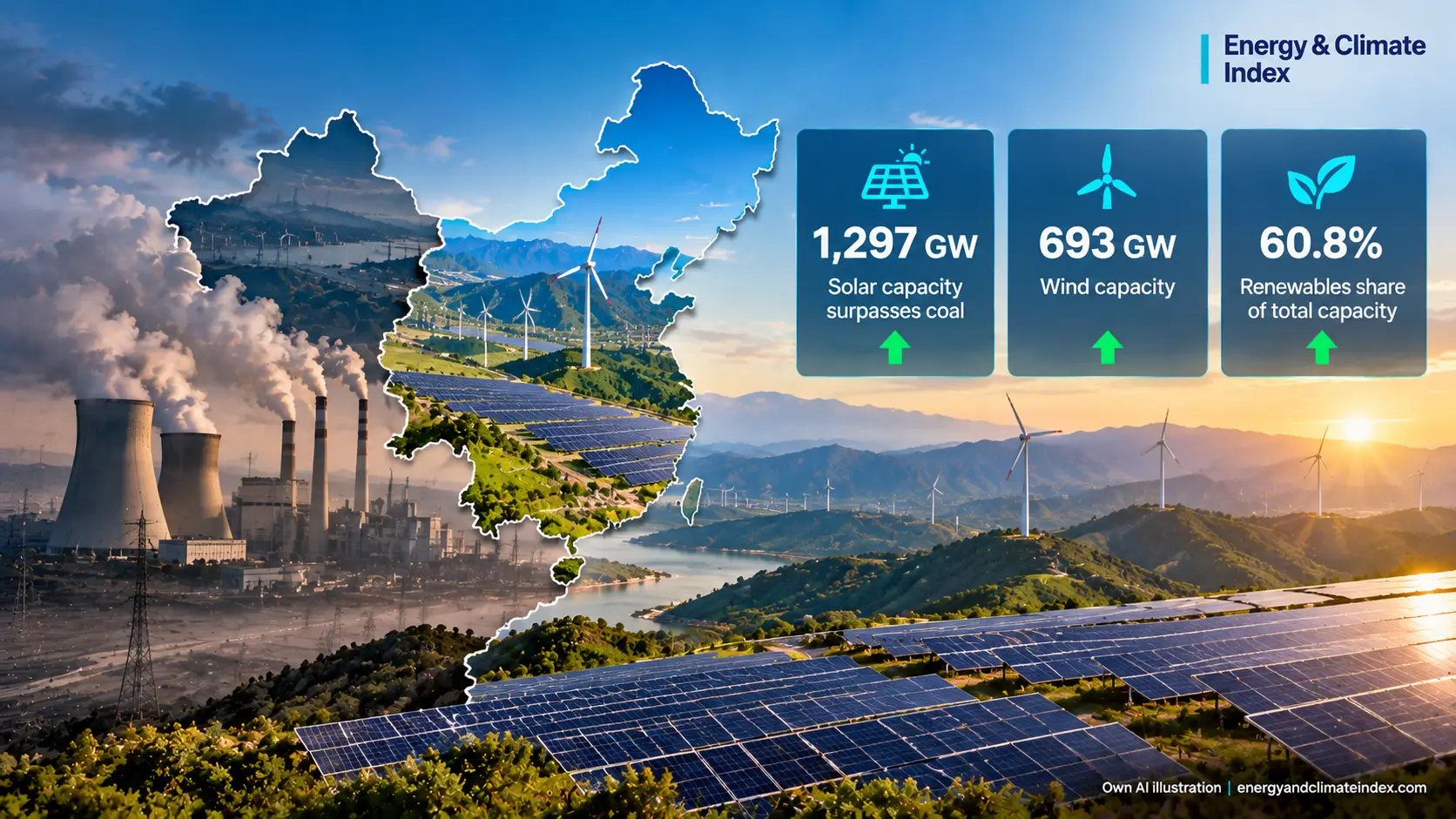
China has reached a new milestone in its energy transition: the installed capacity of solar power plants has surpassed that of coal-fired power plants. According to data published by the National Energy Administration, China’s installed solar capacity reached 1,297 GW by the end of August 2026.
This development highlights how rapidly the structure of China’s electricity system is changing, while also raising the question of whether the growth of renewable energy is reducing the country’s dependence on coal quickly enough.
Renewables Now Account for More Than 60% of Installed Capacity
China’s total installed renewable energy capacity reached 2,496 GW, representing 60.8% of the country’s total power generation capacity. Of this, solar power accounted for 1,297 GW, while wind power reached 693 GW.


In the first eight months of 2026 alone, approximately 159 GW of new renewable energy capacity was added.
These figures confirm China’s leading position in the global deployment of solar and wind power, as well as the enormous scale of investment in generation capacity and electricity infrastructure.
Installed Capacity Is Not the Same as Electricity Generation
Although solar power plants have surpassed coal-fired power plants in terms of installed capacity, this does not mean they generate more electricity than coal-fired power plants.
According to China’s National Energy Administration, renewable energy sources accounted for 41.6% of total electricity generation during the period under review.
The reason lies in their different operating characteristics: coal-fired power plants can generate electricity throughout the day, while solar and wind power generation depends on weather conditions.
ECI