


Jan Rosenow analysis: Battery energy storage is no longer an emerging technology, but it is becoming critical infrastructure that is reshaping how modern electricity systems operate.
Lithium-ion batteries have long been associated with smartphones, laptops and electric vehicles. However, according to the latest analysis by Jan Rosenow, grid-scale battery storage has become one of the fastest-growing technologies in the energy sector, with the potential to fundamentally transform the way electricity markets and power systems function.
From pilot projects to global expansion
Rosenow notes that the first large lithium-ion battery connected to a power grid entered operation only in 2012, when a 5 MW project was commissioned in Oregon, United States.
Today, global battery storage capacity has reached approximately 267 GW, while projections for 2030 range between 800 GW and 1,200 GW, depending on the pace of the energy transition. According to Rosenow, this reflects the classic transition of a technology from demonstration projects to exponential growth, much like solar and wind power experienced over the past decade.


Four markets reveal where the industry is heading
The analysis draws on Modo Energy data from four of the world’s most advanced battery markets:
- Great Britain
- California
- Texas
- Australia
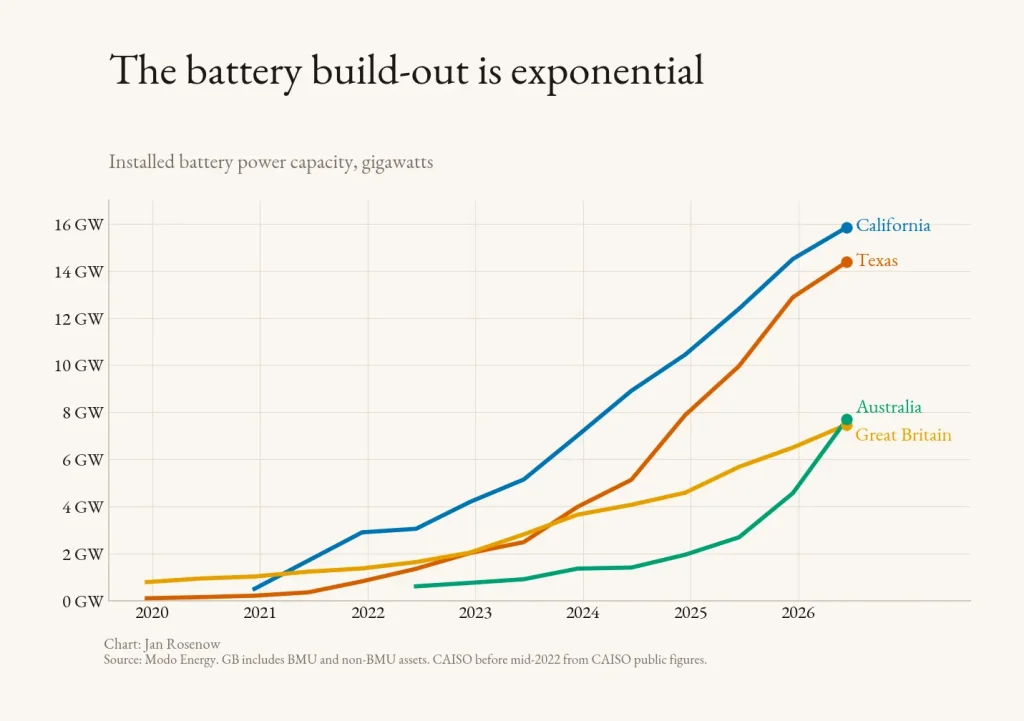
Rosenow shows that combined battery capacity across these four markets has increased from less than 5 GW in 2019 to around 45 GW today.
Texas stands out in particular, with installed battery capacity expanding from roughly 100 MW to more than 14 GW in just six and a half years. California now operates the world’s largest battery fleet, approaching 16 GW of installed capacity.
Battery storage is no longer a supporting technology
According to Rosenow, the real transformation is not simply measured in gigawatts but in the growing role batteries play within electricity systems.
In California, battery capacity has already reached approximately one-third of peak electricity demand, demonstrating that storage is becoming an essential system resource rather than merely supporting renewable energy generation.
The next generation of batteries lasts longer
Rosenow highlights that new investments are increasingly focused on longer-duration battery systems.
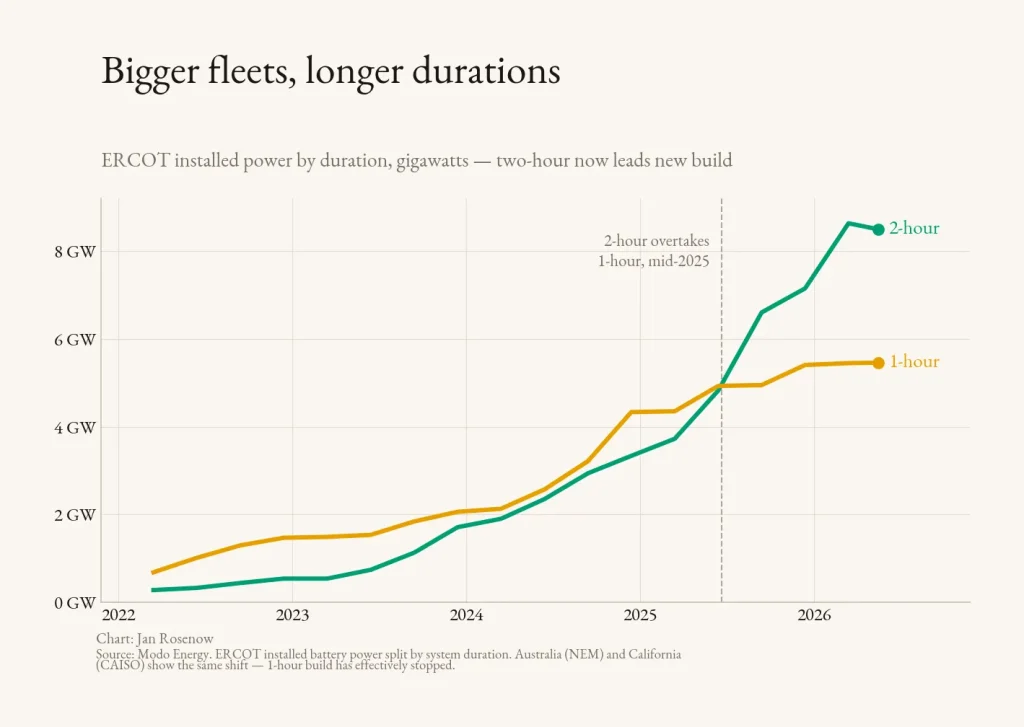
Two-hour batteries have become the standard in Texas, while nearly all new projects in California are designed with four-hour storage duration.
Longer-duration systems allow electricity generated during periods of abundant solar production to be shifted into the evening, when electricity demand and market prices are typically much higher.
As the market matures, revenues are declining
One of the most interesting findings in Rosenow’s analysis concerns market economics.
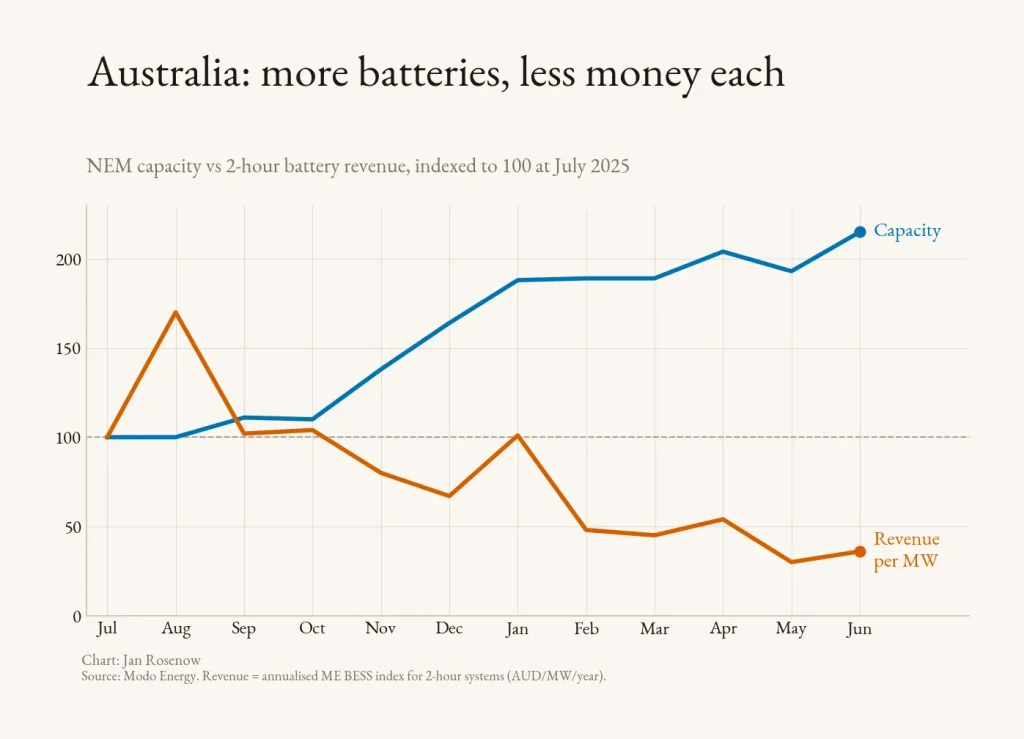
He argues that as more batteries enter the market, opportunities for exceptionally high revenues from energy arbitrage naturally decline.
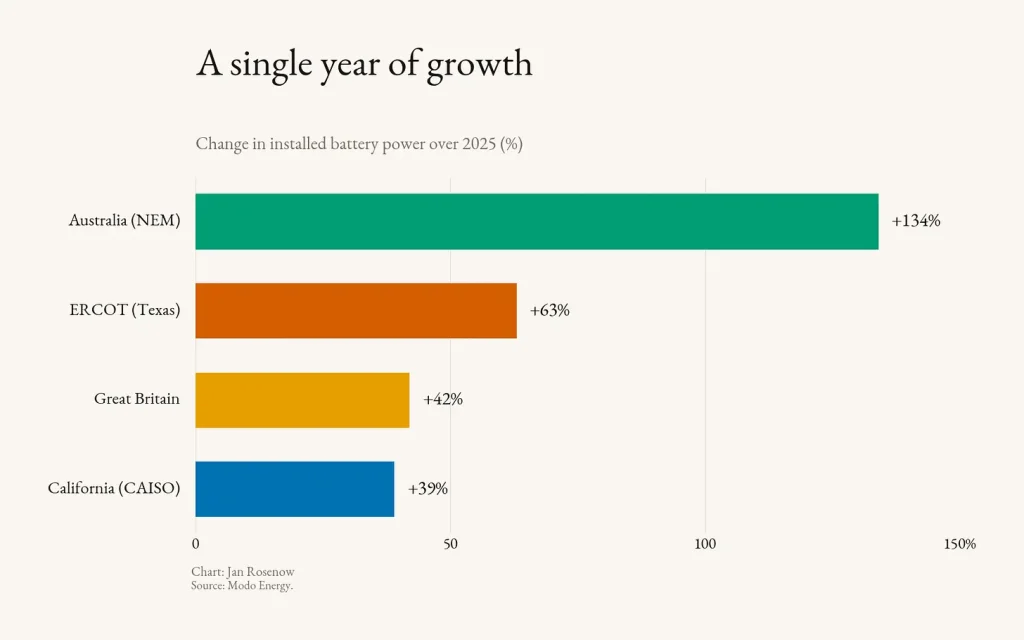
In Australia, installed battery capacity increased by approximately 115% within a single year, while revenues per installed megawatt fell by around 64%.
According to Rosenow, this should not be interpreted as a weakness of the technology. Instead, it signals that battery storage is evolving from a niche, high-return investment into mainstream electricity infrastructure.
Larger projects are becoming the new standard
Rosenow also finds that future growth will not be driven solely by more battery projects, but by significantly larger installations.
In Great Britain, battery projects with capacities of 200 MW or more accounted for 43% of the development pipeline in 2025, with their share expected to rise to 74% for projects scheduled in 2026.
At the same time, Rosenow notes that the industry’s main challenge is no longer investor interest, but the speed at which new projects can secure grid connections.
Conclusion
Rosenow’s central message is that battery storage has moved beyond being a technology of the future—it is already reshaping the architecture of modern power systems.
Greater installed capacity, longer storage duration and increasingly larger projects are transforming batteries from a complementary technology for renewable energy into a core element of grid flexibility, balancing and system reliability. According to Rosenow, the key question is no longer whether batteries will become a fundamental part of electricity systems, but how quickly this transformation will unfold.
ECI