

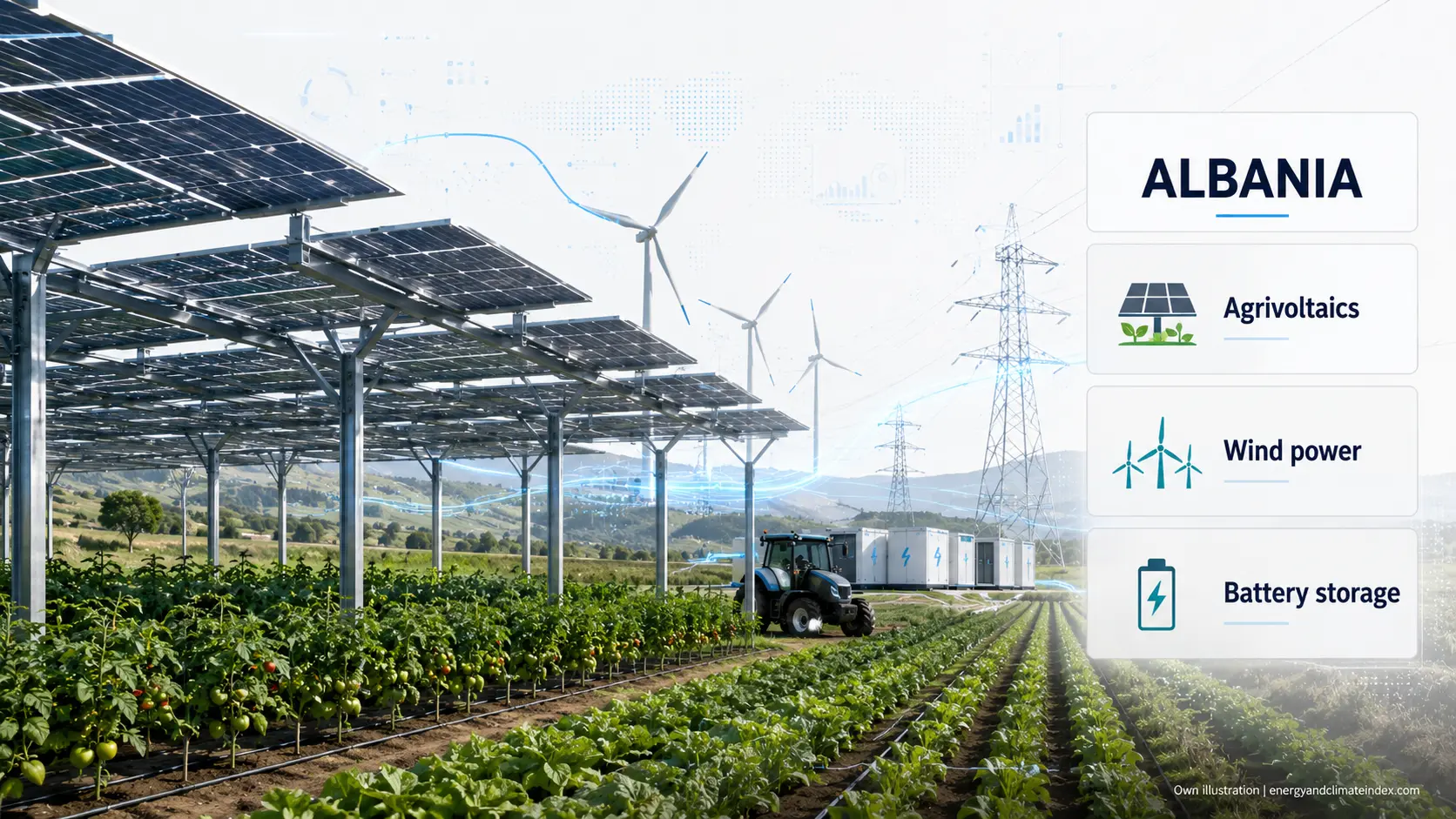
Instead of choosing between food and energy, agrivoltaics allow both to be produced on the same land
The Parliament of Albania has adopted amendments to the Law on the Protection of Agricultural Land, allowing agrivoltaic solar plants, wind farms and energy storage systems to be developed on certain categories of agricultural land.
The legislation was approved with 77 votes in favour. Almost all opposition lawmakers abstained from the vote, while several members of the governing majority also opposed the amendments.


The changes open additional space for renewable energy investment but have also triggered a debate over the protection of Albania’s limited agricultural land.
Energy and food produced on the same land
The amendments place particular emphasis on agrivoltaic systems, a concept defined by the International Energy Agency’s Photovoltaic Power Systems Programme, IEA PVPS, as the simultaneous use of the same land for agricultural production and solar electricity generation.
According to the agency, this approach can reduce competition between food and energy production, provided that the systems are properly designed and agricultural activity continues after the solar panels are installed.
Agrivoltaic projects are already being developed in countries including France, Germany, Italy, Japan and the United States.
Solar panels are installed above crops, pastures or between cultivated areas, allowing the same plot of land to produce both food and electricity.
The government will determine the criteria
The adoption of the law does not mean that every agricultural plot will automatically become available for energy projects.
Albania’s Council of Ministers will determine the criteria, conditions and approval procedures for agrivoltaic systems, wind farms and battery storage facilities.
Projects will be permitted on land with a soil quality rating of up to eight, which is considered to have lower agricultural fertility.
The criteria adopted by the government will therefore determine which locations are eligible and how the continuation of agricultural production will be guaranteed.
Albania is diversifying its electricity production
Albania generates most of its electricity from hydropower, leaving domestic production highly dependent on rainfall and hydrological conditions.
During dry periods, the country must cover electricity shortages through increased imports.
In recent years, Albania has accelerated the development of solar and wind power to diversify its energy mix, reduce its dependence on hydropower and strengthen security of supply.
The new legal amendments are expected to unlock additional locations for renewable energy investment, including projects that combine electricity generation with agricultural production.
ECI