

From political optimism to economic realism
Over the past several years, hydrogen has been presented as one of the key pillars of the global energy transition and a potential solution for decarbonizing sectors where direct electrification remains difficult to implement. The European Union has set ambitious targets for the development of the hydrogen economy, while governments, industries, and financial institutions have announced billions of euros in investments in new production capacities, infrastructure, and industrial projects.
However, the latest DNV Hydrogen Outlook 2060 analysis indicates that the hydrogen transition is entering a far more complex and realistic phase, where economic sustainability, high costs, infrastructure constraints, and global technological competition are becoming just as important as climate ambitions.
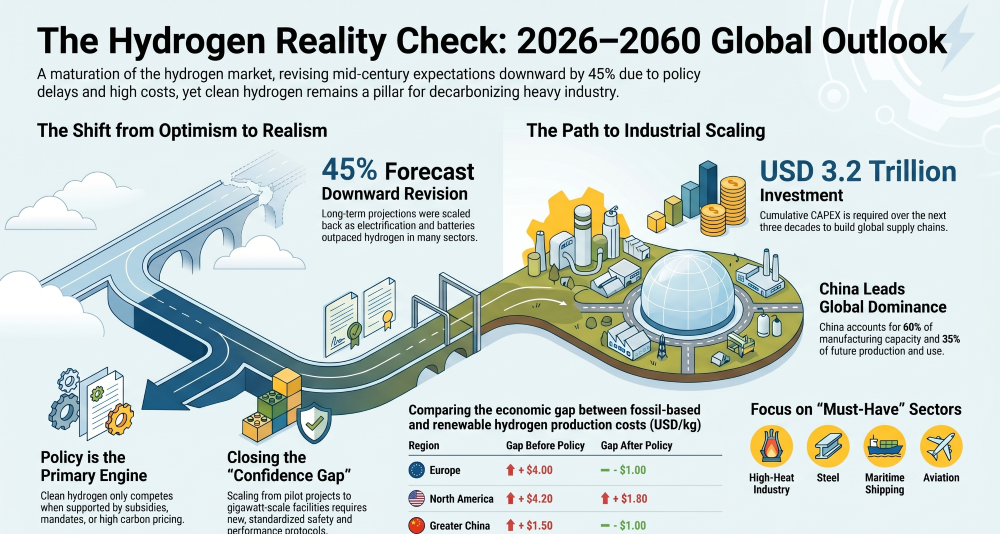
According to the analysis, the global hydrogen sector today represents a market worth approximately USD 240 billion, with annual production of around 100 million tonnes of hydrogen. Yet, almost all current production still relies on fossil fuels, resulting in approximately 1.3 billion tonnes of CO₂ emissions annually. At the same time, DNV estimates that global hydrogen demand could increase by around 170% by 2060, requiring cumulative investments of as much as USD 3.2 trillion in production, renewable energy, and infrastructure.

Europe is already facing an “Implementation Gap”
One of the key conclusions of the analysis is that Europe is already beginning to face a widening gap between political ambitions and the actual implementation of hydrogen projects. Although the European Union was among the first global regions to aggressively promote the hydrogen agenda, DNV points out that part of the initial electrolyser capacity targets are already falling behind the original timeline.
The reasons are multifaceted:
- high electricity prices,
- inflationary pressures,
- slow permitting procedures,
- delays in renewable energy deployment, and
- significantly higher capital investment costs.
This is particularly important because green hydrogen production directly depends on the availability of low-cost renewable electricity. In an environment where electricity prices remain elevated, the economic viability of many projects becomes increasingly difficult without strong state support.
Hydrogen remains important, but not for every sector
DNV makes a clear distinction between sectors where hydrogen may have a long-term strategic role and sectors where alternative technologies are already becoming more efficient and cost-effective solutions. The analysis suggests that hydrogen will most likely remain critically important for:
- heavy industry,
- steel production,
- high-temperature industrial processes,
- aviation through synthetic fuels, and
- maritime transport through ammonia and e-methanol.
At the same time, DNV indirectly confirms that in many other sectors, direct electrification, battery storage systems, and renewable energy technologies are advancing much faster than initially expected, gradually reducing the space for large-scale hydrogen deployment.
This represents a significant shift compared to the early expectations when hydrogen was often portrayed as a near-universal solution for the entire energy transition.
China is becoming the dominant player in the hydrogen industry
One of the most important aspects highlighted in the analysis is China’s rapidly growing role in the global hydrogen industry. According to DNV, China already controls around 60% of global electrolyser manufacturing capacity and benefits from substantially lower production costs compared to Europe and North America.
The report states that Chinese electrolysers typically cost between USD 300 and 600 per kW, which is less than half the price levels seen in Western economies.
This raises a serious geopolitical and industrial challenge for Europe. While the EU seeks to reduce dependence on imported fossil fuels, there is an increasing risk of creating a new strategic dependency — this time on Chinese hydrogen technologies and manufacturing supply chains.
Europe has already experienced similar dynamics in:
- solar panels,
- battery systems, and
- critical minerals required for the energy transition.
From “hyper-optimism” to the selection of economically viable projects
DNV also makes a significant revision to its previous forecasts. The company has reduced its long-term outlook for clean hydrogen development by approximately 45% compared to its 2022 projections.
At the same time, the global hydrogen project pipeline declined from 50 Mt to 37 Mt between 2024 and 2025.
However, the report does not interpret this as a collapse of the sector, but rather as a process of “market filtering,” involving the gradual elimination of projects lacking:
- economic viability,
- secure demand,
- infrastructure support, or
- long-term political stability.
In reality, the hydrogen sector is gradually moving away from a phase characterized by political enthusiasm and large-scale announcements toward a phase focused on realistic and financially sustainable industrial projects.
The Main Challenge: Green Hydrogen is still not competitive
Perhaps the most important conclusion of the report is that green hydrogen remains significantly more expensive than conventional hydrogen produced from fossil fuels.
According to DNV:
- conventional hydrogen currently costs approximately USD 1–5/kg,
- while green hydrogen typically ranges between USD 3–10/kg.
In practice, this means that the hydrogen economy, at this stage, still cannot function without:
- subsidies,
- ETS mechanisms,
- state aid,
- guaranteed demand, and
- regulatory mandates.
This is precisely why the European Union is developing a complex policy mix combining:
- ETS,
- the Hydrogen Bank,
- RED III,
- CBAM, and
- various state-support mechanisms.
This demonstrates that the hydrogen transition today is equally a political and economic project, not merely a technological transformation.
These large-scale financial support mechanisms further confirm that the renewable hydrogen market is still far from economically self-sustainable without substantial state intervention. The fact that the European Union is allocating more than EUR 1 billion in direct support, alongside an additional EUR 1.7 billion in national funding, clearly illustrates that the development of the hydrogen economy at this stage remains heavily dependent on subsidies, ETS mechanisms, regulatory support, and guaranteed demand. This effectively reinforces DNV’s conclusion that the hydrogen transition is gradually shifting from a phase of political optimism toward a phase where the long-term economic sustainability of projects becomes the central issue.
EU Allocates More Than €1 Billion for New Hydrogen Projects Across Europe
Viktor Andonov, M.Sc