

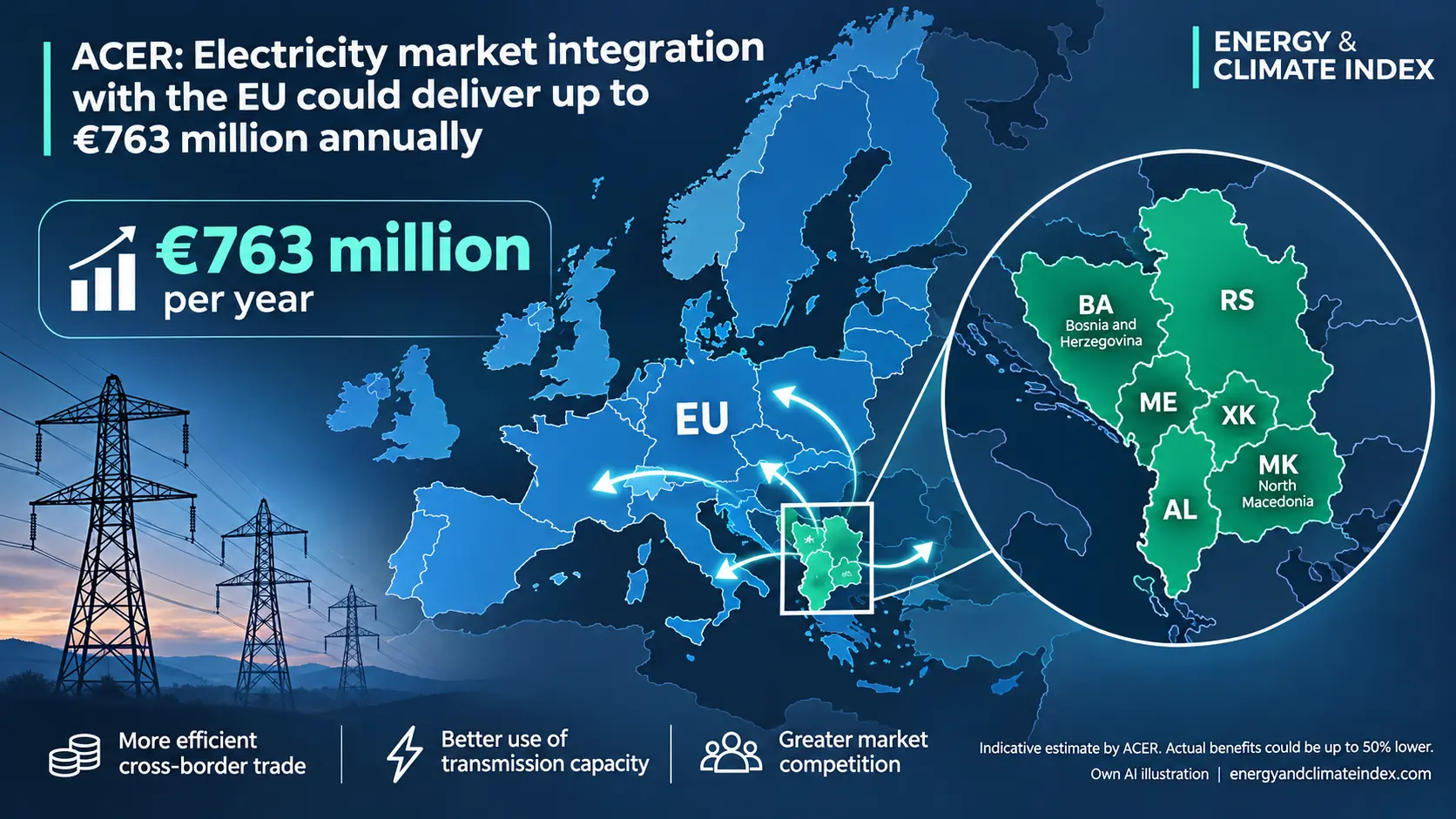
The integration of electricity markets in the Energy Community Contracting Parties with the European Union’s electricity market could generate approximately €763 million in annual economic benefits. This is one of the main estimates presented in a report by the European Union Agency for the Cooperation of Energy Regulators (ACER), examining progress in European electricity market integration.
The report, published on 4 November 2026, is based on 2025 data. On 9 November, the Energy Community highlighted its main findings concerning the Contracting Parties. The analysis was prepared with contributions from the Energy Community Secretariat and national regulatory authorities.
The estimated benefits cover the integration of all nine Energy Community Contracting Parties: North Macedonia, Serbia, Montenegro, Albania, Bosnia and Herzegovina, Kosovo, Moldova, Ukraine and Georgia.


ACER emphasizes that the €763 million figure represents an indicative estimate of economic benefits rather than guaranteed financial savings. Due to methodological assumptions, the actual benefits could be up to 50% lower than estimated.
More efficient cross-border electricity trading and better utilization of transmission networks
The main source of potential benefits is the integration of Energy Community electricity markets into the European Single Day-Ahead Coupling (SDAC) mechanism.
This mechanism enables the simultaneous matching of electricity supply and demand and the automatic allocation of available cross-border transmission capacity.
In practice, electricity can flow more efficiently from lower-priced markets to higher-priced markets, subject to available transmission capacity and operational security constraints.
Without organized market coupling, cross-border transmission capacity is allocated through separate procedures, potentially resulting in underutilization or electricity trading patterns that do not deliver the most economically efficient outcome.
According to ACER, improved coordination can increase overall economic welfare, strengthen competition and contribute to greater convergence of wholesale electricity prices between neighboring markets.
However, market coupling does not automatically lead to lower electricity prices in every country. During certain periods, increased export opportunities may also contribute to higher prices in markets that previously benefited from relatively inexpensive electricity.
At the EU level, ACER estimates that existing cross-border trading in the day-ahead market generates approximately €32 billion in annual economic benefits, while further integration of European electricity markets could deliver at least an additional €4 billion annually.
These estimates relate to different scopes of market integration and should not be mechanically added to the estimated €763 million in potential benefits for the Energy Community.
North Macedonia, Serbia, Montenegro and Moldova undergoing regulatory compliance assessment
One of the main prerequisites for electricity market integration is full alignment with the European regulatory framework governing electricity market integration.
According to the Energy Community, four countries — North Macedonia, Serbia, Montenegro and Moldova — have notified the transposition of the relevant rules and entered the formal process for assessing compliance with EU legislation.
Serbia became the first country to complete this procedure in May 2026, receiving an opinion from the European Commission containing recommendations.
For North Macedonia, the Energy Community’s official records indicate that the compliance assessment procedure began on 25 June 2026 but is currently marked as suspended. Therefore, notification of the transposition of the rules does not mean that full compliance has already been confirmed.
Beyond legislative alignment, integration also requires technical and operational readiness among transmission system operators, organized electricity markets and relevant institutions.
ACER notes that most Energy Community Contracting Parties, with the exception of Serbia and Ukraine, established day-ahead electricity markets between 2023 and 2025. Consequently, liquidity in these markets is still developing, creating an additional challenge for their integration.
Regulatory alignment alone is insufficient without available transmission capacity
ACER’s report highlights that electricity market integration will not deliver the expected benefits if cross-border transmission capacity remains constrained.
Although countries in the region have physical interconnections with neighboring electricity systems, part of their transmission capacity is not always available for cross-border electricity trading.
ACER therefore emphasizes the need for coordinated regional capacity calculation and the implementation of the European requirement to make at least 70% of relevant cross-border transmission capacity available for trading, in accordance with applicable calculation methodologies and operational security requirements.
This requirement does not mean that every transmission line must continuously operate at 70% of its nominal capacity. Rather, it concerns the capacity made available for cross-border electricity trading, subject to specific conditions and exemptions designed to preserve system security.
More efficient capacity allocation can improve the utilization of existing infrastructure without necessarily requiring the construction of new interconnectors.
At the same time, increasing electricity generation from solar and wind power plants further strengthens the importance of integrated markets, enabling more efficient electricity exchanges between systems with different generation and consumption profiles.
For the Western Balkans, integration with the European electricity market represents an opportunity to improve cross-border trading efficiency, increase competition and make better use of existing generation and transmission infrastructure.
ECI