

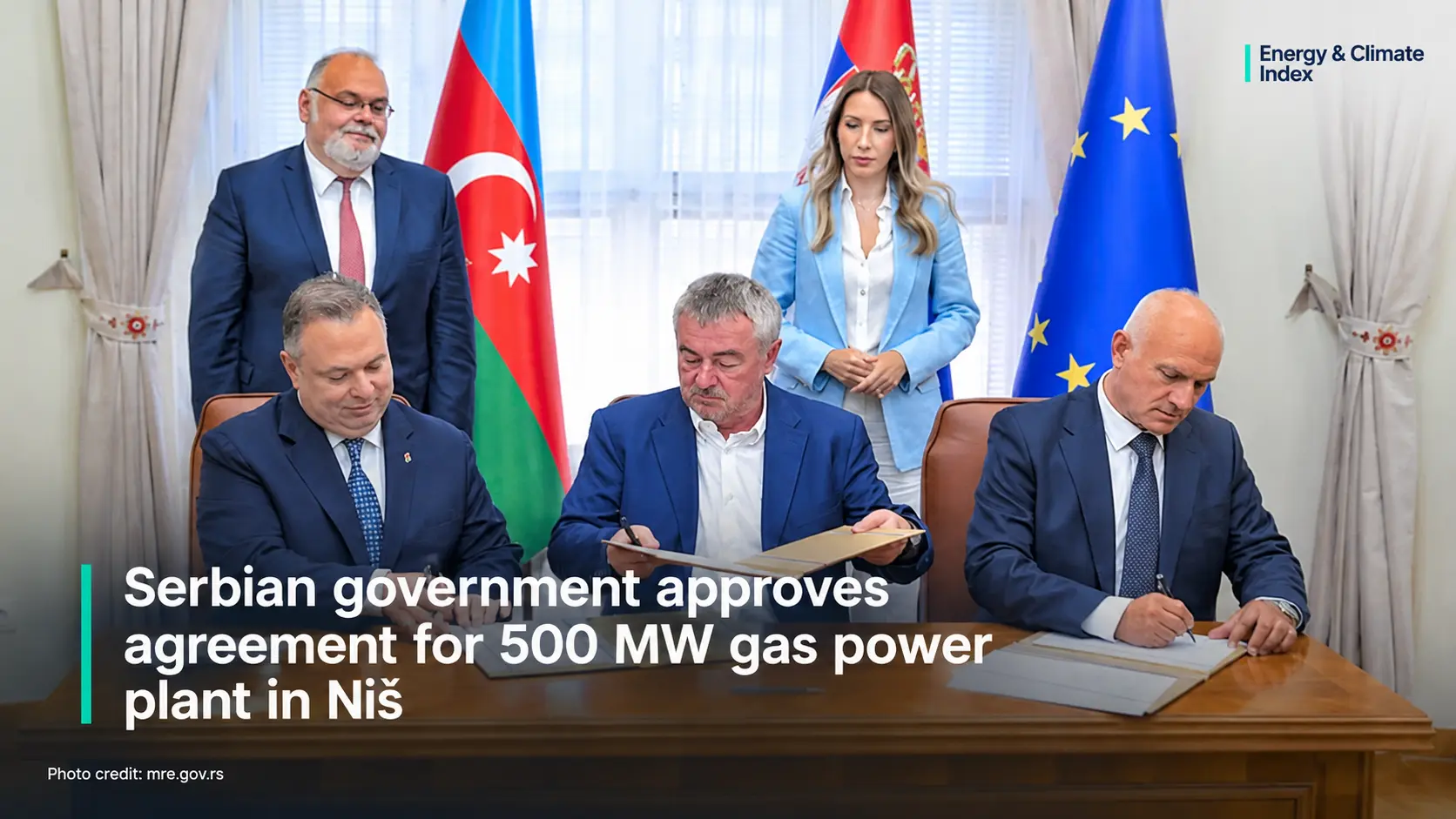
The Serbian government has granted preliminary approval for the shareholders’ agreement between Elektroprivreda Srbije (EPS), Srbijagas and Azerbaijan’s SOCAR, marking another step towards establishing a joint venture to develop a gas-fired power plant in Niš. The planned facility, with a capacity of up to 500 MW, is expected to provide additional generation capacity and greater flexibility for Serbia’s electricity system.
On 15 October 2026, the Serbian government adopted decisions granting preliminary approval for the shareholders’ agreement between EPS, Srbijagas and SOCAR. The decisions were published in the Official Gazette of the Republic of Serbia and relate to approvals previously issued by the governing bodies of the two Serbian companies.
This follows the signing of the shareholders’ agreement between EPS, Srbijagas and SOCAR on 30 September, as previously reported by Energy & Climate Index.


The agreement provides for the establishment of a joint venture responsible for developing, financing, constructing and operating the new power plant, which is intended to generate both electricity and heat.
A joint investment by Serbia and Azerbaijan
Under the agreed ownership structure, EPS and Srbijagas will jointly hold a 50% stake in the new company, while SOCAR will own the remaining 50%.
The proposed facility will use combined-cycle gas turbine technology, with an installed capacity of up to 500 MW. According to previous announcements, completion is targeted for 2030.
The project forms part of Serbia’s broader strategy to diversify electricity generation and strengthen security of supply.
Energy & Climate Index has also previously reported on Serbia’s preparations to develop a 500 MW gas-fired power plant in Niš, as part of the country’s plans to expand natural gas-based generation capacity.
According to EPS, the preliminary feasibility study has been completed, the spatial plan for the City of Niš has been adopted, and work on additional technical and project documentation is under way.
Gas-fired generation to support the energy transition
The new power plant is expected to provide additional flexibility to Serbia’s electricity system, particularly as generation from wind and photovoltaic power plants increases.
Combined-cycle gas power plants can adjust their output in response to changes in electricity demand and renewable generation. However, their economic viability depends on natural gas prices, electricity market conditions and future carbon emission costs.
The project also has wider regional significance, as it strengthens energy cooperation between Serbia and Azerbaijan by linking natural gas supply with the development of new electricity generation capacity.
Although natural gas typically produces fewer direct CO₂ emissions per unit of electricity than coal, it remains a fossil fuel. The long-term role of gas-fired generation will therefore depend on the pace of renewable energy deployment, electricity storage development and evolving climate policies.
Final investment decision still pending
Although government approval represents an important institutional milestone, it does not mean that construction has started or that a final investment decision has been made.
The partners must complete the technical and economic assessments, finalise the financing structure and obtain the necessary permits before construction can begin.
The 2030 completion target remains subject to the successful conclusion of these preparatory activities and the final investment decision.
With the latest government approval, EPS, Srbijagas and SOCAR have moved closer to establishing their joint venture. However, the key financial and technical conditions for constructing the power plant have yet to be finalised.
ECI