

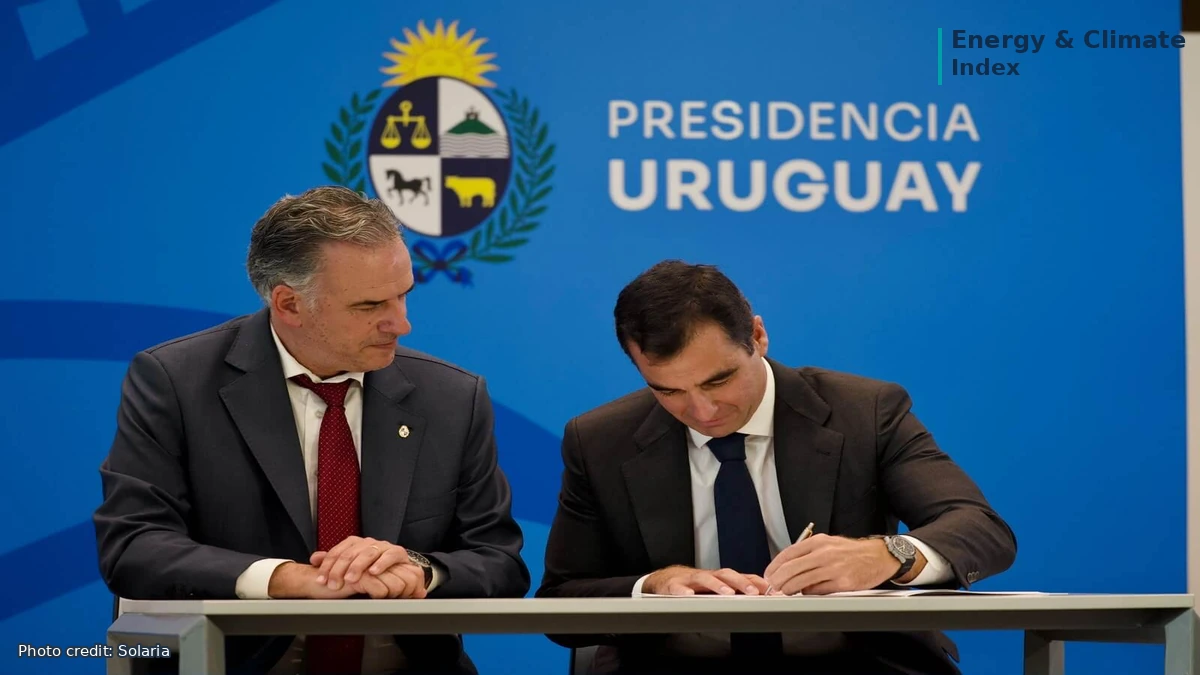
Spanish energy company Solaria has signed a strategic agreement with the Government of Uruguay to develop data centres with a combined capacity of up to 500 MW, supported by new solar power generation. The project represents the largest investment ever announced in the country and highlights the growing connection between digital infrastructure and renewable energy.
Spanish company Solaria Energía y Medio Ambiente has signed a strategic agreement with the Government of Uruguay to develop a large data centre technology campus, representing a total planned investment of $5.7 billion.
The agreement was signed on 14 October 2026 by Uruguay’s President, Yamandú Orsi, and Solaria’s CEO, Arturo Díaz-Tejeiro, with the participation of state-owned electricity company UTE.


The project includes the development of data centres with a combined capacity of up to 500 MW and solar photovoltaic plants with an installed capacity of up to 350 MW. According to the Government of Uruguay, this is the largest investment ever announced in the country.
Investment to be developed in two phases
Of the total planned investment, $5.5 billion will be allocated to the data centres, while an additional $200 million is earmarked for the construction of solar photovoltaic plants.
The first phase includes the development of 200 MW of data centre capacity, alongside the planned 350 MW of solar generation. The second phase will add another 300 MW of data centre capacity, with the possibility of further expanding solar generation.
The technology campus will be developed across three departments in Uruguay: Canelones, San José and Florida.
According to government estimates, the first phase, planned for 2029, is expected to generate approximately 3,100 jobs during construction. Once the entire project is completed, around 1,500 permanent jobs are expected to be created.
The investment represents a significant expansion of Uruguay’s digital infrastructure and could strengthen the country’s position as a regional destination for large-scale data processing and cloud services.
Connection to the 500 kV grid and a solar power agreement of up to 40 years
Solaria will be responsible for developing and managing the technology campus, including the land, infrastructure and services provided to data centre operators.
The company will also develop the electricity infrastructure required to connect the campus to Uruguay’s transmission network at a voltage level of 500 kV.
The solar component includes the construction of one or two photovoltaic plants with a combined capacity of up to 350 MW, on land provided by state-owned electricity company UTE.
The electricity generated by these plants is expected to be sold to UTE under a long-term power purchase agreement (PPA), with a proposed duration of up to 40 years.
This arrangement is an important element of the project’s commercial structure. Although the solar facilities will be developed alongside the data centres, the electricity will be sold to the state-owned utility under the agreed contractual terms.
According to Solaria’s official announcement, the campus will initially focus on cloud computing and data storage services. The project also envisages the use of cooling technologies designed to reduce water consumption, including closed-loop cooling systems.
The planned grid connection and long-term electricity arrangements illustrate the importance of securing reliable power infrastructure for large data centre developments.
Growth of data centres raises new challenges for electricity systems
The project in Uruguay demonstrates the increasingly close relationship between the expansion of data centres, artificial intelligence and investment in electricity infrastructure.
Large data centres require continuous and reliable electricity supplies, while solar photovoltaic plants generate electricity according to solar irradiation and weather conditions.
For Solaria, the agreement represents an expansion of its business model beyond electricity generation towards the development of integrated energy and digital infrastructure.
The company already operates in Uruguay through two photovoltaic plants, located in Young and Mercedes, which generate electricity for the state-owned utility UTE.
The new project would significantly exceed the scale of Solaria’s existing operations in the country and demonstrates how access to electricity and transmission infrastructure is becoming a decisive factor in selecting locations for large data centres.
The development also raises broader questions about how electricity systems will accommodate the growing demand associated with digitalisation and artificial intelligence.
While renewable generation can contribute to meeting this demand, the variability of solar output means that electricity systems must also provide flexibility, grid capacity and reliable supply during periods of limited renewable production.
ECI